logo for University of Minnesota Press
The End of the Cold War
European Unity, Socialism, and the Shift in Global Power
Bogdan Denitch
University of Minnesota Press, 1990

The End of the Cold War was first published in 1990. Minnesota Archive Editions uses digital technology to make long-unavailable books once again accessible, and are published unaltered from the original University of Minnesota Press editions.

Against the backdrop of unprecedented change in the world political and social order, Bogdan Denitch charts the unique opportunities and potential pitfalls that accompany the increased economic and political integration of the European Community. Historically, any move toward unification has had broad ramifications. This, coming as it does in the wake of recent democratic upheavals in Europe, will bring to a close an entire era -- an era of a world dominated by superpowers and the cold war that defined there confrontations.

[more]

front cover of Freedom in Entangled Worlds
Freedom in Entangled Worlds
West Papua and the Architecture of Global Power
Eben Kirksey
Duke University Press, 2012
Eben Kirksey first went to West Papua, the Indonesian-controlled half of New Guinea, as an exchange student in 1998. His later study of West Papua's resistance to the Indonesian occupiers and the forces of globalization morphed as he discovered that collaboration, rather than resistance, was the primary strategy of this dynamic social movement. Accompanying indigenous activists to Washington, London, and the offices of the oil giant BP, Kirksey saw the revolutionaries' knack for getting inside institutions of power and building coalitions with unlikely allies, including many Indonesians. He discovered that the West Papuans' pragmatic activism was based on visions of dramatic transformations on coming horizons, of a future in which they would give away their natural resources in grand humanitarian gestures, rather than watch their homeland be drained of timber, gold, copper, and natural gas. During a lengthy, brutal occupation, West Papuans have harbored a messianic spirit and channeled it in surprising directions. Kirksey studied West Papua's movement for freedom while a broad-based popular uprising gained traction from 1998 until 2008. Blending ethnographic research with indigenous parables, historical accounts, and narratives of his own experiences, he argues that seeking freedom in entangled worlds requires negotiating complex interdependencies.

[more]

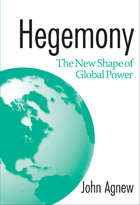
front cover of Hegemony
Hegemony
The New Shape Of Global Power
John Agnew
Temple University Press, 2005
Hegemony tells the story of the drive to create consumer capitalism abroad through political pressure and the promise of goods for mass consumption. In contrast to the recent literature on America as empire, it explains that the primary goal of the foreign and economic policies of the United States is a world which increasingly reflects the American way of doing business, not the formation or management of an empire. Contextualizing both the Iraq war and recent plant closings in the U.S., noted author John Agnew shows how American hegemony has created a world in which power is no longer only shaped territorially. He argues in a sobering conclusion that we are consequently entering a new era of global power, one in which the world the US has made no longer works to its singular advantage.
[more]


Send via email Share on Facebook Share on Twitter