
 A SCHOLARLY BOOK REPOSITORY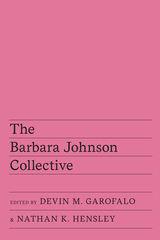
Collaboratively reassesses Barbara Johnson’s legacy as a reader and thinker with an eye to contemporary conditions
Across an archive of essays on abortion and race, Mallarmé and Melville, feminist philosophy, rhetorical device, and pedagogical method, Barbara Johnson built a legacy of thought whose energies reverberate into the present. This collected volume gathers writers and critics from a range of North American higher educational settings to engage with this essential but still often underappreciated critic in a time of renewed and deepening crisis.
In Zoom meetings and shared essays, across a virtualized map of today’s academic and para-academic worlds, the group assessed how the rolling catastrophes of late neoliberalism continue to stage the sort of analogy Johnson herself would highlight between patriarchy, capitalism, ecocide, and other forms of structural violence. Emerging from that assemblage, this experimental collection tracks Johnson’s efforts to link literary reading with concrete matters of personhood and care at a moment when the very system of higher education that enabled Johnson’s work in the 1980s and 1990s faces existential threat. The frozen record of a live experience, the book is an impure procedure, tangled in the idiom of its own unfolding: a temporary culmination of an ongoing collaborative undertaking that will always remain unfinished.

An engaging account of how the New York School poets used art to imagine their queerness as something that might be shared with other people.
How did Frank O’Hara and other New York School poets—a small coterie associated with experimental art and gay culture —become fixtures in today’s culture, quoted on prestige television shows, in teen romances, and at the wedding ceremonies of straight celebrities? How, in other words, did these poets become so relatable? Brian Glavey’s Relatability tells the story of an aesthetic as it traveled from a cluster of mostly queer poets in the middle of the twentieth century to become increasingly central to everyday life in the early twenty-first century.
That the New York School poets are more relatable now than they were during their own lifetime speaks in part to the growing acceptance of same-sex desire in American culture. But Glavey argues that this transformation also tells the story of a shift in the way that aesthetic experience is understood to work. Moving away from forms of modernist impersonality, O’Hara, John Ashbery, James Schuyler, and Joe Brainard made sociability central to the experience of art and literature. Attempting to share their experience of works of art, they were willing to risk the reader’s judgment that they had, perhaps, overshared. Glavey advances an idea of aesthetic judgment that takes seriously its missed connections as well as its successes. Relatability adds a fresh perspective to current conversations around attachment and affect in literary studies.
READERS
Browse our collection.
PUBLISHERS
See BiblioVault's publisher services.
STUDENT SERVICES
Files for college accessibility offices.
RECENTLY PUBLISHED







UChicago Accessibility Resources
home | accessibility | search | about | contact us
BiblioVault ® 2001 - 2026
The University of Chicago Press