 A SCHOLARLY BOOK REPOSITORY
After his long exile in France and Argentina following the Spanish Civil War, Rafael Alberti’s final home in exile was Rome, where he wrote Roma: Peligro para caminantes (Rome: Pedestrians Beware). There, Romulus and Remus sneak down to the Tiber to suckle on feral cats, a jack of all trades pisses on the poet’s shoes, whistling as he walks away, and in the Campo de’ Fiori the poet compares sonnets with the wandering spirit of Giuseppe Gioachino Belli, all in the shadow of the glory of Rome’s imperial ruins.
Two suites of sonnets open and close the book, while in between, Alberti displays masterful poems in metered and free verse, rhyming couplets, and a numbered series of short poems. The blending of classical tradition with post-modern echoes the darkness and luminosity that exist within the poems, tinged with longing, nostalgia, love, as well as hope. In the end, the Eternal City is a refuge for Alberti:”I left for you all that I once held dear. / Oh Rome, my sorrow pleads, hold out your hands / and give me everything I left for you.”
This unique trilingual edition features exquisite and nuanced translations in English and Italian from the original Spanish by Anthony Geist and Giuseppe Leporace alongside visually evocative photographs of Rome by Adam Weintraub. Readers will want to take this poetic walk in Rome since what sometimes elicits caution, an aspect of danger, also becomes a destination for discovery.
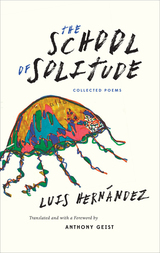
Derived from these notebooks, The School of Solitude is the first book of Hernández’s poetry in English. The haunting voice of Hernández evokes an irrevocably distant past, with the poems contemplating happiness and joy, love and fulfillment, yet always with a sense of sadness, solitude, and dream. Including rare images from Hernández’s notebooks, as well as several poems never before published in any language, The School of Solitude will be read not only for its powerful poetry and imagery, but also as a means to learn more about this enigmatic Latin American poet and the mystery of his life and work.
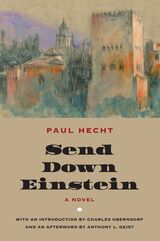
A comic and melancholy novel about translation and living between cultures, set during one historic day in Spain: February 21, 1981, the attempted coup against the newborn Spanish democracy.
Early one morning in 1981, Peter Carp, an American poet and translator living in Granada, wakes to the sounds of shouting and the revving of a motorcycle. These interruptions to Peter’s sleep provoke a series of interrelated thoughts, delivered with wry humor, about personal relations in Spain, gossip, the role of women in a patriarchal society, and the after-effects of expelling the Jewish population from Spain in 1492. We are introduced to Peter’s associative view of the world as he draws on a lifetime of reading poetry, of making sense of his own Jewish sensibility, and how it relates to the cultural history of the Spain he has come to love for its music, people, food, and language.
Peter lives in the home of Alberto, a professor of translation, who was once jailed under Franco’s regime. He has fallen in love with Ana, a young woman who is exploring the new freedoms of post-Franco Spain. Years ago, he had befriended flamenco singers of the Roma community, and his current task is to translate the flamenco lyrics he has collected, a process that challenges his understanding of Spanish and the capacity of language to convey meaning. His day brings him into contact with a wide range of Spaniards, including a gardener at the Alhambra, a group of children playing in the street, a professional beggar, a diverse range of personalities at a neighborhood bar before the midday dinner, and in the evening, a small band of fascist sympathizers encouraged by the attempted coup now taking place in the Spanish parliament.
With prose that mixes social observation, linguistic conjecture, and vivid description, Paul Hecht examines how living is itself a form of translation when moving from one language or culture to another, and how history can erupt into our own world. In Send Down Einstein, Hecht creates a tension between what we dream will happen and what actually does happen. In this bouillabaisse of emotion, the reader will taste how, for Peter Carp—with the right food and the best company—dreams, hope, and words can matter.
READERS
Browse our collection.
PUBLISHERS
See BiblioVault's publisher services.
STUDENT SERVICES
Files for college accessibility offices.
RECENTLY PUBLISHED





UChicago Accessibility Resources
home | accessibility | search | about | contact us
BiblioVault ® 2001 - 2026
The University of Chicago Press