
 A SCHOLARLY BOOK REPOSITORY
In 1900 the global average life expectancy at birth was thirty-one years. By 2000 it was sixty-six. Yet, alongside unprecedented improvements in longevity and material well-being, the twentieth century also saw the rise of fascism and communism and a second world war followed by a cold war. This book tells the story of the battles between economic systems that defined the last century and created today's world.
The nineteenth century was a period of rapid economic growth characterized by relatively open markets and more personal liberty, but it also brought great inequality within and between nations. The following century offered sharp challenges to free-wheeling capitalism from both communism and fascism, whose competing visions of planned economic development attracted millions of people buffeted by the economic storms of the 1930s. The Age of Equality describes the ways in which market-oriented economies eventually overcame the threat of these visions and provided a blueprint for reform in nonmarket economies. This was achieved not through unbridled capitalism but by combining the efficiency and growth potential of markets with government policies to promote greater equality of opportunity and outcome. Following on the heels of economic reform, rapid catch-up growth in countries such as China, India, Indonesia, Brazil, and Poland helped to reduce global inequality.
At a time when inequality is on the rise in nations as disparate as the United States and Egypt, Pomfret’s interpretation of how governments of market economies faced the challenges of the twentieth century is both instructive and cautionary.
Surveying such diverse topics as Jews’ participation in the real estate industry, the liquor industry, and the scrap metal industry, as well as Jewish political groups and unions bent on reforming American capital, such as the American Labor Party and the International Ladies’ Garment Workers’ Union, contributors to this volume provide a new prism through which to view the Jewish encounter with America. The volume also lays bare how American capitalism reshaped Judaism itself by encouraging the mass manufacturing and distribution of foods like matzah and the transformation of synagogue cantors into recording stars. These essays force us to rethink not only the role Jews played in American economic development but also how capitalism has shaped Jewish life and Judaism over the course of the twentieth century.
Contributors:
Marni Davis, Georgia State University
Phyllis Dillon, independent documentary producer, textile conservator, museum curator
Andrew Dolkart, Columbia University
Andrew Godley, Henley Business School, University of Reading
Jonathan Karp, executive director, American Jewish Historical Society
Daniel Katz, Empire State College, State University of New York
Ira Katznelson, Columbia University
David S. Koffman, New York University
Eli Lederhendler, Hebrew University, Jerusalem
Jonathan Z. S. Pollack, University of Wisconsin—Madison
Jonathan D. Sarma, Brandeis University
Jeffrey Shandler, Rutgers University
Daniel Soyer, Fordham University
In a brilliant recreation of the epoch between the 1770s and the 1820s, Emma Rothschild reinterprets the ideas of the great revolutionary political economists to show us the true landscape of economic and political thought in their day, with important consequences for our own. Her work alters the readings of Adam Smith and Condorcet--and of ideas of Enlightenment--that underlie much contemporary political thought.
Economic Sentiments takes up late-eighteenth-century disputes over the political economy of an enlightened, commercial society to show us how the "political" and the "economic" were intricately related to each other and to philosophical reflection. Rothschild examines theories of economic and political sentiments, and the reflection of these theories in the politics of enlightenment. A landmark in the history of economics and of political ideas, her book shows us the origins of laissez-faire economic thought and its relation to political conservatism in an unquiet world. In doing so, it casts a new light on our own times.
In this collection of twenty distinctly but closely related essays, written over the period 1986-89 following the author’s receipt of the Nobel Prize in Economic Science, Professor Buchanan records his increasing interest in and developing ideas on the constitutional order of a free society, especially in its ethical foundations. The essays in this collection extend beyond the boundaries of economics into moral philosophy, political philosophy, methodology, and epistemology Many of the separate essays were initially delivered by special invitation as lectures to general audiences throughout the world.
The linking theme of the essays in The Economics and the Ethics of Constitutional Order is the continuing relevance of Adam Smith’s ideas to issues emerging in the 1990s – issues that have gained a new immediacy since the revolutionary events of 1989. How can societies organize their economies so as to produce goods and services efficiently while at the same time allowing individuals the liberties to make their own choices? Buchanan’s contributions here are directly addressed to this question.
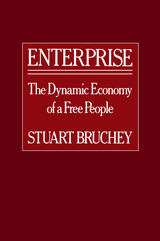
Not since Charles and Mary Beard's The Rise of American Civilization has a narrative been written for the general reader and student alike that so superbly explicates the origins of American capitalism. Arguing that the central fact explaining the success of the American experiment is the development of the economy, the distinguished economic historian Stuart Bruchey shows the reciprocal relationship between economic growth and values, law, and social and political change, as well as between economic development and the more traditional variables of capital, labor, and resources.
Enterprising, risk-taking men and women in all walks of life are at the center of the remarkable story that is the American dream and reality. The farm family moving to an unfamiliar environment and trying new technology; the business executive or worker with a new idea for improving a machine; the jurist venturing down a different legal path to sharpen incentives to invest; lawmakers of all kinds risking tenure or office by giving priority to measures designed to entice capital and labor to their jurisdictions—these entrepreneurs provided the leaven that gradually raised the living standards of the average person to heights unknown anywhere in the past.
Twenty years in the writing, Enterprise summarizes the scholarly contributions of historians and social scientists. It reaches deep into the European past—to fourteenth-century Italy—to retrace the origins of American capitalism. The author tells the story of individual achievement and vertical social mobility and their triumph over obstacles, a never-ending theme of American enterprise. Whether Americans maintain those heights today or will suffer a decline as the price of 1980s “now-nowism”—as Richard Darman characterizes this decade of wanting everything, at once, and paying nothing—remains to be seen.
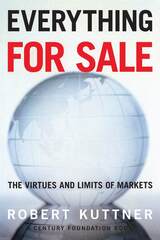
"The best survey of the limits of free markets that we have. . . . A much needed plea for pragmatism: Take from free markets what is good and do not hesitate to recognize what is bad."—Jeff Madrick, Los Angeles Times
"It ought to be compulsory reading for all politicians—fortunately for them and us, it is an elegant read."—The Economist
"Demonstrating an impressive mastery of a vast range of material, Mr. Kuttner lays out the case for the market's insufficiency in field after field: employment, medicine, banking, securities, telecommunications, electric power."—Nicholas Lemann, New York Times Book Review
"A powerful empirical broadside. One by one, he lays on cases where governments have outdone markets, or at least performed well."—Michael Hirsh, Newsweek
"To understand the economic policy debates that will take place in the next few years, you can't do better than to read this book."—Suzanne Garment, Washington Post Book World
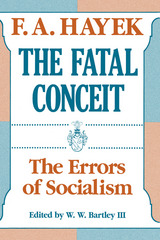
"The achievement of The Fatal Conceit is that it freshly shows why socialism must be refuted rather than merely dismissed—then refutes it again."—David R. Henderson, Fortune.
"Fascinating. . . . The energy and precision with which Mr. Hayek sweeps away his opposition is impressive."—Edward H. Crane, Wall Street Journal
F. A. Hayek is considered a pioneer in monetary theory, the preeminent proponent of the libertarian philosophy, and the ideological mentor of the Reagan and Thatcher "revolutions."
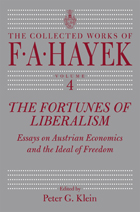
The Reagan and Thatcher "revolutions." The collapse of Eastern Europe dramatically captured in the tearing down of the Berlin Wall. F. A. Hayek, "grand old man of capitalism" and founder of the classical liberal, free-market revival which ignited and inspired these world events, forcefully predicted their occurrence in writings such as The Road to Serfdom, first published in 1944.
Hayek's well-known social and political philosophy—in particular his long-held pessimistic view of the prospects of socialism, irrefutably vindicated by the recent collapse of the Eastern bloc—is fully grounded in the Austrian approach to economics. In this new collection, Hayek traces his intellectual roots to the Austrian school, the century-old tradition founded at the University of Vienna by Carl Menger, and links it to the modern rebirth of classical liberal or libertarian thought.
As Hayek reminds us, the cornerstone of modern economics—the theory of value and price—"represents a consistent continuation of the fundamental principles handed down by the Vienna school." Here, in this first modern collection of essays on the Austrian school by one of its preeminent figures, is the genesis of this tradition and its place in intellectual history.
Reflections on Hayek's days as a young economic theorist in Vienna, his opening address to the inaugural meeting of the Mont Pèlerin Society, and essays on former teachers and other leading figures in the Austrian school are included in volume 4. Two hitherto unavailable memoirs, "The Economics of the 1920s as Seen from Vienna," published here for the first time, and "The Rediscovery of Freedom: Personal Recollections," available for the first time in English, make this collection invaluable for Hayek scholars.
Hayek's writings continue to provide an invaluable education in a subject which is nothing less than the development of the modern world.

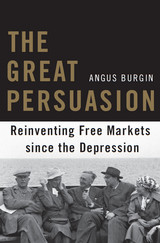
Just as today's observers struggle to justify the workings of the free market in the wake of a global economic crisis, an earlier generation of economists revisited their worldviews following the Great Depression. The Great Persuasionis an intellectual history of that project. Angus Burgin traces the evolution of postwar economic thought in order to reconsider many of the most basic assumptions of our market-centered world.
Conservatives often point to Friedrich Hayek as the most influential defender of the free market. By examining the work of such organizations as the Mont Pèlerin Society, an international association founded by Hayek in 1947 and later led by Milton Friedman, Burgin reveals that Hayek and his colleagues were deeply conflicted about many of the enduring problems of capitalism. Far from adopting an uncompromising stance against the interventionist state, they developed a social philosophy that admitted significant constraints on the market. Postwar conservative thought was more dynamic and cosmopolitan than has previously been understood.
It was only in the 1960s and '70s that Friedman and his contemporaries developed a more strident defense of the unfettered market. Their arguments provided a rhetorical foundation for the resurgent conservatism of Barry Goldwater and Ronald Reagan and inspired much of the political and economic agenda of the United States in the ensuing decades. Burgin's brilliant inquiry uncovers both the origins of the contemporary enthusiasm for the free market and the moral quandaries it has left behind.
A Financial Times Book of the Year
A ProMarket Book of the Year
“Superbly argued and important…Donald Trump is in so many ways a product of the defective capitalism described in The Great Reversal. What the U.S. needs, instead, is another Teddy Roosevelt and his energetic trust-busting. Is that still imaginable? All believers in the virtues of competitive capitalism must hope so.”
—Martin Wolf, Financial Times
“In one industry after another…a few companies have grown so large that they have the power to keep prices high and wages low. It’s great for those corporations—and bad for almost everyone else.”
—David Leonhardt, New York Times
“Argues that the United States has much to gain by reforming how domestic markets work but also much to regain—a vitality that has been lost since the Reagan years…His analysis points to one way of making America great again: restoring our free-market competitiveness.”
—Arthur Herman, Wall Street Journal
Why are cell-phone plans so much more expensive in the United States than in Europe? It seems a simple question, but the search for an answer took one of the world’s leading economists on an unexpected journey through some of the most hotly debated issues in his field. He reached a surprising conclusion: American markets, once a model for the world, are giving up on healthy competition.
In the age of Silicon Valley start-ups and millennial millionaires, he hardly expected this. But the data from his cutting-edge research proved undeniable. In this compelling tale of economic detective work, we follow Thomas Philippon as he works out the facts and consequences of industry concentration, shows how lobbying and campaign contributions have defanged antitrust regulators, and considers what all this means. Philippon argues that many key problems of the American economy are due not to the flaws of capitalism or globalization but to the concentration of corporate power. By lobbying against competition, the biggest firms drive profits higher while depressing wages and limiting opportunities for investment, innovation, and growth. For the sake of ordinary Americans, he concludes, government needs to get back to what it once did best: keeping the playing field level for competition. It’s time to make American markets great—and free—again.
Yet even among those who study his work in depth, few have looked closely at his use of ideas from evolutionary science to advance his vision of markets and society. With this book Naomi Beck offers the first full-length engagement with Hayek’s thought from this perspective. Hayek argued that the capitalism we see in advanced civilizations is an unintended consequence of group selection—groups that adopted free market behavior expanded more successfully than others. But this attempt at a scientific grounding for Hayek’s principles, Beck shows, fails to hold water, plagued by incoherencies, misinterpretations of the underlying science, and lack of evidence. As crises around the globe lead to reconsiderations of the place of capitalism, Beck’s excavation of this little-known strand of Hayek’s thought—and its failure—is timely and instructive.
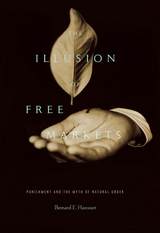
It is widely believed today that the free market is the best mechanism ever invented to efficiently allocate resources in society. Just as fundamental as faith in the free market is the belief that government has a legitimate and competent role in policing and the punishment arena. This curious incendiary combination of free market efficiency and the Big Brother state has become seemingly obvious, but it hinges on the illusion of a supposedly natural order in the economic realm. The Illusion of Free Markets argues that our faith in “free markets” has severely distorted American politics and punishment practices.
Bernard Harcourt traces the birth of the idea of natural order to eighteenth-century economic thought and reveals its gradual evolution through the Chicago School of economics and ultimately into today’s myth of the free market. The modern category of “liberty” emerged in reaction to an earlier, integrated vision of punishment and public economy, known in the eighteenth century as “police.” This development shaped the dominant belief today that competitive markets are inherently efficient and should be sharply demarcated from a government-run penal sphere.
This modern vision rests on a simple but devastating illusion. Superimposing the political categories of “freedom” or “discipline” on forms of market organization has the unfortunate effect of obscuring rather than enlightening. It obscures by making both the free market and the prison system seem natural and necessary. In the process, it facilitated the birth of the penitentiary system in the nineteenth century and its ultimate culmination into mass incarceration today.
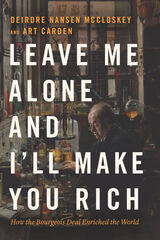
For readers looking for a distillation of McCloskey’s magisterial work, Leave Me Alone and I’ll Make You Rich is what you’ve been waiting for. In this lively volume, McCloskey and the economist and journalist Carden bring together the trilogy’s key ideas and its most provocative arguments. The rise of the west, and now the rest, is the story of the rise of ordinary people to a dignity and liberty inspiring them to have a go. The outcome was an explosion of innovation after 1800, and a rise of real income by an astounding 3,000 percent. The Great Enrichment, well beyond the conventional Industrial Revolution, did not, McCloskey and Carden show, come from the usual suspects, capital accumulation or class struggle. It came from the idea of economic liberty in Holland and the Anglosphere, then Sweden and Japan, then Italy and Israel and China and India, an idea that bids fair in the next few generations to raise up the wretched of the earth. The original shift to liberalism arose from 1517 to 1789 from theological and political revolutions in northwest Europe, upending ancient hierarchies. McCloskey and Carden contend further that liberalism and “innovism” made us better humans as well as richer ones. Not matter but ideas. Not corruption but improvement.
Leave Me Alone and I’ll Make You Rich draws in entertaining fashion on history, economics, literature, philosophy, and popular culture, from growth theory to the Simpsons. It is the perfect introduction for a broad audience to McCloskey’s influential explanation of how we got rich. At a time when confidence in the economic system is under challenge, the book mounts an optimistic and persuasive defense of liberal innovism, and of the modern world it has wrought.
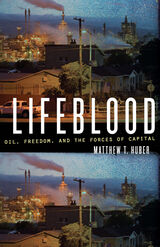
If our oil addiction is so bad for us, why don’t we kick the habit? Looking beyond the usual culprits—Big Oil, petro-states, and the strategists of empire—Lifeblood finds a deeper and more complex explanation in everyday practices of oil consumption in American culture. Those practices, Matthew T. Huber suggests, have in fact been instrumental in shaping the broader cultural politics of American capitalism.
How did gasoline and countless other petroleum products become so central to our notions of the American way of life? Huber traces the answer from the 1930s through the oil shocks of the 1970s to our present predicament, revealing that oil’s role in defining popular culture extends far beyond material connections between oil, suburbia, and automobility. He shows how oil powered a cultural politics of entrepreneurial life—the very American idea that life itself is a product of individual entrepreneurial capacities. In so doing he uses oil to retell American political history from the triumph of New Deal liberalism to the rise of the New Right, from oil’s celebration as the lifeblood of postwar capitalism to increasing anxieties over oil addiction.
Lifeblood rethinks debates surrounding energy and capitalism, neoliberalism and nature, and the importance of suburbanization in the rightward shift in American politics. Today, Huber tells us, as crises attributable to oil intensify, a populist clamoring for cheap energy has less to do with American excess than with the eroding conditions of life under neoliberalism.
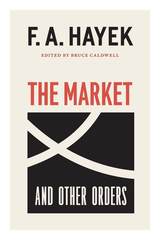
The Market and Other Orders brings together more than twenty works spanning almost forty years that consider this question. Consisting of speeches, essays, and lectures, including Hayek’s 1974 Nobel lecture, “The Pretense of Knowledge,” the works in this volume draw on a broad range of perspectives, including the philosophy of science, the physiology of the brain, legal theory, and political philosophy. Taking readers from Hayek’s early development of the idea of spontaneous order in economics through his integration of this insight into political theory and other disciplines, the book culminates with Hayek’s integration of his work on these topics into an overarching social theory that accounts for spontaneous order in the variety of complex systems that Hayek studied throughout his career.
Edited by renowned Hayek scholar Bruce Caldwell, who also contributes a masterly introduction that provides biographical and historical context, The Market and Other Orders forms the definitive compilation of Hayek’s work on spontaneous order.
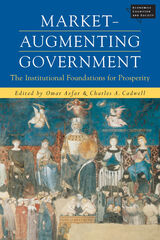
The contributors, renowned experts in their fields on the complex institutional requirements for prosperity, offer arguments from economic theory, economic history, legal theory, and political science. The chapters are simultaneously of high scholarly quality and intensely applicable. Indeed many of the ideas here are being used to design reform projects in developing countries.
Market-Augmenting Government will appeal to legal theorists, economists, and political scientists, and in particular to institutional economists. Its writing is friendly to the general reader, with only a few of the chapters requiring specialized knowledge. The book will also figure importantly in policy circles as governance moves center stage in the practice of reform and development.
Omar Azfar is Research Associate, IRIS Center, University of Maryland, College Park. Charles A. Cadwell is Director and Principle Investigator, IRIS Center, University of Maryland, College Park.
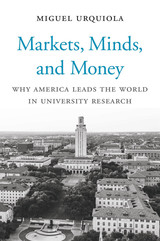
A colorful history of US research universities, and a market-based theory of their global success.
American education has its share of problems, but it excels in at least one area: university-based research. That’s why American universities have produced more Nobel Prize winners than those of the next twenty-nine countries combined. Economist Miguel Urquiola argues that the principal source of this triumph is a free-market approach to higher education.
Until the late nineteenth century, research at American universities was largely an afterthought, suffering for the same reason that it now prospers: the free market permits institutional self-rule. Most universities exploited that flexibility to provide what well-heeled families and church benefactors wanted. They taught denominationally appropriate materials and produced the next generation of regional elites, no matter the students’—or their instructors’—competence. These schools were nothing like the German universities that led the world in research and advanced training. The American system only began to shift when certain universities, free to change their business model, realized there was demand in the industrial economy for students who were taught by experts and sorted by talent rather than breeding. Cornell and Johns Hopkins led the way, followed by Harvard, Columbia, and a few dozen others that remain centers of research. By the 1920s the United States was well on its way to producing the best university research.
Free markets are not the solution for all educational problems. Urquiola explains why they are less successful at the primary and secondary level, areas in which the United States often lags. But the entrepreneurial spirit has certainly been the key to American leadership in the research sector that is so crucial to economic success.
In exploring the material and cultural dimensions of the Age of Millennial Capitalism, the contributors interrogate the so-called crisis of the nation-state, how the triumph of the free market obscures rising tides of violence and cultures of exclusion, and the growth of new forms of identity politics. The collection also investigates the tendency of neoliberal capitalism to produce a world of increasing differences in wealth, environmental catastrophes, heightened flows of people and value across space and time, moral panics and social impossibilities, bitter generational antagonisms and gender conflicts, invisible class distinction, and “pariah” forms of economic activity. In the process, the volume opens up an empirically grounded, conceptual discussion about the world-at-large at a particularly momentous historical time—when the social sciences and humanities are in danger of ceding intellectual initiative to the masters of the market and the media.
In addition to its crossdisciplinary essays, Millennial Capitalism and the Culture of Neoliberalism—originally the third installment of the journal Public Culture’s “Millennial Quartet”—features several photographic essays. The book will interest anthropologists, political geographers, economists, sociologists, and political theorists.
Contributors. Scott Bradwell, Jean Comaroff, John L. Comaroff, Fernando Coronil, Peter Geschiere, David Harvey, Luiz Paulo Lima, Caitrin Lynch, Rosalind C. Morris, David G. Nicholls, Francis Nyamnjoh, Elizabeth A. Povinelli, Paul Ryer, Allan Sekula, Irene Stengs, Michael Storper, Seamus Walsh, Robert P. Weller, Hylton White, Melissa W. Wright, Jeffrey A. Zimmerman
Wittman first considers the characteristic of efficient markets—informed, rational participants competing for well-defined and easily transferred property rights—and explains how they operate in democratic politics. He then analyzes how specific political institutions are organized to operate efficiently. "Markets" such as the the Congress in the United States, bureaucracies, and pressure groups, he demonstrates, contribute to efficient political outcomes. He also provides a theory of institutional design to explain how these political "markets" arise. Finally, Wittman addresses the methodological shortcomings of analyses of political market failure, and offers his own suggestions for a more effective research strategy.
Ultimately, he demonstrates that nearly all of the arguments claiming that economic markets are efficient apply equally well to democratic political markets; and, conversely, that economic models of political failure are not more valid than the analogous arguments for economic market failure.

Since the 1960s, the Asian Tigers have combined economic success and autocratic politics. Now in the wake of a daunting financial crisis, these nations are moving toward political change as well as renewed growth. What direction will these changes take? Will the traditional Asian "development state" give way to the American model of market liberalism?
This book explores the complex transitions under way in China, Japan, South Korea, and Taiwan, as the leaderships shift their economic and political relationships in order to survive in the global economy. Written by a team of international scholars in political science, economics, international relations, and Asian studies, this book illuminates the significant changes in the political economies of the major Asian states.
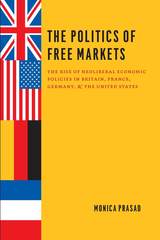
In The Politics of Free Markets, a comparative-historical analysis of the development of neoliberal policies in these four countries,Monica Prasad argues that neoliberalism was made possible in the United States and Britain not because the Left in these countries was too weak, but because it was in some respects too strong. At the time of the oil crisis in the 1970s, American and British tax policies were more punitive to business and the wealthy than the tax policies of France and West Germany; American and British industrial policies were more adversarial to business in key domains; and while the British welfare state was the most redistributive of the four, the French welfare state was the least redistributive. Prasad shows that these adversarial structures in the United States and Britain created opportunities for politicians to find and mobilize dissatisfaction with the status quo, while the more progrowth policies of France and West Germany prevented politicians of the Right from anchoring neoliberalism in electoral dissatisfaction.
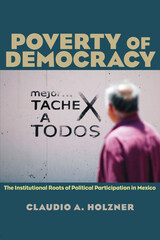
Political participation rates have declined steadily in Mexico since the 1990s. The decline has been most severe among the poor, producing a stratified pattern that more and more mirrors Mexico’s severe socioeconomic inequalities. Poverty of Democracy examines the political marginalization of Mexico’s poor despite their key role in the struggle for democracy.
Claudio A. Holzner uses case study evidence drawn from eight years of fieldwork in Oaxaca, and from national surveys to show how the institutionalization of a free-market democracy created a political system that discourages the political participation of Mexico’s poor by limiting their access to politicians at the local and national level. Though clean elections bolster political activity, Holzner shows that at the local level, and particularly in Mexico’s poorest regions, deeply rooted enclaves of authoritarianism and clientelism still constrict people’s political opportunities.
To explain this phenomenon, Holzner develops an institutional theory in which party systems, state-society linkages, and public policies are the key determinants of citizen political activity. These institutions shape patterns of political participation by conferring and distributing resources, motivating or discouraging an interest in politics, and by affecting the incentives citizens from different income groups have for targeting the state with political activity.
Holzner’s study sheds light on a disturbing trend in Latin America (and globally), in which neoliberal systems exacerbate political and economic disparities and create institutions that translate economic inequalities into political ones.
In The Power of Mammon, Curtis D. Johnson describes how the market economy and market-related forces, such as the media, politics, individualism, and consumerism, radically changed the nature of Baptist congregational life in New York State during three centuries. Collectively, these forces emphasized the importance of material wealth over everything else, and these values penetrated the thinking of Baptist ministers and laypeople alike. Beginning in the 1820s, the pastorate turned into a profession, the laity’s influence diminished, closeknit religious fellowships evolved into voluntary associations, and evangelism became far less effective. Men, being the most engaged in the market, secularized the more quickly and became less involved in church affairs. By the 1870s, male disengagement opened the door to increased female participation in church governance. While scientific advances and religious pluralism also played a role, the market and its related distractions were the primary forces behind the secularization of Baptist life.
The Power of Mammon is history from the ground up. Unlike many denominational histories, this book emphasizes congregational life and the importance of the laity. This focus allows the reader to hear the voices of ordinary Baptists who argued over a host of issues. Johnson deftly connects large social trends with exhaustive attention to archival material, including numerous well-chosen records preserved by forty-two New York churches. These records include details related to membership, discipline, finance, and institutional history. Utilizing statistical analysis to achieve even greater clarity, Johnson effectively bridges the gap between the particularity of church records and the broader history of New York’s Baptist churches.
Johnson’s narrative of Baptist history in New York will serve as a model for other regional studies and adds to our understanding of secularization and its impact on American religion.
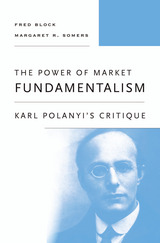
What is it about free-market ideas that give them tenacious staying power in the face of such manifest failures as persistent unemployment, widening inequality, and the severe financial crises that have stressed Western economies over the past forty years? Fred Block and Margaret Somers extend the work of the great political economist Karl Polanyi to explain why these ideas have revived from disrepute in the wake of the Great Depression and World War II, to become the dominant economic ideology of our time.
Polanyi contends that the free market championed by market liberals never actually existed. While markets are essential to enable individual choice, they cannot be self-regulating because they require ongoing state action. Furthermore, they cannot by themselves provide such necessities of social existence as education, health care, social and personal security, and the right to earn a livelihood. When these public goods are subjected to market principles, social life is threatened and major crises ensue.
Despite these theoretical flaws, market principles are powerfully seductive because they promise to diminish the role of politics in civic and social life. Because politics entails coercion and unsatisfying compromises among groups with deep conflicts, the wish to narrow its scope is understandable. But like Marx's theory that communism will lead to a "withering away of the State," the ideology that free markets can replace government is just as utopian and dangerous.
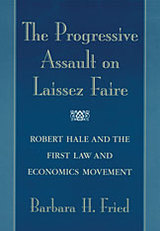
Law and economics is the leading intellectual movement in law today. This book examines the first great law and economics movement in the early part of the twentieth century through the work of one of its most original thinkers, Robert Hale. Beginning in the 1890s and continuing through the 1930s, progressive academics in law and economics mounted parallel assaults on free-market economic principles. They showed first that "private," unregulated economic relations were in fact determined by a state-imposed regime of property and contract rights. Second, they showed that the particular regime of rights that existed at that time was hard to square with any common-sense notions of social justice.
Today, Hale is best known among contemporary legal academics and philosophers for his groundbreaking writings on coercion and consent in market relations. The bulk of his writing, however, consisted of a critique of natural property rights. Taken together, these writings on coercion and property rights offer one of the most profound and elaborated critiques of libertarianism, far outshining the better-known efforts of Richard Ely and John R. Commons. In his writings on public utility regulation, Hale also made important contributions to a theory of just, market-based distribution.
This first, full-length study of Hale's work should be of interest to legal, economic, and intellectual historians.

The post-World War II years in the United States were marked by the business community's efforts to discredit New Deal liberalism and undermine the power and legitimacy of organized labor. In Selling Free Enterprise, Elizabeth Fones-Wolf describes how conservative business leaders strove to reorient workers away from their loyalties to organized labor and government, teaching that prosperity could be achieved through reliance on individual initiative, increased productivity, and the protection of personal liberty.
Based on research in a wide variety of business and labor sources, this detailed account shows how business permeated every aspect of American life, including factories, schools, churches, and community institutions.
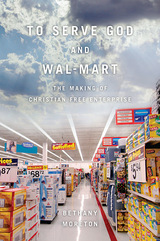
In the decades after World War II, evangelical Christianity nourished America’s devotion to free markets, free trade, and free enterprise. The history of Wal-Mart uncovers a complex network that united Sun Belt entrepreneurs, evangelical employees, Christian business students, overseas missionaries, and free-market activists. Through the stories of people linked by the world’s largest corporation, Bethany Moreton shows how a Christian service ethos powered capitalism at home and abroad.
While industrial America was built by and for the urban North, rural Southerners comprised much of the labor, management, and consumers in the postwar service sector that raised the Sun Belt to national influence. These newcomers to the economic stage put down the plough to take up the bar-code scanner without ever passing through the assembly line. Industrial culture had been urban, modernist, sometimes radical, often Catholic and Jewish, and self-consciously international. Post-industrial culture, in contrast, spoke of Jesus with a drawl and of unions with a sneer, sang about Momma and the flag, and preached salvation in this world and the next.
This extraordinary biography of Wal-Mart’s world shows how a Christian pro-business movement grew from the bottom up as well as the top down, bolstering an economic vision that sanctifies corporate globalization.
The author has assigned her royalties and subsidiary earnings to Interfaith Worker Justice (www.iwj.org) and its local affiliate in Athens, GA, the Economic Justice Coalition (www.econjustice.org).
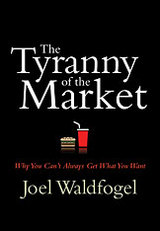
Economists have long counseled reliance on markets rather than on government to decide a wide range of questions, in part because allocation through voting can give rise to a "tyranny of the majority." Markets, by contrast, are believed to make products available to suit any individual, regardless of what others want. But the argument is not generally correct. In markets, you can't always get what you want. This book explores why this is so and its consequences for consumers with atypical preferences.
When fixed costs are substantial, markets provide only products desired by large concentrations of people. As a result, people are better off in their capacity as consumers when more fellow consumers share their product preferences. Small groups of consumers with less prevalent tastes, such as blacks, Hispanics, people with rare diseases, and people living in remote areas, find less satisfaction in markets. In some cases, an actual tyranny of the majority occurs in product markets. A single product can suit one group or another. If one group is larger, the product is targeted to the larger group, making them better off and others worse off.
The book illustrates these phenomena with evidence from a variety of industries such as restaurants, air travel, pharmaceuticals, and the media, including radio broadcasting, newspapers, television, bookstores, libraries, and the Internet.
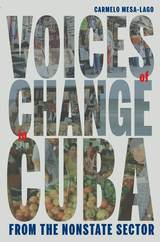
Based on eighty in-depth interviews recently conducted in Cuba, this book captures actual voices from this evolving economic sector. It details workers’ level of satisfaction with what they do and earn, profits (and how they are allocated between consumption and investment), plans to expand their activities, receiving foreign remittances and microcredit, competition, forms of advertising, and payment of taxes. Perhaps most revealing are the speakers’ views on the obstacles they face and their desires for change and improvement. As such, the book offers fascinating insights into today’s Cuban economy from the nonstate sector, while also reflecting on its potential for development and the obstacles it faces.
READERS
Browse our collection.
PUBLISHERS
See BiblioVault's publisher services.
STUDENT SERVICES
Files for college accessibility offices.
RECENTLY PUBLISHED






UChicago Accessibility Resources
home | accessibility | search | about | contact us
BiblioVault ® 2001 - 2024
The University of Chicago Press