
 A SCHOLARLY BOOK REPOSITORY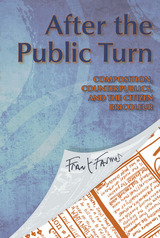
Farmer examines two very different kinds of publics, cultural and disciplinary, and discusses two counterpublics within those broad categories: zine discourses and certain academic discourses. By juxtaposing these two significantly different kinds of publics, Farmer suggests that each discursive world can be seen, in its own distinct way, as a counterpublic, an oppositional social formation that has a stake in widening or altering public life as we know it.
Drawing on major figures in rhetoric and cultural theory, Farmer builds his argument about composition teaching and its relation to the public sphere, leading to a more sophisticated understanding of public life and a deeper sense of what democratic citizenship means for our time.
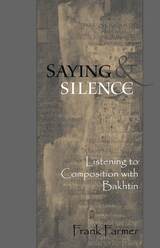
Frank Farmer has contributed important essays to the study of Bakhtin in composition, and in Saying and Silence he gathers some of those, along with several new essays, into a single volume. Scholars who specialize in Bakhtin will find this work engaging, but equally Farmer wants to explicate and apply Bakhtin for readers whose focus is teaching or some other nonspecialist dimension of writing scholarship.
Farmer explores the relationship between the meaningful word and the meaningful pause, between saying and silence, especially as the relationship emerges in our classrooms, our disciplinary conversations, and encounters with publics beyond the academy. Each of his chapters here addresses some aspect of how we and our students, colleagues, and critics have our say and speak our piece, often under conditions where silence is the institutionally sanctioned and preferred alternative. He has enlisted a number of Bakhtinian ideas (the superaddressee, outsideness, voice in dialogue) to help in the project of interpreting the silences we hear, naming the silences we do not hear, and of encouraging all silences to speak in ways that are freely chosen, not enforced.
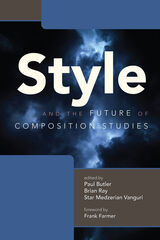
Many college writing teachers operate under the belief that style still refers primarily to the kinds of issues discussed in Strunk and White’s popular but outdated book The Elements of Style. This work not only challenges this view but also offers theories and pedagogies from diverse perspectives that help teachers and students develop strategic habits and mindsets to negotiate languages, genres, and discourse conventions. The chapters explore the ways in which style directly affects—and is affected by—multiple sources of shifting disciplinary inquiry, contributing new insights by drawing on research in cultural studies, sociolinguistics, discourse studies, translingualism, and writing across the curriculum, as well as new approaches to classical rhetorical theory.
The reemergence of stylistic inquiry can be used dynamically to produce new insights not only about emerging disciplinary interests but also about the study of style as a kind of language in and of itself. Style and the Future of Composition Studies demonstrates that style deserves to be a central focus of writing teaching. More than just the next style collection, the book advocates for style’s larger prominence in composition discussions generally. It will be of interest to a broad range of students and scholars of writing studies, as well as a wider set of readers in academe.
Contributors:
Cydney Alexis, Laura Aull, Anthony Box, Jimmy Butts, Mike Duncan, William FitzGerald, Melissa Goldthwaite, Eric House, TR Johnson, Almas Khan, Zak Lancaster, Eric Leake, Andrea Olinger, Thomas Pace, Jarron Slater, Jonathan Udelson
READERS
Browse our collection.
PUBLISHERS
See BiblioVault's publisher services.
STUDENT SERVICES
Files for college accessibility offices.
RECENTLY PUBLISHED





UChicago Accessibility Resources
home | accessibility | search | about | contact us
BiblioVault ® 2001 - 2026
The University of Chicago Press