
front cover of Agents of Liberations
Agents of Liberations
Holocaust Memory in Contemporary Art and Documentary Film
Zoltán Kékesi
Central European University Press, 2015
The book explores representations of the Holocaust in contemporary art practices. Through carefully selected art projects, the author illuminates the specific historical, cultural, and political circumstances that influence the way we speak—or do not speak—about the Holocaust. The book's international focus brings into view film projects made by key artists reflecting critically upon forms of Holocaust memory in a variety of geographical contexts. Kékesi connects the ethical implications of the memory of the Holocaust with a critical analysis of contemporary societies, focusing upon artists who are deeply engaged in doing both of the above within three regions: Eastern Europe (especially Poland), Germany, and Israel. The case studies apply current methods of contemporary art theory, unfolding their implications in terms of memory politics and social critique.
[more]

front cover of American Courage, American Carnage
American Courage, American Carnage
The 7th Infantry Regiment's Combat Experience, 1812 through World War II
John C. McManus
University of Missouri Press, 2025
Only one U.S. Army regiment, the 7th Infantry, has served in every war from 1812 through the present day. In this reissuance of his classic American Courage, American Carnage: 7th Infantry Chronicles 1812 Through World War II, noted military historian and best-selling author John C McManus tells the first part of the 7th’s amazing story, from the Battle of New Orleans through the end of World War II. No American unit has earned more battle streamers and few can boast more Medal of Honor winners.

In the months leading up to the War of 1812, Congress authorized the creation of this regiment. It fought with distinction at the Battle of New Orleans, anchoring General Andrew Jackson's main defensive line, forever earning the nickname "Cottonbalers" because the soldiers of the 7th were said to have battled the British from behind large rows of cotton bales. From now on, whenever Americans went to war, the Cottonbalers would always find themselves in the center of the action, where the danger was greatest.

Between these covers is the whole story, told through the eyes of the soldiers—the realities of combat expressed in raw human terms. From the marshy grounds of the Chalmette plantation in New Orleans to the daunting heights of Chapultepec in Mexico City; from the bloody horror of the long, stone wall at Fredericksburg to the deadly crossfire of the Wheatfield at Gettysburg, from the shocking gore of Custer's massacre at Little Bighorn to the desperation of dusty frontier battles; from the foggy hills of Santiago in Cuba to the muddy, pockmarked no man's land of Belleau Wood in France; from the invasion of North Africa to Sicily, Anzio, southern France, the Vosges Mountains, the breaching of the Rhine, and the 7th's triumphant capture of Hitler's mountain home at Berchtesgaden in May, 1945, this remarkable book chronicles multiple generations of Cottonbalers who have fought and bled for their country.

American Courage, American Carnage is an inside look at the drama, tragedy, fatigue and pathos of war, from America's early nineteenth century struggles as a fledgling republic to its emergence as a superpower in the twentieth. Based on nearly a decade of archival research, battlefield visits, interviews, and intensive study, and illustrated with copious maps and photographs, this book is a moving, authoritative, tale of Americans in combat.
 
[more]

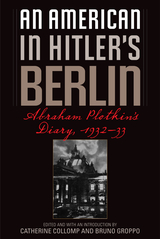
front cover of An American in Hitler's Berlin
An American in Hitler's Berlin
Abraham Plotkin's Diary, 1932-33
Abraham Plotkin; Edited & with an introduction by Catherine Collomp & Bruno Grop
University of Illinois Press, 2007
This is the first published edition of the diary of Abraham Plotkin, an American labor leader of immigrant Jewish origin who lived in Berlin between November 1932 and May 1933. A firsthand account of the Weimar Republic's final months and the early rise of Nazi power in Germany, Plotkin's diary focuses on the German working class, the labor movement, and the plight of German Jews. Plotkin investigated Berlin's social conditions with the help of German Social-Democratic leaders whose analyses of the situation he records alongside his own.

Compared to the writings of other American observers of the Third Reich, Plotkin's diary is unique in style, scope, themes, and time span. Most accounts of Hitler's rise to power emphasize political institutions by focusing on the Nazi party's clashes with other political forces. In contrast, Plotkin is especially attentive to socioeconomic factors, providing an alternative view from the left that stems from his access to key German labor and socialist leaders. Chronologically, the diary reports on the moment when Hitler's seizure of power was not yet inevitable and when leaders on the left still believed in a different outcome of the crisis, but it also includes Plotkin's account of the complete destruction of German labor in May 1933.
[more]

front cover of The Cruel Sky
The Cruel Sky
A Heavy Bomber Group in World War II
Robert Thompson
Westholme Publishing, 2025
The men who flew American heavy bombers over Europe in World War II were very young—most were either in their late teens or early twenties. Before they deployed overseas, they were military amateurs who knew nothing of the violent, dangerous world of air warfare. Heavy bombers flew over Europe in steady formations at high altitudes. There they faced a gauntlet of razor sharp antiaircraft artillery bursts and fighter aircraft firing cannons that shattered Plexiglas, metal, engines, and bone. It is no wonder that bomber crews suffered some of the highest casualty rates of any service during the war. Yet, their courage and sacrifice would help the Allies secure an overwhelming victory over Hitler’s Germany. That bravery and the extreme dangers these young men faced in combat over Europe are vividly portrayed in The Cruel Sky: A Heavy Bomber Group in World War II. Using the 451st Bombardment Group (Heavy) of the Fifteenth Air Force as the focus for this compelling narrative, author Robert Thompson describes how the bomber group was established and trained, what is took to fly its aircraft—the Consolidated B-24 Liberator—the opposition they faced, and the harrowing stories of the missions for which the group received three Distinguished Unit Citations, one of only two units so honored during World War II. Relying on official reports and firsthand accounts of those who flew with the 451st, the book provides a fresh and personal perspective of the deadly air war over Europe that was critical in defeating the Nazis and liberating millions.
 
[more]

front cover of Forward Positions
Forward Positions
The War Correspondence of Homer Bigart
Homer Bigart
University of Arkansas Press, 1992

Among journalists—and particularly war correspondents—Homer Bigart was both legend and example. In a career of four decades, first with the New York Herald Tribuneand then, through 1972, with The New York Times, Bigart distinguished himself as a superb writer and tireless digger for the realities that could be learned only in the field and not at headquarters. In 1943 Bigart sailed for England to cover the air war and was soon on mule-back in Sicily, and hanging on at Anzio. He then went to the Pacific, where his dispatches won him his first Pulitzer Prize for foreign correspondence. When hostilities erupted in Korea he was again on the front lines in the front lines in the Orient, and again recipient of a Pulitzer. By the time of the American involvement in Vietnam, he was an old-timer, a seasoned correspondent admired and celebrated for his wit but regarded with awe for his masterly stories, in which straightforward prose, informed by tenacious reporting, cut to the heart of the issues.

Previously available only n crumbling library copies of the Tribune and the Times, or in microfilm repositories, his dispatches, with their rare insights into warefar and he minds of those who wage war, are now collected in Forward Positions: The War Correspondence of Home Bigart, edited by Betsy Wade and introduced by Harrison E. Salisbury, himself the winner of a Pulitzer Prize for journalism.

Forward Positions does honor to a breed of journalist that had passed into history by the time of Bigart’s death. It includes one of the first accounts of the atomic annihilation of Hiroshima, a report on the war-crimes trial of Adolf Eichmann, a number of dispatches on “hot” battles of the Cold War, and a probing dispatch on Lieutenant William Calley’s testimony on the Mỹ Lai Massacre. With this representative selection of more than fifty of Bigart’s accounts of war on the ground, in the air, and in the courtroom, Wade provides a wealth of background material about his career, as well as glimpses of his impact on journalism. The book promises hours of captivating and informative reading for journalists, historians, veterans, and anyone who likes a good story tautly told.
[more]

front cover of Icon Dresden
Icon Dresden
Baroque City, Air War Symbol, Political Token
Susanne Vees-Gulani
University of Michigan Press, 2026
Icon Dresden explores how memory and politics in Dresden after its 1945 bombing are deeply intertwined with the city’s urban history. It highlights the complex origins of Dresden’s reputation as an exclusively cultural center, focusing on urban planning, marketing, tourism, and the city’s visual archive since the 17th century. Based on this iconic status, a narrative of victimhood arose after its destruction that ignored responsibilities while highlighting the city’s innocence. Despite its origin in Nazi propaganda, this narrative influenced postwar political discourse in socialist and post-reunification Germany. Icon Dresden also provides insight into Dresden’s role under National Socialism and the GDR’s evasive response to this history. It reveals how the strong presence of far-right movements in the city today stems from multiple discourses formed over centuries and communicated from generation to generation. 

Drawing on urban, heritage, and tourism studies, visual and memory studies, and environmental psychology, Icon Dresden examines Dresden’s history, identity, visual representations, and rebuilding decisions. It exposes the narratives that define its place in German and international memory and how, paradoxically, they support both Dresden’s current image as a symbol of peace and reconciliation and its backing of nativist and far-right movements.
[more]

front cover of Jewish Claims Against East Germany
Jewish Claims Against East Germany
Angelika Timm
Central European University Press, 1998

This is the first comprehensive history of Jewish negotiations with East Germany regarding restitution and reparations for Nazi war crimes. Angelika Timm analyzes the politics of old and new anti-Semitism and the context in which they grew under the officially propagated ideology of antifascism.


Investigating the mass of unpublished, newly available archival data from the United States, Israel, and the former German Democratic Republic, and more than forty personal interviews, Timm fills a critical gap in the scholarship on postwar Germany. She analyzes the role of the Holocaust and the image of Jews in the historical consciousness and political culture of East Germany and chronicles the efforts of Jewish organizations, especially the Conference on Jewish Material Claims Against Germany, to negotiate reparations with the East German state. The unique relationship between ideology and Realpolitik defined the manner in which East Germany confronted the crimes of its past and allowed anti-Semitism to reemerge.

[more]

front cover of Life of the 381st Bomb Group
Life of the 381st Bomb Group
The World War II Diary of Eighth Air Force Chaplain James Good Brown
Bob Korkuc
University of Missouri Press, 2026
Life of the 381st Bomb Group depicts the daily life of the men of the 381st Bombardment Group (H) of the Mighty Eighth Air Force during World War II as revealed by its chaplain, James Good Brown, who kept a diary during his time with the bomb group from 1943 until 1945. In his entries, Brown describes with extraordinary candor his observations of the inner workings of the unit during wartime, delighting in the aircrewmen's successes and grieving their many losses. Serving overseas with the 381st Bomb Group while in his early forties, Brown greatly revered the young men, some of them twenty years his junior, who flew the combat missions. More than an unvarnished depiction of the daily activities of a bomb group that participated in 297 bombing raids over Europe fighting against the Luftwaffe, Brown’s diary provides in-depth character assessments of the many men with whom he served. 
 
In addition to judiciously transcribing and paring down Brown’s original document for readability, Korkuc conducted original research to prepare a highly unique appendix to the document, what he calls an Index of Names, in which he tracks down the fate of every member of the many aircrews with whom Brown served. With his Index of Names, Korkuc finishes what Brown started but could not finish by listing the fate of each airman, including those killed in combat, those downed but not accounted for during the war, and those who survived the war. Life of the 381st in World War II provides a rare, firsthand perspective on the early history of the Mighty Eighth Air Force, and on one man’s dedication to his brave team of young airmen. The immediacy of Brown’s narration, combined with Korkuc’s meticulous editing and original contributions, make this a promising new resource to scholars in the field.
 
 
[more]

front cover of Life should be Transparent
Life should be Transparent
Conversations about Lithuania and Europe in the Twentieth Century and Today
Aurimas Svedas
Central European University Press, 2020

This book of thirteen conversations introduces us to the life of an exceptional person—theatre critic, Germanist, and long-time chair of the Open Lithuania Fund board—Irena Veisaitė. The dialogue between Lithuanian historian Aurimas Švedas and a woman who reflects deeply on her experiences reveals both one individual’s historically dramatic life and the fate of Europe and Lithuania in the twentieth century.

Through the complementary lenses of history and memory, we confront with Veisaitė the horrific events of the Holocaust, which brought about the end of the Lithuanian Jewish world. We also meet an array of world-class cultural figures, see fragments of legendary theatre performances, and hear meaningful words that were spoken or heard decades ago.

This book’s interlocutors do not so much seek to answer the question “What was it like?” but instead repeatedly ask each other: “What, how, and why do we remember? What is the meaning of our experiences? How can history help us to live in the present and create the future? How do we learn to understand and forgive?”

A series of Veisaitė’s texts, statements, and letters, presented at the end of the book suggest further ways of answering these questions.

[more]

front cover of The Nazi Olympics
The Nazi Olympics
Sport, Politics, and Appeasement in the 1930s
Edited by Arnd Krüger and William Murray
University of Illinois Press, 2003

The 1936 Olympic Games played a key role in the development of both Hitler’s Third Reich and international sporting competition. The Nazi Olympics gathers essays by modern scholars from prominent participating countries and lays out the issues--sporting as well as political--surrounding the involvement of individual nations. 

The volume opens with an analysis of Germany’s preparations for the Games and the attempts by the Nazi regime to allay the international concerns about Hitler’s racist ideals and expansionist ambitions. Essays follow on the United States, Great Britain, and France--top-tier Olympian nations with misgivings about participation--as well as Germany's future Axis partners Italy and Japan. Other contributions examine the issues involved for Finland, Sweden, Norway, Denmark, and the Netherlands. Throughout, the authors reveal the high political stakes surrounding the Games and how the Nazi Olympics distilled critical geopolitical issues of the time into a spectacle of sport.
[more]

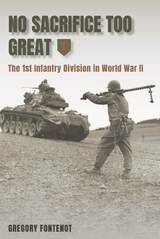
front cover of No Sacrifice Too Great
No Sacrifice Too Great
The 1st Infantry Division in World War II
Gregory Fontenot
University of Missouri Press, 2023
Winner of the 2023 Army Historical Foundation Distinguished Writing Award for Unit History

The U.S. 1st Infantry Division (1st ID), familiarly known as the Big Red One, adapted to dynamic battlefield conditions through­out the course of its deployment during World War II by inno­vating and altering behavior, including tactics, techniques, and procedures. Both the Division’s leaders and soldiers accom­plished this by thinking critically about their experiences in combat and wasting little time in putting lessons learned to good use. Simply put, they learned on the job—in battle and after bat­tle—and did so quickly.

In telling the Division’s WWII story, which includes an extensive photographic essay featuring many previously unpublished im­ages, Gregory Fontenot includes the stories of individual mem­bers of the Big Red One, from high-ranking officers to enlisted men fresh off the streets of Brooklyn, both during and after the conflict. Colonel Fontenot’s rare ability to combine expert anal­ysis with compelling narrative history makes No Sacrifice Too Great an absorbing read for anyone interested in the military his­tory of the United States.

 
[more]

front cover of Patton's War
Patton's War
An American General's Combat Leadership Volume 3: January 1-December 21, 1945
Kevin M. Hymel
University of Missouri Press, 2026
The third and final volume of Kevin Hymel’s Patton’s War trilogy finds Lieutenant General George S. Patton on January 1, 1945, as the master of the battlefield in World War II Europe. Throughout the war, Patton showed the same kind of aggressive leadership and battlefield smarts that made his name synonymous with victory. Patton’s leadership was almost flawless as he led his men through enemy fire and one of the worst winters in European history. 

As with his previous volume, Hymel relies on Patton’s original diaries (not the transcribed, embellished versions historians have relied on for many years) and personal letters to tell the general’s story. Hymel also mined various archives to explain Patton’s encounters with soldiers, government officials, civilians, and reporters to expand on his narrative.

Throughout this three-volume work, Patton emerges not as a larger-than-life myth, but as a human being, one held back by the personal prejudices and antisemitism that ultimately proved to be his demise. Despite these personal failings, Patton was, above all, as Hymel reveals, a commander bent on winning, or, as the general himself might have put it, getting the enemy to dance to his tune. 
 
[more]

logo for Amsterdam University Press
Street Nihonga
The Art of Jimmy Tsutomu Mirikitani
Maki Kaneko
Amsterdam University Press, 2026
Street Nihonga: The Art of Jimmy Tsutomu Mirikitani is the most comprehensive publication to date of Jimmy Tsutomu Mirikitani (1920–2012), a Japanese American artist raised in Hiroshima, Japan. From Nihonga (“Japanese-style”) paintings to intricate collage works crafted on the streets of New York, Mirikitani’s art narrates a life shaped by war, displacement, survival, and collaboration. Drawing from the formal traditions of Japanese painting and the raw immediacy of urban materials, his poignant oeuvre offers a critical narrative of twentieth-century transpacific history and unexpected modes of transnational artistic exchange.
This volume features 163 color illustrations alongside scholarly essays and reflections that frame Mirikitani’s practice as both artistic achievement and political intervention. Maki Kaneko’s introduction situates the exhibition within the artist’s distinctive “street Nihonga” aesthetic—a collaged form of artmaking, storytelling, and community collaboration. Contributors Noriko Murai, Scott Tsuchitani, Yukinori Okamura, and Kris Ercums offer wide-ranging perspectives, including the transnational legacy of Nihonga, the memory politics of Japanese American incarceration, the evolving lineage of “A-bomb art,” and the curatorial process behind the exhibition. Linda Hattendorf and Masa Yoshikawa, Mirikitani’s close friends and documentarians, provide intimate insights into his life and art.
At once scholarly and inviting, Street Nihonga encourages readers to encounter Mirikitani not as an artist of the margins but as a radical reinterpreter of convention and a witness to histories often left untold. This catalogue remains open-ended—a living collage and a call to engage with Mirikitani’s extraordinary life and work.
[more]

front cover of Survival at Treblinka
Survival at Treblinka
Geography, Gender, and Social Networks in Jewish Resistance
Chad S.A. Gibbs
University of Wisconsin Press, 2026

On August 2, 1943, prisoners at the Nazi extermination camp Treblinka, located in occupied Poland, launched an uprising against their captors, during which hundreds successfully escaped while guards killed as many in the process. In this groundbreaking work, Chad S.A. Gibbs draws upon recently discovered sources and novel research methods to fundamentally reassess Jewish resistance at Treblinka—both before and during the revolt.

Using the testimonies of revolt survivors, prior escapees, those who passed through the camp, and a handful of bystander witnesses and former SS guards, Gibbs sheds new light on the events of August 2 as well as many prior acts of resistance. Critical to these new interpretations of the revolt are the actions of women prisoners, who here assume a central place in this story for the first time.

[more]

front cover of They Fought at Anzio
They Fought at Anzio
John S. D. Eisenhower
University of Missouri Press, 2025

Italy, from the toe to the Alps, was the scene of the longest, bloodiest, most frustrating, and least understood series of battles fought by the Western Allies during World War II.        Now, John S. D. Eisenhower offers a new look at the Italian campaign, emphasizing the Anzio offensive—an operation pushed by Winston Churchill that fell largely to American troops to carry out. It was visualized as an amphibious landing of two Allied divisions behind German lines that would force the Wehrmacht to evacuate all of Italy. But the Germans held on and, with the arrival of reinforcements, nearly wiped out the Allied troops pinned down at Anzio Beach.

            By portraying that struggle from the perspectives of both commanders and foot soldiers, this prominent military historian focuses on the experiences of the individuals who fought in the Italian campaign to reveal what the battle at Anzio was all about. But more than the account of one operation, They Fought at Anzio covers the entire Italian campaign, from the landings at Salerno to the capture of Rome.

Eisenhower brings a trained eye to reconstructing the difficult terrain of battle, approaching the Anzio campaign as a contest between opposing commands striving to anticipate and counter the opponent’s moves—not as a field exercise but as a deadly struggle for survival. He analyzes the command decisions that brought about the Anzio stalemate, interspersing his account with personal experiences of the men in the trenches, the nurses of the 56th Evacuation Hospital, and the young officers witnessing the horrors of war for the first time.

As a study in command, Eisenhower’s narrative gives new credit to generals Lucian Truscott and Fred Walker and assesses both the strengths and weaknesses of General Mark Clark, allowing us to grasp the situation as it appeared to those in command. He also offers compelling portraits of German commanders Field Marshal Albert Kesselring and General Frido von Senger und Etterlin.

            It has been said that Anzio was a soldier’s battle, remembered more for blood shed than for military objectives achieved. By focusing on the experiences of the soldiers who fought there and the decisions of commanders in perilous circumstances, They Fought at Anzio offers a new appreciation of the contributions of both and a new understanding of this unheralded theater of the war.

[more]

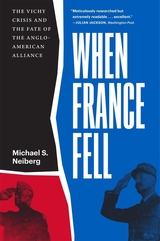
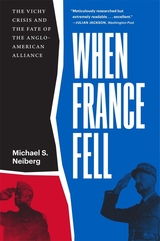
front cover of When France Fell
When France Fell
The Vichy Crisis and the Fate of the Anglo-American Alliance
Michael S. Neiberg
Harvard University Press, 2021

Winner of the Society for Military History’s Distinguished Book Award

Shocked by the fall of France in 1940, panicked US leaders rushed to back the Vichy government—a fateful decision that nearly destroyed the Anglo–American alliance.

According to US Secretary of War Henry Stimson, the “most shocking single event” of World War II was not the Japanese attack on Pearl Harbor, but rather the fall of France in spring 1940. Michael Neiberg offers a dramatic history of the American response—a policy marked by panic and moral ineptitude, which placed the United States in league with fascism and nearly ruined the alliance with Britain.

The successful Nazi invasion of France destabilized American planners’ strategic assumptions. At home, the result was huge increases in defense spending, the advent of peacetime military conscription, and domestic spying to weed out potential fifth columnists. Abroad, the United States decided to work with Vichy France despite its pro-Nazi tendencies. The US–Vichy partnership, intended to buy time and temper the flames of war in Europe, severely strained Anglo–American relations. American leaders naively believed that they could woo men like Philippe Pétain, preventing France from becoming a formal German ally. The British, however, understood that Vichy was subservient to Nazi Germany and instead supported resistance figures such as Charles de Gaulle. After the war, the choice to back Vichy tainted US–French relations for decades.

Our collective memory of World War II as a period of American strength overlooks the desperation and faulty decision making that drove US policy from 1940 to 1943. Tracing the key diplomatic and strategic moves of these formative years, When France Fell gives us a more nuanced and complete understanding of the war and of the global position the United States would occupy afterward.
[more]

front cover of When France Fell
When France Fell
The Vichy Crisis and the Fate of the Anglo-American Alliance
Michael S. Neiberg
Harvard University Press

Winner of the Society for Military History’s Distinguished Book Award

“Deeply researched and forcefully written . . . deftly explains the confused politics and diplomacy that bedeviled the war against the Nazis.”—Wall Street Journal

“Neiberg is one of the very best historians on wartime France, and his approach to the fall of France and its consequences is truly original and perceptive as well as superbly written.”—Antony Beevor, author of The Second World War

“An utterly gripping account, the best to date, of relations within the turbulent triumvirate of France, Britain, and America in the Second World War.”—Andrew Roberts, author of Churchill: Walking with Destiny

The “most shocking single event” of World War II, according to US Secretary of War Henry Stimson, was not the Japanese attack on Pearl Harbor but the fall of France in the spring of 1940. The Nazi invasion of France destabilized Washington’s strategic assumptions, resulting in hasty and desperate decision-making. Michael Neiberg offers a dramatic history of America’s bewildering response—policies that placed the United States in league with fascism and nearly ruined its alliance with Britain.

FDR and his advisors naively believed they could woo Vichy France’s decorated wartime leader, Marshal Philippe Pétain, and prevent the country from becoming a formal German ally. The British, convinced that the Vichy government was fully subservient to Nazi Germany, chose to back Charles de Gaulle and actively financed and supported the Resistance. After the war, America’s decision to work with the Vichy regime cast a pall over US-French relations that lasted for decades.

[more]

front cover of When Roosevelt Planned to Govern France
When Roosevelt Planned to Govern France
Charles L. Robertson
University of Massachusetts Press, 2011

This book tells the story of a plan put forth by President Franklin Roosevelt during World War II for an Allied military occupation of France in the aftermath of liberation, and of General Charles de Gaulle's efforts as self-appointed leader of the Free French Movement to thwart FDR's intentions. Charles L. Robertson frames the narrative as a mystery in which he plays the role of detective. He begins at a dinner party thirty years ago, where he first learned of the alleged plan from an elderly former aide to de Gaulle. Yet it wasn't until 2004, when he heard the same story repeated during the 60th commemoration of D-Day, that he set out to investigate whether it was true.

Many French are aware of this episode and believe, on the basis of later Gaullist officials' writings, that until the last moment a military occupation of their country was imminent. This view, across the years, has helped darken relations between France and the United States. Yet few if any Americans have ever heard of this plan, and in the event, no Allied military government of France was ever established. 

How and why it never came to be, and why the French still believe it almost did, is the subject of this book. Robertson recounts how the president of the most powerful nation in the world was outmaneuvered in both his earlier plans for an occupation of France and his subsequent attempts to keep General de Gaulle from “seizing” power—in a France that ultimately, despite Roosevelt's intentions and expectations, regained its place among the victorious powers under de Gaulle's leadership.

[more]


Send via email Share on Facebook Share on Twitter