
 A SCHOLARLY BOOK REPOSITORY
28 start with A start with A
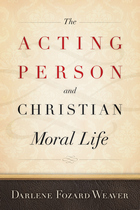
What may we say about the significance of particular moral actions for one’s relationship with God? In this provocative analysis of contemporary Catholic moral theology Darlene Fozard Weaver shows the person as a moral agent acting in relation to God. Using an overarching theological context of sinful estrangement from and gracious reconciliation in God, Weaver shows how individuals negotiate their relationships with God in and through their involvement with others and the world.
Much of current Christian ethics focuses more on persons and their virtues and vices exemplified by the work of virtue ethicists or on sinful social structures illustrated in the work of liberation theologians. These judgments fail to appreciate the reflexive character of human action and neglect the way our actions negotiate our response to God. Weaver develops a theologically robust moral anthropology that advances Christian understanding of persons and moral actions and contends we can better understand the theological import of moral actions by seeing ourselves as creatures who live, move, and have our being in God.
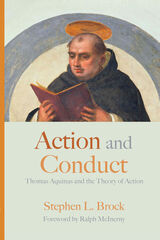
"A first-rate book...Brock's lucid and illuminating analysis offers much of value to both intellectual historians and theologians, as well as philosophers."—Theological Studies"Brock's treatment of Aquinas's account of action exhibits a rare combination of rigor and learning. It is, no doubt, the best we have."—The Thomist

The book is the first of its kind to draw together in conversation the views of the early Church, contemporary biblical and theological scholarship, and post-conciliar teachings. Steck develops a comprehensive, Catholic theology of animals based on an in-depth exploration of Catholicism's fundamental doctrines—trinitarian theology, Christology, pneumatology, eschatology, and soteriology.
All God's Animals makes two central claims. First, we can hope that God will include animals of the present age in the kingdom inaugurated by Christ. Second, because of this inclusion, our responses to animals should be guided by the values of the kingdom.
As Christians await the final liberation of all creation, they are to be witnesses to God’s kingdom by embodying its ideals in their relations with animal life. Because the kingdom's fullness is yet to come and because our world remains marked by the wounds of sin, however, Christian treatment of animals will at times require acts that are at odds with the kingdom’s ideals (for example, those causing suffering and death). Steck examines each of these ideas and explores all of their complexities.
Roman Catholic moral theology is the point of departure for this multifaceted exploration of the challenge of allocating scarce medical resources.
The volume begins its exploration of discerning moral limits to modern high-technology medicine with a consensus statement born of the conversations among its contributors. The seventeen essays use the example of critical care, because it offers one of the few areas in medicine where there are good clinical predictive measures regarding the likelihood of survival. As a result, the health care industry can with increasing accuracy predict the probability of saving lives—and at what cost.
Because critical care involves hard choices in the face of finitude, it invites profound questions about the meaning of life, the nature of a good death, and distributive justice. For those who identify the prize of human life as immortality, the question arises as to how much effort should be invested in marginally postponing death. In a secular culture that presumes that individuals live only once, and briefly, there is an often-unacknowledged moral imperative to employ any means necessary to postpone death. The conflict between the free choice of individuals and various aspirations to equality compounds the challenge of controlling medical costs while also offering high-tech care to those who want its possible benefits. It forces society to confront anew notions of ordinary versus extraordinary, and proportionate versus disproportionate, treatment in a highly technologically structured social context.
This cluster of discussions is enriched by five essays from Jewish, Orthodox Christian, and Protestant perspectives. Written by premier scholars from the United States and abroad, these essays will be valuable reading for students and scholars of bioethics and Christian moral theology.
In this careful analysis and evaluation of the monumental influence of Niebuhr, Werpehowski traces four streams that flow from Niebuhr's theology, particularly as it deals with ethics. In a tightly knit and comprehensive investigation of the work of four contemporary ethicists, important in their own right, Paul Ramsey, Stanley Hauerwas, James Gustafson, and Kathryn Tanner, Werpehowski explores how the legacy of Niebuhr has made an impact on their thought and work. He presents a clear, concise, nuanced, analytical criticism of the development of the four ethicist's construction of ethics-and does it in a way that interweaves and puts the four into a dialogue and conversation with Niebuhr and each other.
Addressing a number of substantive issues, including the viability of just war tradition and the relationship between "church" and "world," American Protestant Ethics and the Legacy of H. Richard Niebuhr demonstrates that Christian ethics operates within a set of polar tensions and that such "conversations" as are developed within need to be a part of moral discourse inside and between a variety of communities of faith.

In Linzey’s view, animal rights is synonymous with animal theology. Linzey argues that historical theology, creatively defined, must reject humanocentricity. Questioning the assumption that if theology is to speak on this issue, “it must only do so on the side of the oppressors,” Linzey investigates not only the abstractions of theory, but also the realities of hunting, animal experimentation, and genetic engineering. His is a pioneering, vital, and unequivocally Christian voice advocating on behalf of the countless creatures who share our world and our lives but cannot speak for themselves.
The Annual, the journal of the Society of Christian Ethics, offers access to a wide variety of the most recent work in Christian and religious ethics. It is an essential source for student and faculty to keep abreast of new developments in the discipline and to locate sources for research.
The Annual, the journal of the Society of Christian Ethics, offers access to a wide variety of the most recent work in Christian and religious ethics. It is an essential source for student and faculty to keep abreast of new developments in the discipline and to locate sources for research.
The Annual, the journal of the Society of Christian Ethics, offers access to a wide variety of the most recent work in Christian and religious ethics. It is an essential source for student and faculty to keep abreast of new developments in the discipline and to locate sources for research.
The Annual, the journal of the Society of Christian Ethics, offers access to a wide variety of the most recent work in Christian and religious ethics. It is an essential source for student and faculty to keep abreast of new developments in the discipline and to locate sources for research.
The Annual, the journal of the Society of Christian Ethics, offers access to a wide variety of the most recent work in Christian and religious ethics. It is an essential source for student and faculty to keep abreast of new developments in the discipline and to locate sources for research.
The Annual, the journal of the Society of Christian Ethics, offers access to a wide variety of the most recent work in Christian and religious ethics. It is an essential source for student and faculty to keep abreast of new developments in the discipline and to locate sources for research.
The Annual, the journal of the Society of Christian Ethics, offers access to a wide variety of the most recent work in Christian and religious ethics. It is an essential source for student and faculty to keep abreast of new developments in the discipline and to locate sources for research.
The Annual, the journal of the Society of Christian Ethics, offers access to a wide variety of the most recent work in Christian and religious ethics. It is an essential source for student and faculty to keep abreast of new developments in the discipline and to locate sources for research.
The Annual, the journal of the Society of Christian Ethics, offers access to a wide variety of the most recent work in Christian and religious ethics. It is an essential source for student and faculty to keep abreast of new developments in the discipline and to locate sources for research.
The Annual, the journal of the Society of Christian Ethics, publishes some of the most recent work by Christian ethicists in North America and offers a convenient way to keep abreast of the best scholarship in the discipline. It is indexed in Religion Index II, Religious and Theological Abstracts, Arts & Humanities Citation Index, Current Content/Arts & Humanities, and Research Alert.
The 1994 issue includes a presidential address by Margaret Farley on love in the postmodern world and essays on health care reform, the Protestant idea of vocation, women and aging, military ethics in the Gulf War, family theory in the Chicago School of economics, and religious freedom. There is a professional resources section on feminist and womanist ethics guest edited by Barbara Anderson.
The Annual, the journal of the Society of Christian Ethics, offers access to a wide variety of the most recent work in Christian and religious ethics. It is an essential source for student and faculty to keep abreast of new developments in the discipline and to locate sources for research.
The 1995 issue presents the presidential address by Jon P. Gunnemann on "Alchemic Temptations." It includes articles by Larry Rasmussen on the integrity of creation, Sumner B. Twiss and Bruce Grelle on comparative religious ethics and human rights, Simeon O. Ilesanmi on inculturation and liberation theology in Africa, Keith Grabe Miller on Mennonite lobbyists, Christine D. Pohl on hospitality, and James A. Nash on renewing the virtue of frugality. The professional resources section on families and the social order is edited by Christine Firer Hinze and Todd David Whitmore.
The Annual, the journal of the Society of Christian Ethics, is an essential source for student and faculty to keep abreast of new developments in Christian and religious ethics and to locate sources for research. It is indexed in The Philosopher's Index, Religion Index II, Religious and Theological Abstracts, Arts & Humanities Citation Index, Current Content/Arts & Humanities, and Research Alert.
The 1996 issue includes articles by Maria Antonaccio on Iris Murdoch's 'Godless' theology, William P. George on the ethics of international regimes, J. Brian Hehir on the changing realities of national sovereignty and the ethics of international relations, Roy May, Jr., on reconciliation in Latin America, Rebekah Miles on Reinhold Niebuhr and feminist ethics, Richard B. Miller on love and death in pediatric intensive care, Robert Tuttle on the common law in Paul Ramsey's ethics, William Werpehowski on anger in the Christian moral life, and David Hollenbach, in his presidential address, on social ethics under the sign of the cross. The professional resources section on covenant and ethics is edited by Douglas F. Ottati and Douglas J. Schurman.
The Annual, the journal of the Society of Christian Ethics, offers access to a wide variety of the most recent work in Christian and religious ethics. It is an essential source for student and faculty to keep abreast of new developments in the discipline and to locate sources for research.
The Annual, the journal of the Society of Christian Ethics, is an essential source for students and faculty to keep abreast of new developments in Christian and religious ethics and to locate sources for research. The Annual publishes nine to ten refereed scholarly articles a year as well as a professional resources section on teaching and scholarship in ethics. Subjects include the nature and tasks of religious ethics, comparative ethics involving a variety of Western and Eastern traditions, religious social ethics and social theory, and problems in professional and applied ethics.
The Annual, the journal of the Society of Christian Ethics, is an essential source for students and faculty to keep abreast of new developments in Christian and religious ethics and to locate sources for research. The Annual publishes nine to ten refereed scholarly articles a year as well as a professional resources section on teaching and scholarship in ethics. Subjects include the nature and tasks of religious ethics, comparative ethics involving a variety of Western and Eastern traditions, religious social ethics and social theory, and problems in professional and applied ethics.
The Annual, the journal of the Society of Christian Ethics, is an essential source for students and faculty to keep abreast of new developments in Christian and religious ethics and to locate sources for research. The Annual publishes nine to ten refereed scholarly articles a year as well as a professional resources section on teaching and scholarship in ethics. Subjects include the nature and tasks of religious ethics, comparative ethics involving a variety of Western and Eastern traditions, religious social ethics and social theory, and problems in professional and applied ethics.
Applying the ethical concepts of Thomas Aquinas to contemporary moral problems, this book both presents new interpretations of Thomist theology and offers new insights into today's perplexing moral dilemmas. This volume addresses such contemporary issues as internalized oppression, especially as it relates to women and African-Americans; feminism and anger; child abuse; friendship and charity; and finally, justice and reason.
The collection revives Aquinas as an ethicist who has relevant things to say about contemporary concerns. These essays illustrate how Thomistic ethics can encourage and empower people in moral struggles. As the first book to use Aquinas to explore such issues as child abuse and oppression, it includes a variety of approaches to Aquinas's ethics.
Aquinas and Empowerment is a valuable resource for students of classical thought and contemporary ethics.
To dismiss the work of philosophers and theologians of the past because of their limited perceptions of the whole of humankind is tantamount to tossing the tot out with the tub water. Such is the case when feminist scholars of religion and ethics confront Thomas Aquinas, whose views of women can only be described as misogynistic. Rather than dispense with him, Susanne DeCrane seeks to engage Aquinas and reflect his otherwise compelling thought through the prism of feminist theology, hermeneutics, and ethics.
Focusing on one of Aquinas's great intellectual contributions, the fundamental notion of "the common good"—in short, the human will toward peace and justice—DeCrane demonstrates the currency of that notion through a contemporary social issue: women's health care in the United States and, specifically, black women and breast cancer. In her skillful re-engagement with Aquinas, DeCrane shows that certain aspects of religious traditions heretofore understood as oppressive to women and minority groups can actually be parsed, "retrieved," and used to rectify social ills.
Aquinas, Feminism, and the Common Good is a bold and intellectually rigorous feminist retrieval of an important text by a Catholic scholar seeking to remain in the tradition, while demanding that the tradition live up to its emphasis on human equity and justice.
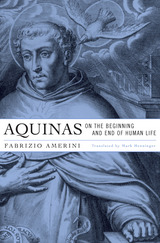
In contemporary discussions of abortion, both sides argue well-worn positions, particularly concerning the question, When does human life begin? Though often invoked by the Catholic Church for support, Thomas Aquinas in fact held that human life begins after conception, not at the moment of union. But his overall thinking on questions of how humans come into being, and cease to be, is more subtle than either side in this polarized debate imagines. Fabrizio Amerini—an internationally-renowned scholar of medieval philosophy—does justice to Aquinas’ views on these controversial issues.
Some pro-life proponents hold that Aquinas’ position is simply due to faulty biological knowledge, and if he knew what we know today about embryology, he would agree that human life begins at conception. Others argue that nothing Aquinas could learn from modern biology would have changed his mind. Amerini follows the twists and turns of Aquinas’ thinking to reach a nuanced and detailed solution in the final chapters that will unsettle familiar assumptions and arguments.
Systematically examining all the pertinent texts and placing each in historical context, Amerini provides an accurate reconstruction of Aquinas’ account of the beginning and end of human life and assesses its bioethical implications for today. This major contribution is available to an English-speaking audience through translation by Mark Henninger, himself a noted scholar of medieval philosophy.
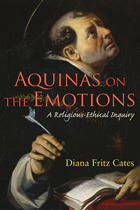
All of us want to be happy and live well. Sometimes intense emotions affect our happiness—and, in turn, our moral lives. Our emotions can have a significant impact on our perceptions of reality, the choices we make, and the ways in which we interact with others. Can we, as moral agents, have an effect on our emotions? Do we have any choice when it comes to our emotions?
In Aquinas on the Emotions, Diana Fritz Cates shows how emotions are composed as embodied mental states. She identifies various factors, including religious beliefs, intuitions, images, and questions that can affect the formation and the course of a person's emotions. She attends to the appetitive as well as the cognitive dimension of emotion, both of which Aquinas interprets with flexibility. The result is a powerful study of Aquinas that is also a resource for readers who want to understand and cultivate the emotional dimension of their lives.
Aquinas on Virtue: A Causal Reading is an original interpretation of one of the most compelling accounts of virtue in the Western tradition, that of the great theologian and philosopher Thomas Aquinas (1224–1274). Taking as its starting point Aquinas's neglected definition of virtue in terms of its "causes," this book offers a systematic analysis of Aquinas on the nature, genesis, and role of virtue in human life.
Drawing on connections and contrasts between Aquinas and contemporary treatments of virtue, Austin argues that Aquinas’s causal virtue theory retains its normative power today. As well as providing a synoptic account of Aquinas on virtue, the book includes an extended treatment of the cardinal virtue of temperance, an argument for the superiority of Aquinas's concept of "habit" over modern psychological accounts, and a rethinking of the relation between grace and virtue. With an approach that is distinctively theological yet strongly conversant with philosophy, this study will offer specialists a bold new interpretation of Aquinas’s virtue theory while giving students a systematic introduction with suggested readings from his Summa Theologiae and On the Virtues.
During the past few decades, high-profile cases like that of Terry Schiavo have fueled the public debate over forgoing or withdrawing artificial nutrition and hydration from patients in a persistent vegetative state (PVS). These cases, whether involving adults or young children, have forced many to begin thinking in a measured and careful way about the moral legitimacy of allowing patients to die. Can families forgo or withdraw artificial hydration and nutrition from their loved ones when no hope of recovery seems possible?
Many Catholics know that Catholic moral theology has formulated a well-developed and well-reasoned position on this and other end-of-life issues, one that distinguishes between "ordinary" and "extraordinary" treatment. But recent events have caused uncertainty and confusion and even acrimony among the faithful. In his 2004 allocution, Pope John Paul II proposed that artificial nutrition and hydration is a form of basic care, thus suggesting that the provision of such care to patients neurologically incapable of feeding themselves should be considered a moral obligation. The pope's address, which seemed to have offered a new development to decades of Catholic health care ethics, sparked a contentious debate among the faithful over how best to treat permanently unconscious patients within the tenets of Catholic morality.
In this comprehensive and balanced volume, Ronald Hamel and James Walter present twenty-one essays and articles, contributed by physicians, clergy, theologians, and ethicists, to reflect the spectrum of perspectives on the issues that define the Catholic debate. Organized into six parts, each with its own introduction, the essays offer clinical information on PVS and feeding tubes; discussions on the Catholic moral tradition and how it might be changing; ecclesiastical and pastoral statements on forgoing or withdrawing nutrition and hydration; theological and ethical analyses on the issue; commentary on Pope John Paul II's 2004 allocution; and the theological commentary, court decisions, and public policy resulting from the Clarence Herbert and Claire Conroy legal cases.
A valuable resource for students and scholars, this teachable volume invites theological dialogue and ethical discussion on one of the most contested issues in the church today.
READERS
Browse our collection.
PUBLISHERS
See BiblioVault's publisher services.
STUDENT SERVICES
Files for college accessibility offices.
RECENTLY PUBLISHED




UChicago Accessibility Resources
home | accessibility | search | about | contact us
BiblioVault ® 2001 - 2025
The University of Chicago Press