
 A SCHOLARLY BOOK REPOSITORY
13 start with A start with A
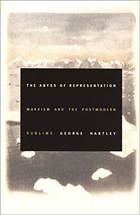
Hartley describes how modern theory from Kant through Lacan attempts to come to terms with the sublime limits of representation and how ideas developed with the Marxist tradition—such as Marx’s theory of value, Althusser’s theory of structural causality, or Zizek’s theory of ideological enjoyment—can be seen as variants of the sublime object. Representation, he argues, is ultimately a political problem. Whether that problem be a Marxist representation of global capitalism, a deconstructive representation of subaltern women, or a Chicano self-representation opposing Anglo-American images of Mexican Americans, it is only through this grappling with the negative, Hartley explains, that a Marxist theory of postmodernism can begin to address the challenges of global capitalism and resurgent imperialism.

A suspicious mind.
Sextus Empiricus (ca. AD 160–210), exponent of scepticism and critic of the Dogmatists, was a Greek physician and philosopher, pupil and successor of the medical sceptic Herodotus (not the historian) of Tarsus. He probably lived for years in Rome and possibly also in Alexandria and Athens. His three surviving works are Outlines of Pyrrhonism (three books on the practical and ethical scepticism of Pyrrho of Elis, ca. 360–275 BC, as developed later, presenting also a case against the Dogmatists); Against the Dogmatists (five books dealing with the Logicians, the Physicists, and the Ethicists); and Against the Professors (six books: Grammarians, Rhetors, Geometers, Arithmeticians, Astrologers, and Musicians). These two latter works might be called a general criticism of professors of all arts and sciences. Sextus’ work is a valuable source for the history of thought especially because of his development and formulation of former sceptic doctrines.
The Loeb Classical Library edition of Sextus Empiricus is in four volumes.
A suspicious mind.
Sextus Empiricus (ca. AD 160–210), exponent of scepticism and critic of the Dogmatists, was a Greek physician and philosopher, pupil and successor of the medical sceptic Herodotus (not the historian) of Tarsus. He probably lived for years in Rome and possibly also in Alexandria and Athens. His three surviving works are Outlines of Pyrrhonism (three books on the practical and ethical scepticism of Pyrrho of Elis, ca. 360–275 BC, as developed later, presenting also a case against the Dogmatists); Against the Dogmatists (five books dealing with the Logicians, the Physicists, and the Ethicists); and Against the Professors (six books: Grammarians, Rhetors, Geometers, Arithmeticians, Astrologers, and Musicians). These two latter works might be called a general criticism of professors of all arts and sciences. Sextus’ work is a valuable source for the history of thought especially because of his development and formulation of former sceptic doctrines.
The Loeb Classical Library edition of Sextus Empiricus is in four volumes.
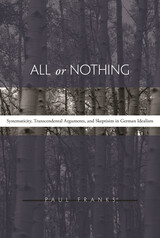
Interest in German Idealism--not just Kant, but Fichte and Hegel as well--has recently developed within analytic philosophy, which traditionally defined itself in opposition to the Idealist tradition. Yet one obstacle remains especially intractable: the Idealists' longstanding claim that philosophy must be systematic. In this work, the first overview of the German Idealism that is both conceptual and methodological, Paul W. Franks offers a philosophical reconstruction that is true to the movement's own times and resources and, at the same time, deeply relevant to contemporary thought.
At the center of the book are some neglected but critical questions about German Idealism: Why do Fichte, Schelling, and Hegel think that philosophy's main task is the construction of a system? Why do they think that every part of this system must derive from a single, immanent and absolute principle? Why, in short, must it be all or nothing? Through close examination of the major Idealists as well as the overlooked figures who influenced their reading of Kant, Franks explores the common ground and divergences between the philosophical problems that motivated Kant and those that, in turn, motivated the Idealists. The result is a characterization of German Idealism that reveals its sources as well as its pertinence--and its challenge--to contemporary philosophical naturalism.
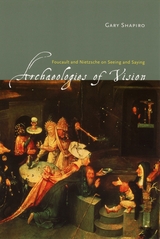
Shapiro explores the whole range of Foucault's writings on visual art, including the theory of visual resistance, the concept of the phantasm or simulacrum, and his interrogation of the relation of painting, language, and power in artists from Bosch to Warhol. Shapiro also shows through an excavation of little-known writings that the visual is a major theme in Nietzsche's thought. In addition to explaining the significance of Nietzsche's analysis of Raphael, Dürer, and Claude Lorrain, he examines the philosopher's understanding of the visual dimension of Greek theater and Wagnerian opera and offers a powerful new reading of Thus Spoke Zarathustra.
Archaeologies of Vision will be a landmark work for all scholars of visual culture as well as for those engaged with continental philosophy.
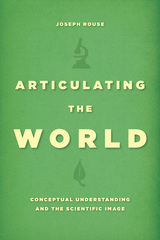
In Articulating the World, Joseph Rouse argues that the most pressing challenge for advocates of naturalism today is precisely this: to understand how to make sense of a scientific conception of nature as itself part of nature, scientifically understood. Drawing upon recent developments in evolutionary biology and the philosophy of science, Rouse defends naturalism in response to this challenge by revising both how we understand our scientific conception of the world and how we situate ourselves within it.

In 1972, philosopher of science Thomas Kuhn threw an ashtray at Errol Morris. This book is the result.
At the time, Morris was a graduate student. Now we know him as one of the most celebrated and restlessly probing filmmakers of our time, the creator of such classics of documentary investigation as The Thin Blue Line and The Fog of War. Kuhn, meanwhile, was—and, posthumously, remains—a star in his field, the author of The Structure of Scientific Revolutions, a landmark book that has sold well over a million copies and introduced the concept of “paradigm shifts” to the larger culture. And Morris thought the idea was bunk.
The Ashtray tells why—and in doing so, it makes a powerful case for Morris’s way of viewing the world, and the centrality to that view of a fundamental conception of the necessity of truth. “For me,” Morris writes, “truth is about the relationship between language and the world: a correspondence idea of truth.” He has no patience for philosophical systems that aim for internal coherence and disdain the world itself. Morris is after bigger game: he wants to establish as clearly as possible what we know and can say about the world, reality, history, our actions and interactions. It’s the fundamental desire that animates his filmmaking, whether he’s probing Robert McNamara about Vietnam or the oddball owner of a pet cemetery. Truth may be slippery, but that doesn’t mean we have to grease its path of escape through philosophical evasions. Rather, Morris argues powerfully, it is our duty to do everything we can to establish and support it.
In a time when truth feels ever more embattled, under siege from political lies and virtual lives alike, The Ashtray is a bracing reminder of its value, delivered by a figure who has, over decades, uniquely earned our trust through his commitment to truth. No Morris fan should miss it.
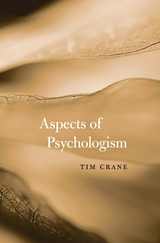
Aspects of Psychologism is a penetrating look into fundamental philosophical questions of consciousness, perception, and the experience we have of our mental lives. Psychologism, in Tim Crane's formulation, presents the mind as a single subject-matter to be investigated not only empirically and conceptually but also phenomenologically: through the systematic examination of consciousness and thought from the subject's point of view.
How should we think about the mind? Analytical philosophy tends to address this question by examining the language we use to talk about our minds, and thus translates our knowledge of mind and consciousness into knowledge of the concepts which this language embodies. Psychologism rejects this approach. The philosophy of mind, Crane believes, has become too narrow in its purely conceptual focus on the logical and linguistic formulas that structure thought. We cannot assume that the categories needed to understand the mind correspond absolutely with such semantic categories. A central claim of Crane's psychologism is that intentionality--the "aboutness" or "directedness" of the mind--is essential to all mental phenomena. In addition, Crane responds to proponents of materialist doctrines about consciousness and defends the claim that perception can represent the world in a non-conceptual, non-propositional way.
Philosophers must take more seriously the findings of psychology and phenomenology, Crane contends. An investigation of mental phenomena from this broader viewpoint opens up philosophy to a more realistic and plausible account of the mind's nature.

Why did abstraction dominate American art, social science, and natural science in the mid-twentieth century? Why, despite opposition, did abstraction and theoretical knowledge flourish across a diverse set of intellectual pursuits during the Cold War? In recovering the centrality of abstraction across a range of modernist projects in the United States, Alma Steingart brings mathematics back into the conversation about midcentury American intellectual thought. The expansion of mathematics in the aftermath of World War II, she demonstrates, was characterized by two opposing tendencies: research in pure mathematics became increasingly abstract and rarified, while research in applied mathematics and mathematical applications grew in prominence as new fields like operations research and game theory brought mathematical knowledge to bear on more domains of knowledge. Both were predicated on the same abstractionist conception of mathematics and were rooted in the same approach: modern axiomatics.
For American mathematicians, the humanities and the sciences did not compete with one another, but instead were two complementary sides of the same epistemological commitment. Steingart further reveals how this mathematical epistemology influenced the sciences and humanities, particularly the postwar social sciences. As mathematics changed, so did the meaning of mathematization.
Axiomatics focuses on American mathematicians during a transformative time, following a series of controversies among mathematicians about the nature of mathematics as a field of study and as a body of knowledge. The ensuing debates offer a window onto the postwar development of mathematics band Cold War epistemology writ large. As Steingart’s history ably demonstrates, mathematics is the social activity in which styles of truth—here, abstraction—become synonymous with ways of knowing.
READERS
Browse our collection.
PUBLISHERS
See BiblioVault's publisher services.
STUDENT SERVICES
Files for college accessibility offices.
RECENTLY PUBLISHED




UChicago Accessibility Resources
home | accessibility | search | about | contact us
BiblioVault ® 2001 - 2024
The University of Chicago Press