logo for American Library Association
Becoming a Media Mentor
A Guide for Working with Children and Families
Cen Campbell
American Library Association, 2016

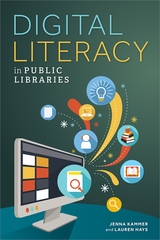
front cover of Digital Literacy in Public Libraries
Digital Literacy in Public Libraries
Jenna Kammer and Lauren Hays
American Library Association, 2026
Today's libraries are thoroughly digital environments, not only storing and preserving written information electronically, but also emphasizing digital access to information as a pathway to equitably educating the community on issues of health, employment, education, and local history. And fostering patrons' ability to effectively use digital tools for information and personal enrichment is a natural fit for public libraries, complimenting other initiatives like information literacy and media literacy. This book provides a holistic view of digital literacy support across the full spectrum of the public library, using real-world examples to help public libraries transform the work of digital literacy from answering on-the-fly tech questions to implementing full scale digital literacy programs which are integrated throughout the library. Public library workers, library board members, and those who want to understand more about the digital literacy imperative within public libraries will
  • delve into the concept of digital literacy, the ways in which it empowers individuals in digital systems of information, and how it fits in with other kinds of literacy;
  • find ideas for effective digital literacy technical support, programming, services, spaces, collection development, outreach, and more;
  • learn how to measure the impact of digital literacy initiatives, identify gaps within the community where the library can make an impact, and overcome challenges;
  • discover guidance on building partnerships, both internal and external, and finding additional sources of funding to expand digital literacy opportunities within the scope of what is already available;
  • receive practical advice from the "Ask the Expert" sidebars throughout the book, where practitioners share their knowledge and experience; and
  • get adaptable tools such as sample language, an expenditure budget, an individual needs assessment, a digital literacy readiness checklist, survey instruments, and a lesson plan template that can be used for digital literacy programming.
[more]

logo for American Library Association
Information Literacy Instruction that Works
A Guide to Teaching by Discipline and Student Population
Patrick Ragains
American Library Association, 2013

logo for American Library Association
A Matter of Facts
The Value of Evidence in an Information Age
Laura A. Millar
American Library Association, 2019
“Like Orwell and Bradbury, like Stanley and Siskind, Laura Millar has written a book that people in the future will look back on and say, ‘This is one of the books that helped us to survive until a new era.’” — from the Foreword by Lee McIntyre

The safeguarding of authentic facts is essential, especially in this disruptive Orwellian age, where digital technologies have opened the door to a post-truth world in which “alternative facts” can be so easily accepted as valid. And because facts matter, evidence matters. In this urgent manifesto, archives luminary Millar makes the case that authentic and accurate records, archives, data, and other sources of documentary proof are crucial in supporting and fostering a society that is respectful, democratic, and self-aware. An eye-opening treatise for the general public, an invaluable resource for archives students, and a provocative call-to-arms for information and records professionals, Millar’s book

  • explains the concept of evidence and discusses the ways in which records, archives, and data are not just useful tools for our daily existence but also essential sources of evidence both today and in the future;
  • includes plentiful examples that illustrate the critical role evidence plays in upholding rights, enforcing responsibilities, tracing family or community stories, and capturing and sharing memories; and
  • examines the impact of digital technologies on how records and information are created and used.

With documentary examples ranging from Mesopotamian clay tablets to World War II photographs to today’s Twitter messages and Facebook posts, Millar’s stirring book will encourage readers to understand more fully the importance of their own records and archives, for themselves and for future generations.

[more]

logo for American Library Association
Metaliteracy in Practice
Trudi E. Jacobson
American Library Association, 2015

logo for American Library Association
Teaching Information Literacy
50 Standards-Based Exercises for College Students
Joanna M. Burkhardt
American Library Association, 2010

logo for American Library Association
Using Libguides to Enhance Library Services
Aaron Dobbs
American Library Association, 2013

logo for American Library Association
Using Technology to Teach Information Literacy
American Library Association
American Library Association, 2008


Send via email Share on Facebook Share on Twitter