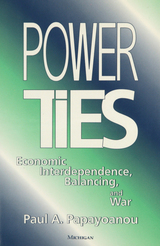
Power Ties
Economic Interdependence, Balancing, and War
Paul A. Papayoanou
University of Michigan Press, 1999
Will the growth of economic interdependence since the Second World War help to maintain the peace that we have seen for more than fifty years among the great powers? Some argue that the benefits that come from being integrated into today's world economy make it unlikely that countries will pursue aggressive policies. Others are not so sanguine, arguing that international economic ties have little effect on the making of national security strategies. Power Ties contradicts both arguments. Analyzing the history of the great-power system since the late nineteenth century, Paul Papayoanou shows that international economic relations have a significant impact on states's security strategies. A great power's economic ties generate powerful domestic economic interests that influence a leader's ability to mobilize support and resources for credibly opposing threatening powers in the international system. This accounts for the strength or weakness of alliance commitments and defense expenditures, and in turn, the likelihood that aspiring revisionist powers will be deterred from initiating a military offensive that upsets the territorial status quo. Power Ties also revises much of the conventional wisdom about the pacifying effects of economic interdependence, for it demonstrates that extensive economic ties are not necessarily associated with peace and can make war more likely. Papayoanou's union of theory and history provides a bold new interpretation of the most significant developments in international politics over the past century. This book will be of interest to students and scholars of political science, history, and international relations.
[more]