
 A SCHOLARLY BOOK REPOSITORY
Results by Title
2 books about Disturbance
2 books about Disturbance
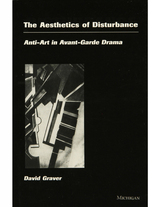
Aesthetics of Disturbance
Anti-Art in Avant-Garde Drama
David Graver
University of Michigan Press, 1995
The wild innovations of the early twentieth-century avant-garde have been widely celebrated for their influence on the course of experimental drama but rarely examined closely and systematically. Through an exploration of the plays from Germany, France, and England, The Aesthetics of Disturbance discusses modernism and the avant-garde, the relationship of drama to art movements such as expressionism, dada, and surrealism, and the interactions of visual, literary, and performance art.Beginning with a survey of the history and theory of avant-garde art, David Graver critically juxtaposes important competing interpretations of the avant-garde, establishes basic distinctions between forms of avant-garde art, compares the aesthetic interests of the avant- garde to those of modernism, and discusses the relationship between the avant-garde and drama. Then, through close readings of the works of five preeminent avant-garde playwrights and visual artists - Oskar Kokoschka, Gottfried Benn, Raymond Roussel, Roger Vitrac, and Wyndham Lewis - he examines the innovations in dramatic literature carried out by these visionaries and finally relates them to the innovations in theater articulated by Brecht and Artaud. Graver argues that anti-art principles, most noticeable in the confrontational tactics of dada performance, can also be found within literary dramatic texts, where they create an "aesthetics of disturbance" that destabilizes the integrity of the work without allowing it to self-destruct."A corrective to the oft-repeated, over-simple idea that anti-art consists of the same destructive gesture repeated in different forms. This is a useful book that fills a gap, both conceptually and in terms of the figures discussed." --Philip Auslander, Georgia Institute of Technology"Original, important, well-done." --Anthony Kubiak, Harvard University
[more]
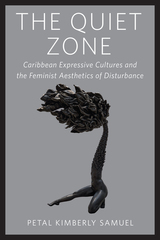
The Quiet Zone
Caribbean Expressive Cultures and the Feminist Aesthetics of Disturbance
Petal Kimberly Samuel
Rutgers University Press, 2026
A serene beach. The classroom of an elite private school. The still nights in an upscale residential neighborhood. An acclaimed poet with a quiet, dignified mode of address. The sonic etiquette and experience of quiet is integral to each of these scenes. The Quiet Zone examines what the emergence of quiet as an elite aesthetic, privilege, and entitlement means for minoritized people who are often narrated as loud, disruptive, and disturbing, sonically, visually, and otherwise. Taking the Caribbean and its diasporas as its key sites of study, the book explores what we can learn from efforts to transform the region into the quintessential site of quiet leisure, in part, through the enactment of regimes of sonic discipline and surveillance directed against its majority Black population. Analyzing the work of Afro-Caribbean artists that catalog and critique sonic surveillance, the book questions the ways that quiet gets produced both as a regulatory ideal of racial, gender, sexual, national, and civilizational belonging and as a universal object of desire
[more]
READERS
Browse our collection.
PUBLISHERS
See BiblioVault's publisher services.
STUDENT SERVICES
Files for college accessibility offices.
RECENTLY PUBLISHED


UChicago Accessibility Resources
home | accessibility | search | about | contact us
BiblioVault ® 2001 - 2026
The University of Chicago Press