
 A SCHOLARLY BOOK REPOSITORY

Today, the work of government often involves coordination at the federal, state, and local levels as well as with contractors and citizens’ groups. This process of governance across levels of government, jurisdictions, and types of actors is called intergovernmental relations, and intergovernmental management (IGM) is the way work is administered in this increasingly complex system. Leading authority Robert Agranoff reintroduces intergovernmental management for twenty-first-century governance to a new generation of scholars, students, and practitioners.
Agranoff examines IGM in the United States from four thematic perspectives: law and politics, jurisdictional interdependency, multisector partners, and networks and networking. Common wisdom holds that government has “hollowed out” despite this present era of contracting and networked governance, but he argues that effective intergovernmental management has never been more necessary or important. He concludes by offering six next steps for intergovernmental management.
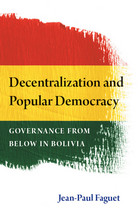
Bolivia decentralized in an effort to deepen democracy, improve public services, and make government more accountable. Unlike many countries, Bolivia succeeded. Over the past generation, public investment shifted dramatically toward primary services and resource distribution became far more equitable, partly due to the creation of new local governments. Many municipalities responded to decentralization with transparent, accountable government, yet others suffered ineptitude, corruption, or both. Why? Jean-Paul Faguet combines broad econometric data with deep qualitative evidence to investigate the social underpinnings of governance. He shows how the interaction of civic groups and business interests determines the quality of local decision making.
In order to understand decentralization, Faguet argues, we must understand governance from the ground up. Drawing on his findings, he offers an evaluation of the potential benefits of decentralization and recommendations for structuring successful reform.

Press introduces the primary debate in this confrontation as a choice between political centralization and decentralization. Do citizens faced with environmental crises tend to look first to a centralized leadership for solutions or do they tend to respond at a more local and grassroots level? What is the role of technical expertise in this process and how does it effect public participation in these matters? Do confrontations over environmental issues increase support for a more fully democratic decisionmaking process? Representing social, political, and economic challenges to democracy, these and other questions are then investigated empirically through analyses of case studies. Focusing on two recent controversies in the western United States, ancient-forest logging in Oregon and California and hazardous waste management in California, and drawing on in-depth interviews with individuals involved, Press clarifies the relationship between environmentalism and democracy and explores the characteristics of "new" democratic forms of environmental policymaking.
Revealing a need for a more decentralized process and increased individual and collective action in response to environmental crises, Democratic Dilemmas in the Age of Ecology will be of interest to a wide range of audiences, from scholars concerned with applications of democratic theory, to activists and policymakers seeking to change or implement environmental policy.
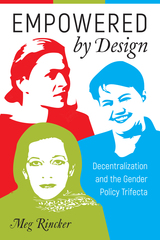
In her probing book, Empowered by Design, Meg Rincker asks, Under what conditions will decentralization lead to women’s empowerment in countries around the globe? Using three case studies—the United Kingdom, Poland, and Pakistan—she shows how decentralization reforms create new institutional offices as power shifts from the national level to a meso-tier level, which is located between the national government and local municipalities. These shifts impact a country’s political, administrative, and fiscal reforms as well as women’s representation.
Rincker argues that this shift should be inclusive of women—or at least lead more women to participate in institutions—but this is not always the case. She indicates that three conditions, “the gender policy trifecta,” need to be met to achieve this: legislative gender quotas, women’s policy agencies, and gender-responsive budgeting at the level of governance in question. Rincker's innovative research uses original comparative data about what women want, quantitative cross-national analyses, and interviews with women’s organization leaders and politicians to show how cross-institutional policymaking can empower women.
Rincker’s fine-grained analysis makes a significant contribution to the study of representation and gendered implications of decentralization, as well as how representatives go about understanding and aggregating our diverse policy preferences.

Based on interviews with more than 1,200 mayors, local officials, and farmers in 390 municipal territories in four Latin American nations, the authors analyze the ways in which different forms of decentralization affect the governance arrangements for rural development “on the ground.” Their comparative analysis suggests that rural development outcomes are systemically linked to locally negotiated institutional arrangements—formal and informal—between government officials, NGOs, and farmer groups that operate in the local sphere. They find that local-government actors contribute to public services that better assist the rural poor when local actors cooperate to develop their own institutional arrangements for participatory planning, horizontal learning, and the joint production of services.
This study brings substantive data and empirical analysis to a discussion that has, until now, more often depended on qualitative research in isolated cases. With more than 60 percent of Latin America’s rural population living in poverty, the results are both timely and crucial.

Networked Business and Politics in Decentralizing Indonesia evaluates three cases of deep-seated political conflict and intrigue including central government, local governments, and multinational companies. It looks at how the structure of the national political economy has changed as the result of local politicians becoming involved in disputes with the national government over control of natural resources. It also analyzes how these changes will affect the distribution of wealth in the country as well as Indonesia’s evolving democratic politics and modes of governance.
Fuller first untangles the economic and cultural currents that have eroded the efficacy of—and our trust in—large institutions over the past half century. From there we meet intrepid leaders who have been doing things differently. Traveling from a charter school in San Francisco to a veterans service network in Iowa, from a Pennsylvania health-care firm to the Manhattan branch of a Swedish bank, he explores how creative managers have turned local staff loose to craft inventive practices, untethered from central rules and plain-vanilla routines. By holding their successes and failures up to the same analytical light, he vividly reveals the key cornerstones of social organization on which motivating and effective decentralization depends. Ultimately, he brings order and evidence to the often strident debates about who has the power—and on what scale—to structure how we work and live locally.
Written for managers, policy makers, and reform activists, Organizing Locally details the profound decentering of work and life inside firms, unfolding across postindustrial societies. Its fresh theoretical framework explains resurging faith in decentralized organizations and the ingredients that deliver vibrant meaning and efficacy for residents inside. Ultimately, it is a synthesizing study, a courageous and radical new way of conceiving of American vitality, creativity, and ambition.

The U.S. death penalty is a peculiar institution, and a uniquely American one. Despite its comprehensive abolition elsewhere in the Western world, capital punishment continues in dozens of American states– a fact that is frequently discussed but rarely understood. The same puzzlement surrounds the peculiar form that American capital punishment now takes, with its uneven application, its seemingly endless delays, and the uncertainty of its ever being carried out in individual cases, none of which seem conducive to effective crime control or criminal justice. In a brilliantly provocative study, David Garland explains this tenacity and shows how death penalty practice has come to bear the distinctive hallmarks of America’s political institutions and cultural conflicts.
America’s radical federalism and local democracy, as well as its legacy of violence and racism, account for our divergence from the rest of the West. Whereas the elites of other nations were able to impose nationwide abolition from above despite public objections, American elites are unable– and unwilling– to end a punishment that has the support of local majorities and a storied place in popular culture.
In the course of hundreds of decisions, federal courts sought to rationalize and civilize an institution that too often resembled a lynching, producing layers of legal process but also delays and reversals. Yet the Supreme Court insists that the issue is to be decided by local political actors and public opinion. So the death penalty continues to respond to popular will, enhancing the power of criminal justice professionals, providing drama for the media, and bringing pleasure to a public audience who consumes its chilling tales.
Garland brings a new clarity to our understanding of this peculiar institution– and a new challenge to supporters and opponents alike.
As if by unseen signal toward the end of the 1980s, many Latin American governments suddenly transferred money and decision-making power to local municipalities. At the same time, national authorities allowed local governments to choose their leaders in free and open elections. The resulting revolution has been profound in its reach and stunning in the silent shift of power from central to local authorities.
The Quiet Revolution traces the growth and effects of decentralization and democratization in Latin America throughout the 1980s and 1990s. Based on first-hand accounts from mayors, local officials, and neighborhood leaders, Tim Campbell focuses on those cities and towns that made the most of their new intergovernmental arrangements. He further argues that the reforms, which are vital to long-term sustainable growth in the region, are in danger of being smothered by current policy responses from national and international institutions. Campbell's research, conducted over a ten-year span, counters conventional wisdom about the role of development banks in the process of state reform and offers timely insights into similar events taking place in other parts of the world.

Using new data on ethnicity and sub-national discrimination in India, national and state archives, parliamentary records, cross-national analysis and her original fieldwork, Lacina explains ethnoterritorial politics as a three-sided interaction of the center and rival interests in the periphery. Ethnic entrepreneurs use militancy to create national political pressure in favor of their goals when the prime minister lacks clear electoral reasons to court one regional group over another. Second, ethnic groups rarely win autonomy or mobilize for violence in regions home to electorally influential anti-autonomy interests. Third, when a regional ethnic majority is politically important to the prime minister, its leaders can deter autonomy demands within their borders, while actively discriminating against minorities.
Rival Claims challenges the conventional beliefs that territorial autonomy demands are a reaction to centralized power and that governments resist autonomy to preserve central prerogatives. The center has allegiances in regional politics, and ethnoterritorial violence reflects the center’s entanglement with rival interests in the periphery.
Michael DiLeo and Eleanor Smith look closely and discover that there are profound truths embedded in the folk tradition. And equally profound misconceptions. Probing the surprising and little-known history of the split-state movement, the authors find that its underlying sentiments have been part of California politics and culture since territorial days. What the issues are today, what their implications are for our lives in the 1980s, and what we can do about them are the focus of this fascinating book.
The current water controversy, perhaps the most crucial in the state's history, cannot be resolved until the two Californias make peace with each other. No other book confronts the environmental and philosophical problems that plague California and have nationwide echoes as thoroughly and as intelligently as Two Californias does. Two Californias is entertaining – and it also thought-provoking. It is very likely to change the ways we think about living together and sharing resources in the 1980s.
Now that responsibility for welfare policy has devolved from Washington to the states, Pamela Winston examines how the welfare policymaking process has changed. Under the welfare reform act of 1996, welfare was the first and most basic safety net program to be sent back to state control. Will the shift help or further diminish programs for low-income people, especially the millions of children who comprise the majority of the poor in the United States?
In this book, Winston probes the nature of state welfare politics under devolution and contrasts it with welfare politics on the national level. Starting with James Madison's argument that the range of perspectives and interests found in state policymaking will be considerably narrower than in Washington, she analyzes the influence of interest groups and other key actors in the legislative process at both the state and national levels. She compares the legislative process during the 104th Congress (1995-96) with that in three states — Maryland, Texas, and North Dakota — and finds that the debates in the states saw a more limited range of participants, with fewer of them representing poor people, and fewer competing ideas.
The welfare reform bill of 1996 comes up for renewal in 2002. At stake in the U.S. experiment in welfare reform are principles of equal opportunity, fairness, and self-determination as well as long-term concerns for political and social stability. This investigation of the implications of the changing pattern of welfare politics will interest scholars and teachers of social policy, federalism, state politics, and public policy generally, and general readers interested in social policy, state politics, social justice, and American politics.
READERS
Browse our collection.
PUBLISHERS
See BiblioVault's publisher services.
STUDENT SERVICES
Files for college accessibility offices.
RECENTLY PUBLISHED







UChicago Accessibility Resources
home | accessibility | search | about | contact us
BiblioVault ® 2001 - 2024
The University of Chicago Press