
front cover of A Century of International Crisis Behavior
A Century of International Crisis Behavior
Edited by Jonathan Wilkenfeld, Kyle Beardsley, and Patrick James
University of Michigan Press, 2026

Perhaps more than ever, we need to invest in the study of the causes and consequences of crises. Since its founding in 1975, the International Crisis Behavior (ICB) Project has aimed to better equip academics, policymakers, and the next generation of engaged citizens to make sense of why crises arise and how they can be more effectively managed and prevented. The ICB Project’s data holdings consist of full-length qualitative case studies, along with an expanding range of quantitative datasets that include information regarding the characteristics of the states in crisis, crisis behavior, attempts at third-party crisis management, the role of nonstate actors, and the system-level context.

A Century of International Crisis Behavior summarizes the evolving patterns of international crisis behavior in the more than 500 cases cataloged since 1918, provides an accounting of the state of the scholarship to make sense of the patterns, and presents new findings that advance our understanding. Chapters are grouped according to their level of analysis: studies of systems, dyads, and states. The authors highlight what we have learned and what we have yet to learn regarding the prevention, escalation, and de-escalation of international crises.
[more]

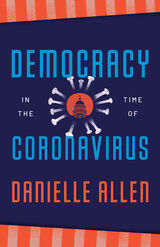
front cover of Democracy in the Time of Coronavirus
Democracy in the Time of Coronavirus
Danielle Allen
University of Chicago Press, 2022
From a leading political thinker, this book is both an invaluable playbook for meeting our current moment and a stirring reflection on the future of democracy itself.
 
The COVID-19 pandemic has demonstrated some of the strengths of our society, including the rapid development of vaccines. But the pandemic has also exposed its glaring weaknesses, such as the failure of our government to develop and quickly implement strategies for tracing and containing outbreaks as well as widespread public distrust of government prompted by often confusing and conflicting choices—to mask, or not to mask. Even worse is that over half a million deaths and the extensive economic devastation could have been avoided if the government had been prepared to undertake comprehensive, contextually-sensitive policies to stop the spread of the disease.
 
In Democracy in the Time of Coronavirus, leading political thinker Danielle Allen untangles the US government’s COVID-19 victories and failures to offer a plan for creating a more resilient democratic polity—one that can better respond to both the present pandemic and future crises. Looking to history, Allen also identifies the challenges faced by democracies in other times that required strong government action. In an analysis spanning from ancient Greece to the Reconstruction Amendments and the present day, Allen argues for the relative effectiveness of collaborative federalism over authoritarian compulsion and for the unifying power of a common cause. But for democracy to endure, we—as participatory citizens—must commit to that cause: a just and equal social contract and support for good governance.
[more]

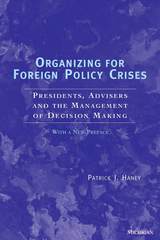
front cover of Organizing for Foreign Policy Crises
Organizing for Foreign Policy Crises
Presidents, Advisers, and the Management of Decision Making
Patrick J. Haney
University of Michigan Press, 2002
Presidents often assemble ad hoc groups of advisers to help them make decisions during foreign policy crises. These advisers may include the holders of the traditional foreign policy positions--secretaries of state and defense--as well as others from within and without the executive branch. It has never been clear what role these groups play in the development of policy. In this landmark study, Patrick Haney examines how these crisis decision groups were structured and how they performed the tasks of providing information, advice, and analysis to the president. From this, Haney investigates the links between a president's crisis management structure and the decision-making process that took place during a foreign policy crisis.
Haney employs case studies to examine the different ways presidents from Truman through Bush used crisis decision-making groups to help manage foreign policy crises. He looks at the role of these groups in handling the Berlin blockade in 1948, the Suez Crisis in 1956, the Tet offensive in 1968, the Yom Kippur War in 1973, and the Panama invasion in 1989, among other crises. He extends our understanding of the organization, management and behavior of the decision-making groups presidents assemble during foreign policy crises. This book will appeal to scholars of the American presidency and American foreign policy.
Patrick Haney is Assistant Professor of Political Science, Miami University of Ohio.
[more]

front cover of Ronald Reagan and the House Democrats
Ronald Reagan and the House Democrats
Gridlock, Partisanship, and the Fiscal Crisis
Karl Gerard Brandt
University of Missouri Press, 2009
When Democrats in the House of Representatives locked horns with President Ronald Reagan over the latter’s fiscal policies, the ensuing conflict reinforced the seismic shift in the political landscape that the 1980 election had brought. Karl Brandt now tells the story of how the New Deal Democratic coalition was able to sustain itself in the face of an unprecedented Republican assault—in a conflict whose reverberations are still being felt today.
            After a bipartisan conservative House coalition passed Reagan’s budget and tax cuts in 1981, conservative Democrats became worried about the increasingly large deficits produced by Reaganomics and questioned the administration’s spending priorities. In one of the few studies of congressional politics in the 1980s, Brandt describes the House Democratic leadership’s efforts to rebuild party unity while facing challenges from conservative Democrats, the Reagan administration, and the emerging fiscal crisis. He tells how Democrats worked hard to rein in party conservatives, to craft consensus-oriented policies palatable to all Democrats, and over the coming years to force the president and the Senate to compromise over fiscal policy.
            Drawing on primary source materials unavailable in the 1980s—including transcripts from closed-door meetings and internal House documents—Brandt chronicles the events that resulted in the deepening of the fiscal crisis, examines the growth of an intensely partisan political environment, and provides insight into the dynamics of creating a national budget. He cuts through conservative rhetoric to show how Reagan’s fiscal policies deepened federal deficits and reveals how the partisan struggles of the Reagan years redefined the Democrats along more centrist lines.
            When the dust had settled, the Democratic Party had become more unified in the face of budget conflict and had proved that it could practice fiscal conservatism and make tough budget choices when necessary. Carefully argued and thoroughly researched, Brandt’s work brings historical perspective to this important chapter in recent history as it explores conflicting visions of the economy, American society, and the very future of the nation.
[more]

front cover of Sovereignty in Ruins
Sovereignty in Ruins
A Politics of Crisis
George Edmondson and Kalus Mladek, editors
Duke University Press, 2017
Featuring essays by some of the most prominent names in contemporary political and cultural theory, Sovereignty in Ruins presents a form of critique grounded in the conviction that political thought is itself an agent of crisis. Aiming to develop a political vocabulary capable of critiquing and transforming contemporary political frameworks, the contributors advance a politics of crisis that collapses the false dichotomies between sovereignty and governmentality and between critique and crisis. Their essays address a wide range of topics, such as the role history plays in the development of a politics of crisis; Arendt's controversial judgment of Adolf Eichmann; Strauss's and Badiou's readings of Plato's Laws; the acceptance of the unacceptable; the human and nonhuman; and flesh as a biopolitical category representative of the ongoing crisis of modernity. Altering the terms through which political action may take place, the contributors think through new notions of the political that advance countermodels of biopolitics, radical democracy, and humanity.

Contributors. Judith Butler, George Edmondson, Roberto Esposito, Carlo Galli, Klaus Mladek, Alberto Moreiras, Andrew Norris, Eric L. Santner, Adam Sitze, Carsten Strathausen, Rei Terada, Cary Wolfe
[more]


Send via email Share on Facebook Share on Twitter