
front cover of Beneath the Surface
Beneath the Surface
A Transnational History of Skin Lighteners
Lynn M. Thomas
Duke University Press, 2020
For more than a century, skin lighteners have been a ubiquitous feature of global popular culture—embraced by consumers even as they were fiercely opposed by medical professionals, consumer health advocates, and antiracist thinkers and activists. In Beneath the Surface, Lynn M. Thomas constructs a transnational history of skin lighteners in South Africa and beyond. Analyzing a wide range of archival, popular culture, and oral history sources, Thomas traces the changing meanings of skin color from precolonial times to the postcolonial present. From indigenous skin-brightening practices and the rapid spread of lighteners in South African consumer culture during the 1940s and 1950s to the growth of a billion-dollar global lightener industry, Thomas shows how the use of skin lighteners and experiences of skin color have been shaped by slavery, colonialism, and segregation as well as by consumer capitalism, visual media, notions of beauty, and protest politics. In teasing out lighteners’ layered history, Thomas theorizes skin as a site for antiracist struggle and lighteners as a technology of visibility that both challenges and entrenches racial and gender hierarchies.
[more]

front cover of Domesticating Brown
Domesticating Brown
Movements of Racial Imagination
Christopher B. Patterson
Duke University Press, 2026
Domesticating Brown interrogates the slippery senses that brownness as a racial form has manifested over time, charting its transitions across historical colonial contexts and into the transpacific dynamics of contemporary empire. Christopher B. Patterson rethinks universalist definitions of race to consider the constant movements in racial contexts, meanings, and practices that “brownness” reveals: as a site for the ungovernable brown mass, as peoples marked for domestication through strategies of colonial containment, and as the complex shades that reveal troubling genealogies and shameful intimacies. Tracing the emergences and transformations of brownness in various contexts of transpacific encounter—from the Mongol Empire to Filipino plantation migration in Hawaiʻi, from the imperial management of Hong Kong to contemporary brown authorship—Domesticating Brown explores how colonial subjects and other marginalized peoples have strategized ways of resisting and reversing dominating notions of brownness through art, story, and embodied difference.
[more]

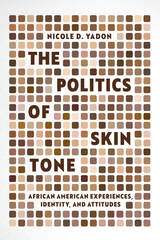
front cover of The Politics of Skin Tone
The Politics of Skin Tone
African American Experiences, Identity, and Attitudes
Nicole D. Yadon
University of Chicago Press, 2025

A nuanced examination of the salience of skin tone within African American politics.

Research shows that skin tone is associated with significant differences in life experiences. On average, African Americans with darker skin earn lower wages, suffer worse health outcomes, and endure more negative criminal justice experiences than lighter-skinned African Americans. Nicole D. Yadon conceptualizes skin tone as one facet of the multidimensional construct of race that powerfully influences racialized experiences which, in turn, can influence political identities and attitudes.

Drawing on evidence from one hundred in-depth interviews, multiple surveys, and a survey experiment, The Politics of Skin Tone investigates the political associations of skin tone. Yadon finds that skin tone correlates with political attitudes, particularly on issues where color-based disparities are especially pronounced such as criminal justice. Moreover, a sizable number of African Americans adopt a skin tone-based identity. In an era of shifting racial boundaries and growing color-based discrimination, The Politics of Skin Tone examines the implications for both scholars and policymakers.

[more]


Send via email Share on Facebook Share on Twitter