front cover of Alibi Lullaby
Alibi Lullaby
Norma Cole
Omnidawn, 2025
A collection of poems that embrace musicality and locate the patterns of ancient songs in the body, nature, and world events.
 
Alibi, in Latin, meant “elsewhere,” and “lullaby”—from lull, to soothe, and bye, near, close by—has elements linguistic elements that appear across cultures. Music, from ancient songs recorded on tables to contemporary compositions, share related framing elements that have persisted across time: formal patterns and rhythms, peaceful and hypnotic movements, and elements of terror arising from the moving frontier of “thrill, dread, certainty.”
 
In this collection, Norma Cole considers the ancient and transcendent patterns of music, finding them through nature, heart sounds, the spectral elegance of blood flow, the murmur of melody, and many diverse patterns and beats. Sounds of summer, massacres, “empathy through distress,” unknowing, energy, suspense, and fragility echo throughout the poems and other writings. Drawing on a poetics that embraces formal freefall and looks forward while holding up the shifting mirror of memory, Alibi Lullaby is a lyrical montage at the edges of musicality.
 
[more]

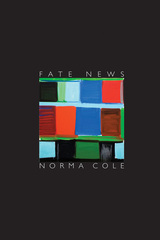
front cover of Fate News
Fate News
Norma Cole
Omnidawn, 2018
All timing all the time! Fate News is poetry in the crosshairs of action (kairos) and clock time (chronos). With a topical setlist in four sections, “Local,” “On-Going,” “Stay Songs,” and “Harmolodics,” Fate News relentlessly pierces the surface of lyric gesture. Its osmotic exchanges and searching encounters vibrate with the clarity of fiercely delicate shouts and murmurs, undertones and overtones. The vision of “Mount Fiasco” is on fire.
[more]

logo for Omnidawn
Spinoza in Her Youth
Norma Cole
Omnidawn, 2002
Norma Cole's rich and rigorous poems delight in and disrupt the framing structures of language, memory, history, so as to inhabit new fluencies of possibility. Informed by a diversity of subject matter (including emotional, political, philosophic), each poem finds its balance of form and content upon the knifepoint of a lyric integrity that is as responsive to the gravity of experience as it is to the fallibility of our means of representing it.
[more]

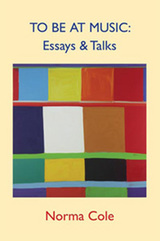
front cover of To Be At Music
To Be At Music
Essays & Talks
Norma Cole
Omnidawn, 2010
To Be At Music is the first collection of essays by Norma Cole, who is one of our most respected poets writing in the innovative tradition, as well as an esteemed translator and visual artist. These 21 prose pieces reflect her inimitable ability to make the critical essay an art form that engages both the sensual and the cerebral, the aural and the visual, the analytic and the intuitive nature of her readers. Many of these are essays or talks written in response to invitations to discuss the works of writers and artists such as Hans Christian Andersen, Robin Blaser, Edmond Jabès, Mina Loy, Lorine Niedecker, George Oppen, Stanley Whitney, and Christa Wolf. Each offers Cole's unique appreciation of what it means to read, to interact with a work of art, to write, or to translate, and to perceive each activity as a way to attune oneself anew to the world that is both within and beyond our expected methods of understanding.
[more]

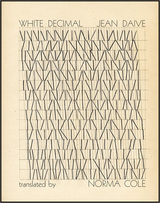
front cover of White Decimal
White Decimal
Jean Daive
Omnidawn, 2017
“The publication of Décimale blanche in 1967 marked a major shift in French poetry, introducing an entirely new sensibility. Fifty years later, Norma Cole’s superb new translation is no less exciting. Not only is it a masterful rendition of this classic, capturing all its spare force and uncanny grace, but it also stands in its own right as an important contribution to American poetry. White Decimal is a striking literary event, and an extremely beautiful one.” —Cole Swensen, author of Noise That Stays Noise
[more]

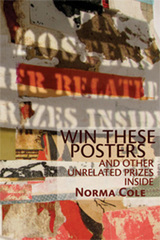
front cover of Win These Posters and Other Unrelated Prizes Inside
Win These Posters and Other Unrelated Prizes Inside
Norma Cole
Omnidawn, 2012
Win These Posters and Other Unrelated Prizes Inside opens with a foreword, an envoi laying out the concerns of the book. The book’s rhythmic geography tracks a shadow epic with its “1400 Facts,” aspects of feats, or anti-feats, events on the ground, but the hero/anti-hero is “you” & “I” & “we” and the narrative is “splinters of stars.” Fact/fiction, the West/Middle East, present/past, surface/depths, sound/silence— antinomies or continua? “More Facts” marks the question, “When// does the past/ begin?” What does it mean, “to be at war”? How do we measure agency or time? Compression, compassion, rigor, reduction, focus. By means of posters, messages, notices, announcements and images. The poems, linked to one another by motion, emotion, image, diction, consider questions & “facts” – what are facts? “It is the simple fact of one’s own existence as possibility or potentiality.” [Giorgio Agamben, The Coming Community Ch.11] What are dreams? The book closes with “If I’m Asleep” —don’t wake me.

[more]


Send via email Share on Facebook Share on Twitter