logo for University of Michigan Press
Agony for Others
On Literature and Pain
Jeremy Colangelo
University of Michigan Press, 2026

Agony for Others investigates the phenomenological, rhetorical, and political challenges of representing pain in literature. Pain cries vary between cultural and linguistic groups, and pain expression (such as grimacing or crying) can likewise vary in quality and intensity from person to person, affected by disability, temperament, and past experiences with pain, as well as the experiencer’s own understanding of what that pain is and what it means. Jeremy Colangelo explores pain's role as a subjective indication of objective damage, that, contrary to claims of its subjective privacy, the feeling of pain is always felt in terms of an objectively existing entity (one’s physical body) which is perceivable by others. Thus, pain enters into intersubjectivity through the physical body—one's expressions, words, actions, presence—which then mediates between the self and the other.

Drawing on disability studies, phenomenology, philosophy, and literary studies, Colangelo examines works by Virginia Woolf, James Baldwin, Sarah Kane, Elie Wiesel, and Margaret Edson to argue that the belief that pain is incommunicable and thought-destroying obscures its central role in relationships and community formation. Agony for Others demonstrates that pain is not excluded from, but rather constitutive of, intersubjectivity, and argues that the aesthetic dimension of interpretation is essential to understanding the ethical and political role of pain.


[more]

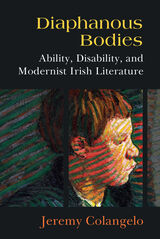
front cover of Diaphanous Bodies
Diaphanous Bodies
Ability, Disability, and Modernist Irish Literature
Jeremy Colangelo
University of Michigan Press, 2021

Diaphanous Bodies: Ability, Disability, and Modernist Irish Literature examines ability, as a category of embodiment and embodied experience, and in the process opens up a new area of inquiry in the growing field of literary disability studies. It argues that the construction of ability arises through a process of exclusion and forgetting, in which the depiction of sensory information and epistemological judgment subtly (or sometimes un-subtly) elide the fact of embodied subjectivity. The result is what Colangelo calls “the myth of the diaphanous abled body,” a fiction that holds that an abled body is one which does not participate in or situate experience.  The diaphanous abled body underwrites the myth that abled and disabled constitute two distinct categories of being rather than points on a constantly shifting continuum.

In any system of marginalization, the dominant identity always sets itself up as epistemologically and experientially superior to whichever group it separates itself from. Indeed, the norm is always most powerful when it is understood as an empty category or a view from nowhere. Diaphanous Bodies explores the phantom body that underwrites the artificial dichotomy between abled and disabled upon which the representation of embodied experience depends.

[more]


Send via email Share on Facebook Share on Twitter