
front cover of Clinical Trials in Ovarian Cancer
Clinical Trials in Ovarian Cancer
Walsh, Christine S
Rutgers University Press, 2017
When a patient is diagnosed with a gynecological malignancy, she and her doctors must make urgent, high-risk decisions about her course of treatment. In selecting an appropriate plan of care, physicians must weigh the patient’s individual needs, the tumor’s specific characteristics, and the treatment’s potential side effects. Because there is no one-size-fits-all treatment solution, a plethora of clinical trials have been performed on ovarian cancer patients, but clinicians may struggle to keep up with this ever-growing body of research.   
 
Collecting and synthesizing research findings from a wide array of medical journal articles and book chapters, Clinical Trials in Ovarian Cancer provides physicians with an invaluable resource. Gynecologic oncologist Christine S. Walsh systematically outlines each of the seminal Phase III trials that have shaped the treatment of ovarian cancers, detailing the rationale for the trial, the patient population studied, treatment delivery methods, efficacy, toxicity, and trial conclusions. She provides a clear overview of established treatments, as well as still-controversial experimental approaches. 
 
The first book to organize this cutting-edge research into an easy-to-use reference, Clinical Trials in Ovarian Cancer should help medical personnel at all levels provide their patients with the highest standard of care. 
 
[more]

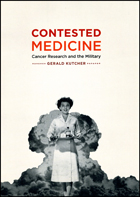
front cover of Contested Medicine
Contested Medicine
Cancer Research and the Military
Gerald Kutcher
University of Chicago Press, 2009

In the 1960s University of Cincinnati radiologist Eugene Saenger infamously conducted human experiments on patients with advanced cancer to examine how total body radiation could treat the disease. But, under contract with the Department of Defense, Saenger also used those same patients as proxies for soldiers to answer questions about combat effectiveness on a nuclear battlefield.
 

Using the Saenger case as a means to reconsider cold war medical trials, Contested Medicine examines the inherent tensions at the heart of clinical studies of the time. Emphasizing the deeply intertwined and mutually supportive relationship between cancer therapy with radiation and military medicine, Gerald Kutcher explores post–World War II cancer trials, the efforts of the government to manage clinical ethics, and the important role of military investigations in the development of an effective treatment for childhood leukemia. Whereas most histories of human experimentation judge research such as Saenger’s against idealized practices, Contested Medicine eschews such an approach and considers why Saenger’s peers and later critics had so much difficulty reaching an unambiguous ethical assessment. Kutcher’s engaging investigation offers an approach to clinical ethics and research imperatives that lays bare many of the conflicts and tensions of the postwar period.
[more]

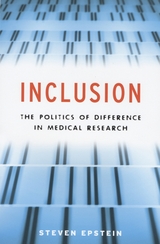
front cover of Inclusion
Inclusion
The Politics of Difference in Medical Research
Steven Epstein
University of Chicago Press, 2007

With Inclusion, Steven Epstein argues that strategies to achieve diversity in medical research mask deeper problems, ones that might require a different approach and different solutions.

Formal concern with this issue, Epstein shows, is a fairly recent phenomenon. Until the mid-1980s, scientists often studied groups of white, middle-aged men—and assumed that conclusions drawn from studying them would apply to the rest of the population. But struggles involving advocacy groups, experts, and Congress led to reforms that forced researchers to diversify the population from which they drew for clinical research. While the prominence of these inclusive practices has offered hope to traditionally underserved groups, Epstein argues that it has drawn attention away from the tremendous inequalities in health that are rooted not in biology but in society.

“Epstein’s use of theory to demonstrate how public policies in the health profession are shaped makes this book relevant for many academic disciplines. . . . Highly recommended.”—Choice

“A masterful comprehensive overview of a wide terrain.”—Troy Duster, Biosocieties
[more]

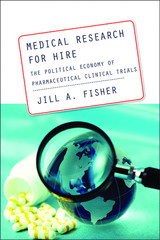
front cover of Medical Research for Hire
Medical Research for Hire
The Political Economy of Pharmaceutical Clinical Trials
Fisher, Jill A
Rutgers University Press, 2008
Today, more than 75 percent of pharmaceutical drug trials in the United States are being conducted in the private sector. Once the sole province of academic researchers, these important studies are now being outsourced to non-academic physicians.

According to Jill A. Fisher, this major change in the way medical research is performed is the outcome of two problems in U.S. health care: decreasing revenue for physicians and decreasing access to treatment for patients. As physicians report diminishing income due to restrictive relationships with insurers, increasing malpractice insurance premiums, and inflated overhead costs to operate private practices, they are attracted to pharmaceutical contract research for its lucrative return. Clinical trials also provide limited medical access to individuals who have no or inadequate health insurance because they offer "free" doctors' visits, diagnostic tests, and medications to participants. Focusing on the professional roles of those involved, as well as key research practices, Fisher assesses the risks and advantages for physicians and patients alike when pharmaceutical drug studies are used as an alternative to standard medical care.

A volume in the Critical Issues in Health and Medicine series, edited by Rima D. Apple and Janet Golden

[more]

front cover of Negotiating Pharmaceutical Uncertainty
Negotiating Pharmaceutical Uncertainty
Women's Agency in a South African HIV Prevention Trial
Eirik Saethre
Vanderbilt University Press, 2017
Telling the story of a clinical trial testing an innovative gel designed to prevent women from contracting HIV, Negotiating Pharmaceutical Uncertainty provides new insight into the complex and contradictory relationship between medical researchers and their subjects. Although clinical trials attempt to control and monitor participants' bodies, Saethre and Stadler argue that the inherent uncertainty of medical testing can create unanticipated opportunities for women to exercise control over their health, sexuality, and social relationships. Combining a critical analysis of the social production of biomedical knowledge and technologies with a detailed ethnography of the lives of female South African trial participants, this book brings to light issues of economic exclusion, racial disparity, and spiritual insecurity in Johannesburg's townships. Built on a series of tales ranging from strategy sessions at the National Institutes of Health to witchcraft accusations against the trial, Negotiating Pharmaceutical Uncertainty illuminates the everyday social lives of clinical trials.

As embedded anthropologists, Saethre and Stadler provide a unique and nuanced perspective of the reality of a clinical trial that is often hidden from view.
[more]

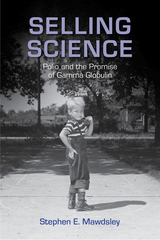
front cover of Selling Science
Selling Science
Polio and the Promise of Gamma Globulin
Mawdsley, Stephen E
Rutgers University Press, 2016
Today, when many parents seem reluctant to have their children vaccinated, even with long proven medications, the Salk vaccine trial, which enrolled millions of healthy children to test an unproven medical intervention, seems nothing short of astonishing. In Selling Science, medical historian Stephen E. Mawdsley recounts the untold story of the first large clinical trial to control polio using healthy children—55,000 healthy children—revealing how this long-forgotten incident cleared the path for Salk’s later trial.
 
Mawdsley describes how, in the early 1950s, Dr. William Hammon and the National Foundation for Infantile Paralysis launched a pioneering medical experiment on a previously untried scale. Conducted on over 55,000 healthy children in Texas, Utah, Iowa, and Nebraska, this landmark study assessed the safety and effectiveness of a blood component, gamma globulin, to prevent paralytic polio. The value of the proposed experiment was questioned by many prominent health professionals as it harbored potential health risks, but as Mawdsley points out, compromise and coercion moved it forward. And though the trial returned dubious results, it was presented to the public as a triumph and used to justify a federally sanctioned mass immunization study on thousands of families between 1953 and 1954. Indeed, the concept, conduct, and outcome of the GG study were sold to health professionals, medical researchers, and the public at each stage. At a time when most Americans trusted scientists, their mutual encounter under the auspices of conquering disease was shaped by politics, marketing, and at times, deception.

Drawing on oral history interviews, medical journals, newspapers, meeting minutes, and private institutional records, Selling Science sheds light on the ethics of scientific conduct, and on the power of marketing to shape public opinion about medical experimentation.
 
[more]


Send via email Share on Facebook Share on Twitter