
 A SCHOLARLY BOOK REPOSITORY
12 start with A start with A
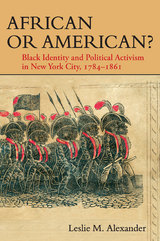
During the early national and antebellum eras, black leaders in New York City confronted the tenuous nature of Northern emancipation. Despite the hope of freedom, black New Yorkers faced a series of sociopolitical issues including the persistence of Southern slavery, the threat of forced removal, racial violence, and the denial of American citizenship. Even efforts to create community space within the urban landscape, such as the African Burial Ground and Seneca Village, were eventually demolished to make way for the city's rapid development. In this illuminating history, Leslie M. Alexander chronicles the growth and development of black activism in New York from the formation of the first black organization, the African Society, in 1784 to the eve of the Civil War in 1861. In this critical period, black activists sought to formulate an effective response to their unequal freedom. Examining black newspapers, speeches, and organizational records, this study documents the creation of mutual relief, religious, and political associations, which black men and women infused with African cultural traditions and values.
As Alexander reveals, conflicts over early black political strategy foreshadowed critical ideological struggles that would bedevil the black leadership for generations to come. Initially, black leaders advocated racial uplift through a sense of communalism and connection to their African heritage. Yet by the antebellum era, black activists struggled to reconcile their African identity with a growing desire to gain American citizenship. Ultimately, this battle resulted in competing agendas; while some leaders argued that the black community should dedicate themselves to moral improvement and American citizenship, others began to consider emigrating to Africa or Haiti. In the end, the black leadership resolved to assert an American identity and to expand their mission for full equality and citizenship in the United States. This decision marked a crucial turning point in black political strategy, for it signaled a new phase in the quest for racial advancement and fostered the creation of a nascent Black Nationalism.
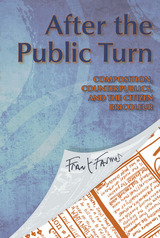
Farmer examines two very different kinds of publics, cultural and disciplinary, and discusses two counterpublics within those broad categories: zine discourses and certain academic discourses. By juxtaposing these two significantly different kinds of publics, Farmer suggests that each discursive world can be seen, in its own distinct way, as a counterpublic, an oppositional social formation that has a stake in widening or altering public life as we know it.
Drawing on major figures in rhetoric and cultural theory, Farmer builds his argument about composition teaching and its relation to the public sphere, leading to a more sophisticated understanding of public life and a deeper sense of what democratic citizenship means for our time.
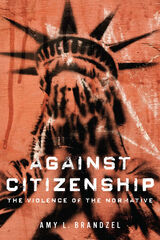
Brandzel's focus on three legal case studies--same-sex marriage law, hate crime legislation, and Native Hawaiian sovereignty and racialization--exposes how citizenship confounds and obscures the mutual processes of settler colonialism, racism, sexism, and heterosexism. In this way, Brandzel argues that citizenship requires anti-intersectionality, that is, strategies that deny the mutuality and contingency of race, class, gender, sexuality, and nation--and how, oftentimes, progressive left activists and scholars follow suit.
Against Citizenship is an impassioned plea for a queer, decolonial, anti-racist coalitional stance against the systemized human de/valuing and anti-intersectionalities of citizenship.
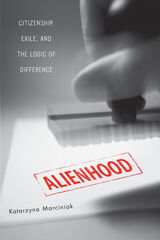
Using examples from exilic literature and cinema, including the works of Julia Alvarez, Eva Hoffman, Gregory Nava, and Roman Polanski, Alienhood theorizes multicultural experiences of liminal characters that belong in the interstices between nations. Investigating gendered, racialized, and ideological formations of “aliens,” Marciniak’s readings put into dialogue narratives from both the second world and the third world in relation to “first worldness.” This dialogue problematizes the meanings of “transnational” and brings the so-called second world into these debates. In doing so, Marciniak reorients the study of immigrant or exile subjects beyond the celebrated notion of transnationalism.
With its unique focus on “aliens” in relation to discourses of immigration, exile, and displacement, Alienhood shows how transnationality is, for many dislocated people, an unattainable privilege.
Katarzyna Marciniak is associate professor of English at Ohio University.

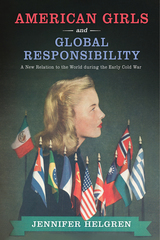
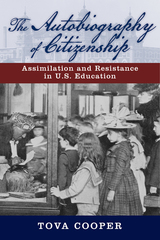
Jennifer Helgren argues that a new internationalist girl citizenship took root in the country in the years following World War II in youth organizations such as Camp Fire Girls, Girl Scouts, YWCA Y-Teens, schools, and even magazines like Seventeen. She shows the particular ways that girls’ identities and roles were configured, and reveals the links between internationalist youth culture, mainstream U.S. educational goals, and the U.S. government in creating and marketing that internationalist girl, thus shaping the girls’ sense of responsibilities as citizens.
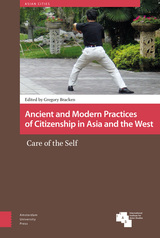
At the genesis of the Republic of China in 1912, many political leaders, educators, and social reformers argued that republican education should transform China's people into dynamic modern citizens—social and political agents whose public actions would rescue the national community. Over subsequent decades, however, they came to argue fiercely over the contents of citizenship and how it should be taught. Moreover, many of their carefully crafted policies and programs came to be transformed by textbook authors, teachers, administrators, and students. Furthermore, the idea of citizenship, once introduced, raised many troubling questions. Who belonged to the national community in China, and how was the nation constituted? What were the best modes of political action? How should modern people take responsibility for "public matters"? What morality was proper for the modern public?
This book reconstructs civic education and citizenship training in secondary schools in the lower Yangzi region during the Republican era. It also analyzes how students used the tools of civic education introduced in their schools to make themselves into young citizens and explores the complex social and political effects of educated youths' civic action.
READERS
Browse our collection.
PUBLISHERS
See BiblioVault's publisher services.
STUDENT SERVICES
Files for college accessibility offices.
RECENTLY PUBLISHED





UChicago Accessibility Resources
home | accessibility | search | about | contact us
BiblioVault ® 2001 - 2024
The University of Chicago Press