
 A SCHOLARLY BOOK REPOSITORY
In resource-challenged Athens County, Ohio, staff and volunteers at the nonprofit Athens County Foundation came up with a daring idea: to host a locally sourced, gourmet dinner for four hundred people. The meal would be held on the brick-paved main street of the city of Athens, to raise funds for the food bank, and increase awareness of the persistent local struggle with food insecurity, as well as raise the visibility of the foundation. The logistical challenges were daunting, but the plan would unite the community around the common theme of providing for its own.
Since then, Bounty on the Bricks has become a touchstone event that raises close to one hundred thousand dollars for the food bank. In The Community Table, Athens County Foundation executive director Susan Urano translates her years of nonprofit experience with large-scale annual fundraisers into a step-by-step guide for development professionals, community leaders, and volunteers.
Urano guides readers to consider when to mount a fundraiser, who the stakeholders are, what social and financial value the event will bring to the community, and how partnerships might augment the payoff. Using real-life examples, she explains how organizers can learn from mistakes and illustrates methods of team building, conflict resolution, and problem solving. Sample ideas, timelines, budgets, publicity plans, and committee structures round out The Community Table.
In the face of global financial problems and stressed government budgets, the ability of private philanthropy to step in and help solve public problems—and support vital private institutions as well—has perhaps never been more important. But how can donors be sure their contributions will be effective? And how can fundraisers make their case for support in a way that is compelling and productive?
With The Essence of Strategic Giving, Peter Frumkin distills the lessons of his comprehensive, award-winning study, Strategic Giving, into a concise, practical guide for everyone involved in private philanthropy, from donors to managers of nonprofits to fund-raisers. He defines five critical challenges that all donors must address if their philanthropy is to amount to more than indiscriminate charity, including being aware of the time frame that guides a gift, specifying the intended impact being pursued, and recognizing how a donation fits with a donor’s own identity and style. Acknowledging and understanding these fundamental, strategic aspects of giving, Frumkin argues, will help ensure philanthropy that more effectively achieves its aims—and at the same time builds a lasting relationship between donors and the institutions they support.
As the next generation of donors wrestle with the challenge of effectively distributing what Andrew Carnegie called “surplus wealth,” Frumkin’s road map will be an indispensible resource for years to come.
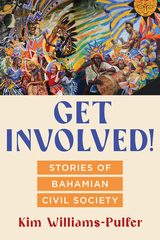
Junkanoo is the national cultural festival of The Bahamas. It fosters a sense of community pride, identity, companionship, spirituality and unity. Watch a video about Junknoo:
https://www.youtube.com/watch?v=tnMpMesNb1Q&t=14s
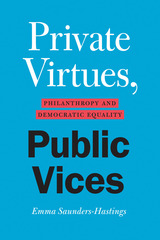
Philanthropy plays a huge role in supporting the provision of many public goods in contemporary societies. As a result, decisions that affect public outcomes and people’s diverse interests are often dependent on the preferences and judgments of the rich. Political theorist Emma Saunders-Hastings argues that philanthropy is a deeply political activity. She asks readers to look at how the power wielded by philanthropy impacts democracy and deepens political inequality by enabling the wealthy to exercise outsize influence in public life and by putting in place paternalistic relationships between donors and their intended beneficiaries. If philanthropy is to be made compatible with a democratic society of equals, it must be judged not simply on the benefits it brings but on its wider political consequences. Timely and thought-provoking, Private Virtues, Public Vices will challenge readers’ thoughts on what philanthropy is and how it truly affects us.
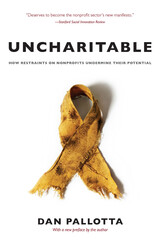
Uncharitable goes where no other book on the nonprofit sector has dared to tread. Where other texts suggest ways to optimize performance inside the existing charity paradigm, Uncharitable suggests that the paradigm itself is the problem and calls into question our fundamental canons about charity. Dan Pallotta argues that society’s nonprofit ethic creates an inequality that denies the nonprofit sector critical tools and permissions that the for-profit sector is allowed to use without restraint. These double standards place the nonprofit sector at an extreme disadvantage. While the for-profit sector is permitted to use all the tools of capitalism, the nonprofit sector is prohibited from using any of them. Capitalism is blamed for creating inequities in our society, but charity is prohibited from using the tools of capitalism to rectify them—and ironically, this is all done in the name of charity. This irrational system, Pallotta explains, has its roots in four-hundred-year-old Puritan ethics that banished self-interest from the realm of charity. The ideology is policed today by watchdog agencies and the use of so-called efficiency measures, which Pallotta argues are flawed, unjust, and should be abandoned. By declaring our independence from these obsolete ideas, Pallotta theorizes, we can dramatically accelerate progress on the most urgent social issues of our time. Uncharitable is an important, provocative, timely, and accessible book—a manifesto about equal economic rights for charity. This edition has a new, updated introduction by the author.
READERS
Browse our collection.
PUBLISHERS
See BiblioVault's publisher services.
STUDENT SERVICES
Files for college accessibility offices.
RECENTLY PUBLISHED



UChicago Accessibility Resources
home | accessibility | search | about | contact us
BiblioVault ® 2001 - 2024
The University of Chicago Press