
 A SCHOLARLY BOOK REPOSITORY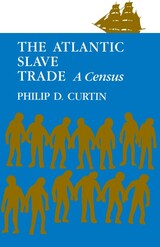
Curtin combines modern research and statistical methods with his broad knowledge of the field to present the first book-length quantitative analysis of the Atlantic slave trade. Its basic evidence suggests revision of currently held opinions concerning the place of the slave trade in the economies of the Old World nations and their American colonies.
“Curtin’s work will not only be the starting point for all future research on the slave trade and comparative slavery, but will become an indispensable reference for anyone interested in Afro-American studies.”—Journal of American History
“Curtin has produced a stimulating monograph, the product of immaculate scholarship, against which all past and future studies will have to be judged.”—Journal of American Studies
“Professor Curtin’s new book is up to his customary standard of performance: within the limits he set for himself, The Atlantic Slave Trade could hardly be a better or more important book.”—American Historical Review

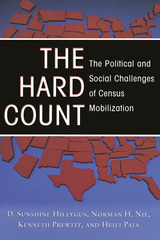

Every census misses some people, but those who are poor, male, urban, black, and Hispanic are most likely not to be counted. In 1980 and 1990, big city mayors complained that census undercounts were depriving their communities of their correct representation in Congress and of their fair share of state and federal dollars. The mayors filed lawsuits to demand recounts and statistical corrections to the census. Harvey Choldin tells the story of the conflict between Census Bureau staff and politicians over how to handle the undercount.
Statisticians at the census bureau were caught between their own rigorous scientific standards and these strong political demands. Choldin explains the political and statistical issues in the undercount controversy, and describes the major research and development program in which statisticians developed innovative techniques with which to measure and correct undercounts. He concludes by showing that, despite the undercount, the United States has an excellent census.

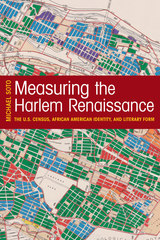
Measuring the Harlem Renaissance sifts through a wide range of authors and ideas—from W. E. B. Du Bois, Rudolph Fisher, and Nella Larsen to Zora Neale Hurston, Langston Hughes, and Wallace Thurman, and from census history to the Great Migration—to provide a fresh take on late nineteenth—and twentieth—century literature and social thought. Soto reveals how Harlem came to be known as the "cultural capital of black America," and how these ideas left us with unforgettable fiction and poetry.
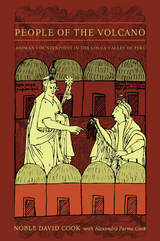
Social structures, the domestic export and economies, and spiritual spheres within native Andean communities are key elements of analysis. Also highlighted is the persistence of duality in the Andean world: perceived dichotomies such as those between the coast and the highlands, Europeans and Indo-Peruvians. Even before the conquest, the Cabana and Collagua communities sharing the Colca Valley were divided according to kinship and location. The Incas, and then the Spanish, capitalized on these divisions, incorporating them into their state structure in order to administer the area more effectively, but Colca Valley peoples resisted total assimilation into either. Colca Valley communities have shown a remarkable tenacity in retaining their social, economic, and cultural practices while accommodating various assimilationist efforts over the centuries. Today’s population maintains similarities with their ancestors of more than five hundred years ago—in language, agricultural practices, daily rituals, familial relationships, and practices of reciprocity. They also retain links to ecological phenomena, including the volcanoes from which they believe they emerged and continue to venerate.
READERS
Browse our collection.
PUBLISHERS
See BiblioVault's publisher services.
STUDENT SERVICES
Files for college accessibility offices.
RECENTLY PUBLISHED





UChicago Accessibility Resources
home | accessibility | search | about | contact us
BiblioVault ® 2001 - 2024
The University of Chicago Press