
 A SCHOLARLY BOOK REPOSITORY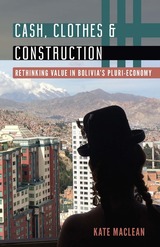
A groundbreaking feminist perspective on Movimiento al Socialismo (MAS) rule in Bolivia and the country’s radical transformation under Evo Morales
The presidency of Evo Morales in Bolivia (2006–2019) has produced considerable academic scholarship, much of it focused on indigenous social movements or extractivism, and often triumphalist about the successes of Morales’s Movimiento al Socialismo (MAS). Turning a new lens on the movement, Cash, Clothes, and Construction presents the first gender-based analysis of “pluri-economy,” a central pillar of Bolivia’s program under Morales, evaluating the potential of this vision of “an economy where all economies fit” to embrace feminist critiques of capitalism and economic diversity.
Based on more than twelve years of empirical research exploring the remarkable transformations in Bolivia since 2006, this book focuses on three sectors—finance, clothing, and construction—in which indigenous women have defied gendered expectations. Kate Maclean presents detailed case studies of women selling secondhand high street clothes from the United States in the vast, peri-urban markets of Bolivian cities; Aymaran designers of new pollera (traditional Andean dress) fashions, one of whom exhibited her collection in New York City; and the powerful and rich chola paceña, whose real estate investments have transformed the cultural maps of La Paz and El Alto.
Cash, Clothes, and Construction offers a gendered analysis of the mission of MAS to dismantle neoliberalism and decolonize politics and economy from the perspective of the Indigenous women who have radically transformed Bolivia’s economy from the ground up.
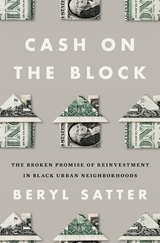
An incisive history of government and corporate failures to infuse capital into Black urban neighborhoods—as well as the organizers and activists who stood up to predatory financial practices.
In the 1960s, conditions in impoverished Black neighborhoods attracted mainstream attention as civil unrest erupted in hundreds of cities across the United States. Finally recognizing the dire effects of racial segregation and urban disinvestment, politicians and corporations joined community activists to call for capital infusion, or reinvestment, in struggling communities. Proposals for reinvestment universally claimed the shared goal of reviving Black neighborhoods, but most of these efforts—some well-meaning, others cynical and predatory—failed to do so.
As renowned historian Beryl Satter shows, private and government interests have long manipulated reinvestment programs to benefit outside business, finance, and real estate professionals. Because these programs focused on corporate tax breaks and federal insurance for lenders, they were easily exploited by private interests to divert funding from poor urban neighborhoods. Meanwhile, community organizers proposed much bolder reinvestment plans that directly confronted institutionally racist practices. They called for a significant reallocation of resources, including government investments in depleted areas and guaranteed incomes for poor people. Activists, often working-class women, also united across racial divides to challenge predatory finance and real estate practices. Yet while they successfully advocated for laws to impede such behaviors, reform legislation often contained loopholes that accommodated racism and corporate greed.
To revive impoverished neighborhoods, we must not only challenge institutional racism in finance and real estate but also resist government policies that enable predatory practices. Cash on the Block envisions a future in which reinvestment policy, guided by community leaders, at last benefits those it is meant to serve.
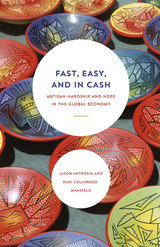
Antrosio and Colloredo-Mansfeld demonstrate how artisan trades evolve in modern Latin American communities. In uncertain economies, small manufacturers have adapted to excel at home-based production, design, technological efficiency, and investments. Vivid case studies illuminate this process: peasant farmers in Túquerres, Otavalo weavers, Tigua painters, and the t-shirt industry of Atuntaqui. Fast, Easy, and In Cash exposes how these ambitious artisans, far from being holdovers from the past, are crucial for capitalist innovation in their communities and provide indispensable lessons in how we should understand and cultivate local economies in this era of globalization.

The dairy business is at the heart of the culture and economy of Vermont, just as it is in many other states. That fact meant little to Kirk Kardashian until he started taking his daughter to daycare at a dairy farm a few miles from his Vermont home. The farm had been owned by the same family for generations but struggled to make ends meet in a market where retail milk prices have held steady for decades while the prices paid to farmers have plummeted. Suddenly, the abstractions of economics and commodities markets were replaced by the flesh and blood of a farm family whom he greeted every day.
In the tradition of Michael Pollan and Eric Schlosser, Kardashian asks whether it is right that family farmers in America should toil so hard, produce a food so wholesome and so popular, and still lose money. His investigation uncovers the hidden forces behind dairy farm consolidation and explains why milk—a staple subject to both government oversight and industry collusion—has proven so tricky to stabilize, even as scores of small dairy farms close. This new edition brings the story up to date, as farmers grapple with an ever-changing landscape that includes shifting consumer preferences, immigration issues, climate change, and bird flu.
READERS
Browse our collection.
PUBLISHERS
See BiblioVault's publisher services.
STUDENT SERVICES
Files for college accessibility offices.
RECENTLY PUBLISHED






UChicago Accessibility Resources
home | accessibility | search | about | contact us
BiblioVault ® 2001 - 2025
The University of Chicago Press