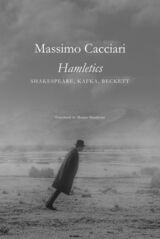
front cover of Hamletics
Hamletics
Shakespeare, Kafka, Beckett
Massimo Cacciari
Seagull Books, 2023
One of Italy's best-known contemporary philosophers and leftists offers a literature-informed take on our contemporary political situation.

During the dramatic course of the twentieth century, amid the clash of the titans which marked that era, humanity could still think in terms of partisan struggles in which large masses took sides against one another. The new millennium, by contrast, appears to have opened under the guise of generalized insecurity, which pertains not only to the historical and social situation, or to one’s personal psychological predicament, but to our very being. The Earth’s current faltering and the twilight of every convention that might govern it—where roles, images, and languages become confused by a lack of direction and distance—were already powerfully prophesied in Shakespeare’s Hamlet, and later in the works of Kafka and Beckett. In Hamletics, Massimo Cacciari, one of Italy’s foremost philosophers and leftist political figures, establishes a dialogue between these fateful authors, exploring the relationship between European nihilism and the aporias of action in the present.
[more]


front cover of The Labour of Spirit
The Labour of Spirit
Massimo Cacciari
Seagull Books, 2025
A provocative examination of the fate of autonomous, creative labor under capitalism.

Between 1917 and 1919, Max Weber delivered two lectures titled Die geistige Arbeit als Beruf, which we might translate as The Labour of Spirit as Vocation. This weighty formula represented the hope that animated the world of bourgeois culture from the likes of Kant, Goethe, Schiller, Fichte, and Hegel and would later form the earliest threads of revolutionary thought from Feuerbach and Marx. The “labor of spirit” is creative, autonomous labor—human labor understood in its fully effectual power. To press for its realization is to liberate all activity from the condition of commanded or alienated work. But the dissolution of the labor of spirit into the capitalist form of production, into the universal machinism that swallows up that science which remains the true engine of development, also ends up delegitimating political authority, whose own foundation lies in the “promise of liberation.”

Massimo Cacciari takes up old questions and confronts them anew: Is the “iron cage” fated to imprison that “labor of spirit” that is political praxis? Will the spirit of capitalism end up completely undermining the space of the political? Or are relations between science and politics still thinkable that might free us from our “debt” as we proceed without means or ends within the techno-economic system?
[more]


Send via email Share on Facebook Share on Twitter