
 A SCHOLARLY BOOK REPOSITORY
Results by Title
2 books about Bureaucratization
2 books about Bureaucratization
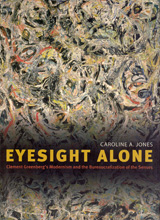
Eyesight Alone
Clement Greenberg's Modernism and the Bureaucratization of the Senses
Caroline A. Jones
University of Chicago Press, 2006
Even a decade after his death, Clement Greenberg remains controversial. One of the most influential art writers of the twentieth century, Greenberg propelled Abstract Expressionist painting-in particular the monumental work of Jackson Pollock-to a leading position in an international postwar art world. On radio and in print, Greenberg was the voice of "the new American painting," and a central figure in the postwar cultural history of the United States.
Caroline Jones's magisterial study widens Greenberg's fundamental tenet of "opticality"-the idea that modernist art is apprehended through "eyesight alone"-to a broader arena, examining how the critic's emphasis on the specular resonated with a society increasingly invested in positivist approaches to the world. Greenberg's modernist discourse, Jones argues, developed in relation to the rationalized procedures that gained wide currency in the United States at midcentury, in fields ranging from the sense-data protocols theorized by scientific philosophy to the development of cultural forms, such as hi-fi, that targeted specific senses, one by one. Greenberg's attempt to isolate and celebrate the visual was one manifestation of a large-scale segmentation-or bureaucratization-of the body's senses. Working through these historical developments, Jones brings Greenberg's theories into contemporary philosophical debates about agency and subjectivity.
Eyesight Alone offers artists, art historians, philosophers, and all those interested in the arts a critical history of this generative figure, bringing his work fully into dialogue with the ideas that shape contemporary critical discourse and shedding light not only on Clement Greenberg but also on the contested history of modernism itself.
Caroline Jones's magisterial study widens Greenberg's fundamental tenet of "opticality"-the idea that modernist art is apprehended through "eyesight alone"-to a broader arena, examining how the critic's emphasis on the specular resonated with a society increasingly invested in positivist approaches to the world. Greenberg's modernist discourse, Jones argues, developed in relation to the rationalized procedures that gained wide currency in the United States at midcentury, in fields ranging from the sense-data protocols theorized by scientific philosophy to the development of cultural forms, such as hi-fi, that targeted specific senses, one by one. Greenberg's attempt to isolate and celebrate the visual was one manifestation of a large-scale segmentation-or bureaucratization-of the body's senses. Working through these historical developments, Jones brings Greenberg's theories into contemporary philosophical debates about agency and subjectivity.
Eyesight Alone offers artists, art historians, philosophers, and all those interested in the arts a critical history of this generative figure, bringing his work fully into dialogue with the ideas that shape contemporary critical discourse and shedding light not only on Clement Greenberg but also on the contested history of modernism itself.
[more]

Professional Professoriate
Unionization, Bureaucratization, and the AAUP
Philo A. Hutcheson
Vanderbilt University Press, 2000
Starting with the question "How have professors and educational institutions responded to pressures to be professional yet act bureaucratically," Philo Hutcheson uses federal and AAUP records and surveys and blends historical research and sociological analysis to develop a full understanding of the problem. With the dramatic expansion of the professoriate following World War II came increasing tensions between the professor's perceived traditional status as an autonomous professional on the one hand and new role as a bureaucrat subject to institutional authority and responsible for departmental and committee assignments on the other. In this increasingly conflicted realm, the AAUP functioned as a key intermediary, dealing with such issues as tenure, salary, contracts, and even faculty strikes.
Hutcheson examines how tensions between the requirements of institutional bureaucracies and the norms of the academic profession resulted in contentiousness and conflict within the national AAUP, between administrators and faculty members on individual campuses, within the ranks of faculties themselves, and even deep in the consciences of many concerned individuals. The book analyzes the association's ability to respond effectively and to balance the values of collegial representation with the powers of collective bargaining. It thus offers a detailed and authoritative examination of the AAUP's search for ways to sustain professionalism while dealing with the fundamental changes in the nature of the professoriate in the post-World War II era.
Hutcheson examines how tensions between the requirements of institutional bureaucracies and the norms of the academic profession resulted in contentiousness and conflict within the national AAUP, between administrators and faculty members on individual campuses, within the ranks of faculties themselves, and even deep in the consciences of many concerned individuals. The book analyzes the association's ability to respond effectively and to balance the values of collegial representation with the powers of collective bargaining. It thus offers a detailed and authoritative examination of the AAUP's search for ways to sustain professionalism while dealing with the fundamental changes in the nature of the professoriate in the post-World War II era.
[more]
READERS
Browse our collection.
PUBLISHERS
See BiblioVault's publisher services.
STUDENT SERVICES
Files for college accessibility offices.
RECENTLY PUBLISHED




UChicago Accessibility Resources
home | accessibility | search | about | contact us
BiblioVault ® 2001 - 2026
The University of Chicago Press