
 A SCHOLARLY BOOK REPOSITORY
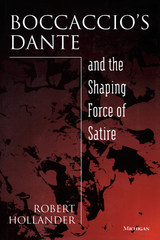
Among commentators, it had been an unexamined commonplace that the "young" Boccaccio either did not know well or did not understand sufficiently the texts of Dante (even though the "young" Boccaccio is construed as including the thirty-eight-year-old author of the Decameron.) In Boccaccio's Dante and the Shaping Force of Satire, Robert Hollander offers a valuable synthesis of new material and some previously published essays, addressing the question of Dante's influence on Boccaccio, particularly concerning the Commedia and the Decameron.
Hollander reveals that Boccaccio's writings are heavy with reminiscences of the Dante text, which he believed to be the greatest "modern" work. It was Boccaccio's belief that Dante was the only writer who had achieved a status similar to that reserved for the greatest writers of antiquity. Most of these essays try to show how carefully Boccaccio reflects the texts of Dante in the Decameron. Some essays also turn to the question of Boccaccio's allied reading of Ovid, especially the amatory work, as part of his strategy to base his work primarily on these two great authorities as he develops his own vernacular and satiric vision of human foolishness.
Boccaccio's Dante and the Shaping Force of Satire is a welcome addition to the field of Dante studies and to medieval studies in general.
Robert Hollander is Professor in European Literature and Chair, Department of Comparative Literature, Princeton University. He has received the city of Florence's gold medal for work advancing our understanding of Dante.
Because divergent political, municipal, and literary histories would have made the Italian cities--Genoa, Florence, and Milan--unfamiliar to an English poet from medieval London, Ginsberg argues that we must consider what Chaucer overlooked and mistook from his Italian models alongside the material he did appropriate. To make sense of premises in texts like Dante's Comedy that were peculiarly Italian, Chaucer would look to Boccaccio as a gloss; by reading these authors in conjunction with one another, Chaucer generates an "Italian tradition" that translates into the terms of his English experience works already mediated by a prior stage of transposition.
Ginsberg explores Chaucer's relationship to Italian poets not in terms of the interaction of individual talents with accredited authorities (Chaucer and Dante, Boccaccio and Petrarch, etc.). Rather, he focuses on the shifts in tension that occur when the civic engagements and disengagements of Florence's poets are brought into contact with Chaucer's growing metropolitanism and increasing reluctance to make London the locus of his poetic art.
Beyond its appeal to medievalists and those who study the Renaissance, Chaucer's Italian Tradition will be welcomed by readers interested in theoretical questions about translation and the development of tradition, including individuals who study history, literature, and the nature of the humanities.
Warren Ginsberg is Professor of English, University of Oregon.
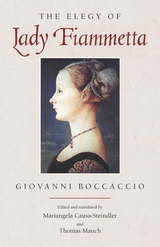
Lady Fiammetta, the first-person narrator and protagonist, recounts how, although a married woman, she falls in love with a handsome young foreigner named Panfilo and, driven by irresistible passion, becomes his lover. Panfilo subsequently abandons Fiammetta and returns to his native land, where his elderly father is said to be dying. When he fails to keep his promise to return, Fiammetta, in what is the heart of the narrative, describes her longings, her anguish, and her despair. A host of contradictory sentiments drive her to desperation and to an unsuccessful suicide attempt. After a time, Fiammetta resumes her futile wait for Panfilo. She finally resolves to seek him out in his native land. Disguising her true intent from her husband, she secures his promise to help her in this undertaking. Addressing an exclusively female audience, Fiammetta warns them about the vicious ways of men. Her whole narrative, in fact, adds up to an indictment of men as both readers and lovers. Eliciting a remarkably wide range of responses from readers and critics, Fiammetta has been variously described as a pathetic victim of male cruelty; an irresponsible fool of a girl; a sophisticated, cunning, and wholly disingenuous female; and, finally, a genuinely modern woman. Whatever judgment we make of her, Fiammetta stands out among medieval women as an ardent and outspoken feminist.
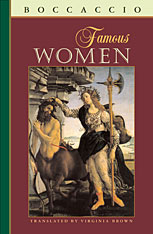

After the composition of the Decameron, and under the influence of Petrarch’s humanism, Giovanni Boccaccio (1313–1375) devoted the last decades of his life to compiling encyclopedic works in Latin. Among them is Famous Women, the first collection of biographies in Western literature devoted exclusively to women.
The 106 women whose life stories make up this volume range from the exemplary to the notorious, from historical and mythological figures to Renaissance contemporaries. In the hands of a master storyteller, these brief biographies afford a fascinating glimpse of a moment in history when medieval attitudes toward women were beginning to give way to more modern views of their potential.
Famous Women, which Boccaccio continued to revise and expand until the end of his life, became one of the most popular works in the last age of the manuscript book, and had a signal influence on many literary works, including Chaucer’s Canterbury Tales and Castiglione’s Courtier. This edition presents the first English translation based on the autograph manuscript of the Latin.
Giovanni Boccaccio’s Genealogy of the Pagan Gods is an ambitious work of humanistic scholarship whose goal is to plunder ancient and medieval literary sources so as to create a massive synthesis of Greek and Roman mythology. The work also contains a famous defense of the value of studying ancient pagan poetry in a Christian world.
The complete work in fifteen books contains a meticulously organized genealogical tree identifying approximately 950 Greco-Roman mythological figures. The scope is enormous: 723 chapters include over a thousand citations from two hundred Greek, Roman, medieval, and Trecento authors. Throughout the Genealogy, Boccaccio deploys an array of allegorical, historical, and philological critiques of the ancient myths and their iconography.
Much more than a mere compilation of pagan myths, the Genealogy incorporates hundreds of excerpts from and comments on ancient poetry, illustrative of the new spirit of philological and cultural inquiry emerging in the early Renaissance. It is at once the most ambitious work of literary scholarship of the early Renaissance and a demonstration to contemporaries of the moral and cultural value of studying ancient poetry. This is the first volume of a projected three-volume set of Boccaccio’s complete Genealogy.
Genealogy of the Pagan Gods by Giovanni Boccaccio (1313–1375) is an ambitious work of humanistic scholarship whose goal is to plunder ancient and medieval literary sources so as to create a massive synthesis of Greek and Roman mythology. The work also contains a famous defense of the value of studying ancient pagan poetry in a Christian world.
The complete work in fifteen books contains a meticulously organized genealogical tree identifying approximately 950 Greco-Roman mythological figures. The scope is enormous: 723 chapters include over a thousand citations from 200 Greek, Roman, medieval, and Trecento authors. Throughout the Genealogy, Boccaccio deploys an array of allegorical, historical, and philological critiques of the ancient myths and their iconography.
Much more than a mere compilation of pagan myths, the Genealogy incorporates hundreds of excerpts from and comments on ancient poetry, illustrative of the new spirit of philological and cultural inquiry emerging in the early Renaissance. It is at once the most ambitious work of literary scholarship of the early Renaissance and a demonstration to contemporaries of the moral and cultural value of studying ancient poetry.
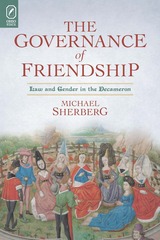
Through a series of close readings at all three levels of the text—the author’s statements, the frame narrative, and the stories themselves—Sherberg shows how Boccaccio exposes and explores gender tensions rooted in a notion of the patriarchal household, which finds its own rationale in the natural-law postulate of the inferiority of women. Relying on the writings of the great twentieth-century legal theorist Hans Kelsen, Sherberg demonstrates how through the complex architecture of the Decameron Boccaccio dismantles the logic of natural law, exposing it instead as a rhetoric used by men to justify their control of women.
The Governance of Friendship aims well to advance our understanding of Boccaccio as an intellectual: not only steeped in the key texts of his time, but also at the forefront of critical thinking about such issues as law and gender which will play out over the coming centuries and beyond.
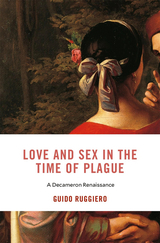
As a pandemic swept across fourteenth-century Europe, the Decameron offered the ill and grieving a symphony of life and love.
For Florentines, the world seemed to be coming to an end. In 1348 the first wave of the Black Death swept across the Italian city, reducing its population from more than 100,000 to less than 40,000. The disease would eventually kill at least half of the population of Europe. Amid the devastation, Giovanni Boccaccio’s Decameron was born. One of the masterpieces of world literature, the Decameron has captivated centuries of readers with its vivid tales of love, loyalty, betrayal, and sex. Despite the death that overwhelmed Florence, Boccaccio’s collection of novelle was, in Guido Ruggiero’s words, a “symphony of life.”
Love and Sex in the Time of Plague guides twenty-first-century readers back to Boccaccio’s world to recapture how his work sounded to fourteenth-century ears. Through insightful discussions of the Decameron’s cherished stories and deep portraits of Florentine culture, Ruggiero explores love and sexual relations in a society undergoing convulsive change. In the century before the plague arrived, Florence had become one of the richest and most powerful cities in Europe. With the medieval nobility in decline, a new polity was emerging, driven by Il Popolo—the people, fractious and enterprising. Boccaccio’s stories had a special resonance in this age of upheaval, as Florentines sought new notions of truth and virtue to meet both the despair and the possibility of the moment.
READERS
Browse our collection.
PUBLISHERS
See BiblioVault's publisher services.
STUDENT SERVICES
Files for college accessibility offices.
RECENTLY PUBLISHED




UChicago Accessibility Resources
home | accessibility | search | about | contact us
BiblioVault ® 2001 - 2024
The University of Chicago Press