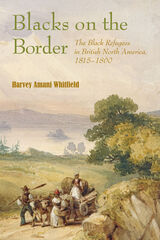
front cover of Blacks on the Border
Blacks on the Border
The Black Refugees in British North America, 1815–1860
Harvey Whitfield
University Press of New England, 2006
Following the American Revolution, free black communities and enslaved African Americans increasingly struggled to reconcile their African heritage with their American home. This struggle resulted in tens of thousands of African Americans seeking new homes in areas as diverse as Haiti and Nova Scotia. Black refugees arrived in Nova Scotia after the War of 1812 with little in common but their desire for freedom. By 1860, they had formed families, communities, and traditions. Harvey Amani Whitfield’s study reconstructs the lives and history of a sizeable but neglected group of African Americans by placing their history within the framework of free black communities in New England and Nova Scotia during the nineteenth century. It examines which aspects of American and African American culture black expatriates used or discarded in an area that forced them to negotiate the overlapping worlds of Great Britain, the United States, Afro–New England, and the African American Diaspora, while considering how former American slaves understood freedom long before the Civil War.
[more]

front cover of Unwelcome Shores
Unwelcome Shores
Black Refugees in America
Bernadette Ludwig
Rutgers University Press, 2026
Unwelcome Shores is an ethnographic study of the Liberian refugee community in Staten Island, New York, home to the largest per capita concentration of Liberians in the U.S., that sheds light on the racialization of Black refugees and the racism they have experienced at every step of their migration journey. In this pioneering study, sociologist Bernadette Ludwig explores how Liberians have responded to such racist exclusions, noting how members of this community reject the informal refugee label once they are resettled in the United States. Liberian migrants often view the label as a liability since the larger general public, the media, and the U.S. government tend to regard Black refugees as an economic and social burden unworthy of assistance. Indeed, Black refugees’ humanity is often ignored, Ludwig contends, in favor of overemphasizing presumed barbaric violence, endemic wars, cultural backwardness, and diseases. By detailing the lack of aid and support for Black refugees and describing how Liberian refugees in particular have had to overcome various struggles and barriers in coming to the U.S. and while living here, Unwelcome Shores highlights the overarching role of race and anti-Black racism in American society.

[more]


Send via email Share on Facebook Share on Twitter