
 A SCHOLARLY BOOK REPOSITORY
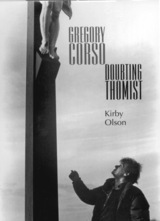
Gregory Corso is the most intensely spiritual of the Beat generation poets and still by far the least explored. The virtue of Kirby Olson’s Gregory Corso: Doubting Thomist is that it is the first book to place all of Corso’s work in a philosophical perspective, concentrating on Corso as a poet torn between a static Catholic Thomist viewpoint and that of a progressive surrealist.
While Corso is a subject of great controversy—his work often being seen as nihilistic and wildly comic—Olson argues that Corso’s poetry, in fact, maintains an insistent theme of doubt and faith with regard to his early Catholicism. Although many critics have attempted to read his poetry, and some have done so brilliantly, Olson—in his approach and focus—is the first to attempt to give a holistic understanding of the oeuvre as essentially one not of entertainment or hilarity but of a deep spiritual and philosophical quest by an important and profound mind.
In nine chapters, Olson addresses Corso from a broad philosophical perspective and shows how Corso takes on particular philosophical issues and contributes to new understandings. Corso’s concerns, like his influence, extend beyond the Beat generation as he speaks about concerns that have troubled thinkers from the beginning of the Western tradition, and his answers offer provocative new openings for thought.
Corso may very well be the most important Catholic poet in the American literary canon, a visionary like Burroughs and Ginsberg, whose work illuminated a generation. Written in a lively and engaging style, Gregory Corso: Doubting Thomist seeks to keep Corso’s memory alive and at last delve fully into Corso’s poetry.

The canonical works of authors such as Joseph Conrad, Andre Malraux, Jose Eustasio Rivera, and others present jungles and wildernesses as fundamentally corrupting and dangerous. Rogers explores how the methods these authors use to communicate the physical and psychological maladies that afflict their characters evolved symbiotically with modern medicine. While the wilderness challenges Conrad's and Malraux's European travelers to question their civility and mental stability, Latin American authors such as Alejo Carpentier deftly turn pseudoscientific theories into their greatest asset, as their characters transform madness into an essential creative spark.
Ultimately, Jungle Fever suggests that the greatest horror of the jungle is the unknown regions of the character's own mind.
--Harold Bloom, Genius
" . . . a truly literary study in the largest, most humane, sense. Instead of subjecting poems to the distortions of theory, it brings biography, theology, psychology, and cultural history to bear on the intricacies of language, where all the issues of the poet's life and work converge, contend, and seek resolution."
--Albert Gelpi, American Literature
" . . . insightful readings of many of Dickinson's difficult poems and . . . a significant contribution to Dickinson studies."
---Choice
"McIntosh shows the power of Dickinson's religious quest in word, in verse, and in truth. He shows that she was much more than an ever-adolescent angry rebel trying to subvert the religious oppression of benighted Amherst neighbors."
---Emily Dickinson Journal
Looks at early religious texts and their influence on medieval literature and culture.
Looks at early religious texts and their influence on medieval literature and culture.
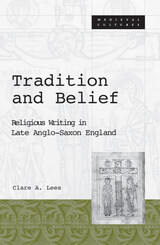
In this major study of Anglo-Saxon religious texts-sermons, homilies, and saints’ lives written in Old English-Clare A. Lees reveals how the invention of preaching transformed the early medieval church, and thus the culture of medieval England. By placing Anglo-Saxon prose within a social matrix, her work offers a new way of seeing medieval literature through the lens of culture.To show how the preaching mission of the later Anglo-Saxon church was constructed and received, Lees explores the emergence of preaching from the traditional structures of the early medieval church-its institutional knowledge, genres, and beliefs. Understood as a powerful rhetorical, social, and epistemological process, preaching is shown to have helped define the sociocultural concerns specific to late Anglo-Saxon England.The first detailed study of traditionality in medieval culture, Tradition and Belief is also a case study of one cultural phenomenon from the past. As such-and by concentrating on the theoretically problematic areas of history, religious belief, and aesthetics-the book contributes to debates about the evolving meaning of culture.ISBN 0-8166-3002-X Cloth £34.50 $49.95xxISBN 0-8166-3003-8 Paper £14.00 $19.95x232 Pages 5 7/8 x 9 NovemberMedieval Cultures Series, volume 19Translation inquiries: University of Minnesota PressREADERS
Browse our collection.
PUBLISHERS
See BiblioVault's publisher services.
STUDENT SERVICES
Files for college accessibility offices.
RECENTLY PUBLISHED




UChicago Accessibility Resources
home | accessibility | search | about | contact us
BiblioVault ® 2001 - 2025
The University of Chicago Press