
 A SCHOLARLY BOOK REPOSITORY
Results by Title
2 books about Bearden, Elizabeth
2 books about Bearden, Elizabeth
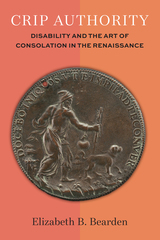
Crip Authority
Disability and the Art of Consolation in the Renaissance
Elizabeth B. Bearden
University of Michigan Press, 2025
Crip Authority explores how Renaissance writers and artists with disabilities drew on consolatory literature to enhance their authority and create a sense of disability community across the centuries. Elizabeth B. Bearden considers how Renaissance writers and artists understood their lived experiences of disability by drawing on the ancient genre of consolation, which aims to comfort people for a variety of hardships, including mental and physical disability. Renaissance writers used the art of consolation to resignify the mental and physical disabilities that their society frequently scorned into an expression of their military, spiritual, political, and most importantly for this study, writerly authority. Bearden names this kind of defiant authorial self-representation crip authority, thereby transgressively cripping our society’s ableist notions of who has the ability and authority to write.
Disabled authors include Francesco Petrarca, Teresa de Cartagena, Giovani Paolo Lomazzo, Miguel de Cervantes Saavedra, Robert Burton, and John Milton. They all explore their experiences of disability, but their work has rarely or never been considered from a disability studies perspective. Bearden thus brings today’s models of disability studies and crip theory together with early modern articulations of disability based on ancient and Renaissance models of military, political, biblical, and literary authority. In sum, Crip Authority makes a significant contribution to the growing field of early modern disability studies and invites us to rethink the extent of crip history and the endurance of disability gain.
Disabled authors include Francesco Petrarca, Teresa de Cartagena, Giovani Paolo Lomazzo, Miguel de Cervantes Saavedra, Robert Burton, and John Milton. They all explore their experiences of disability, but their work has rarely or never been considered from a disability studies perspective. Bearden thus brings today’s models of disability studies and crip theory together with early modern articulations of disability based on ancient and Renaissance models of military, political, biblical, and literary authority. In sum, Crip Authority makes a significant contribution to the growing field of early modern disability studies and invites us to rethink the extent of crip history and the endurance of disability gain.
[more]
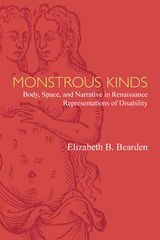
Monstrous Kinds
Body, Space, and Narrative in Renaissance Representations of Disability
Elizabeth B. Bearden
University of Michigan Press, 2019
Monstrous Kinds is the first book to explore textual representations of disability in the global Renaissance. Elizabeth B. Bearden contends that monstrosity, as a precursor to modern concepts of disability, has much to teach about our tendency to inscribe disability with meaning. Understanding how early modern writers approached disability not only provides more accurate genealogies of disability, but also helps nuance current aesthetic and theoretical disability formulations.
The book analyzes the cultural valences of early modern disability across a broad national and chronological span, attending to the specific bodily, spatial, and aesthetic systems that contributed to early modern literary representations of disability. The cross section of texts (including conduct books and treatises, travel writing and wonder books) is comparative, putting canonical European authors such as Castiglione into dialogue with transatlantic and Anglo-Ottoman literary exchange. Bearden questions grand narratives that convey a progression of disability from supernatural marvel to medical specimen, suggesting that, instead, these categories coexist and intersect.
The book analyzes the cultural valences of early modern disability across a broad national and chronological span, attending to the specific bodily, spatial, and aesthetic systems that contributed to early modern literary representations of disability. The cross section of texts (including conduct books and treatises, travel writing and wonder books) is comparative, putting canonical European authors such as Castiglione into dialogue with transatlantic and Anglo-Ottoman literary exchange. Bearden questions grand narratives that convey a progression of disability from supernatural marvel to medical specimen, suggesting that, instead, these categories coexist and intersect.
[more]
READERS
Browse our collection.
PUBLISHERS
See BiblioVault's publisher services.
STUDENT SERVICES
Files for college accessibility offices.
RECENTLY PUBLISHED




UChicago Accessibility Resources
home | accessibility | search | about | contact us
BiblioVault ® 2001 - 2025
The University of Chicago Press