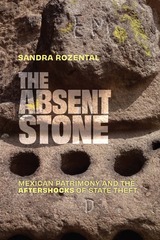
front cover of The Absent Stone
The Absent Stone
Mexican Patrimony and the Aftershocks of State Theft
Sandra Rozental
Duke University Press, 2026
Where and to whom do ancient things belong? What happens when they are stolen—not by a colonial power, but by a national museum claiming them as state patrimony? What kinds of healing and restitution can follow? In The Absent Stone, Sandra Rozental tells the story of the Piedra de los Tecomates, the largest stone monument in the Americas, popularly identified as the pre-Hispanic rain deity Tlaloc. In 1964, the Mexican state called in the military to forcefully relocate this 167-ton carving from the town of Coatlinchan to Mexico City’s National Anthropology Museum. Using in-depth historical and ethnographic research, Rozental traces how the stone’s absence continues to affect and unsettle Coatlinchan and its residents decades later, revealing the tensions between patrimony, nationalism, territory, memory, and materiality in Mexico. Questioning the premise that historical artifacts belong in museums under state-sanctioned care, The Absent Stone pushes contemporary critical scholarship on monuments and museum collections beyond the language of law, heritage, and cultural property, demonstrating how ancient things remain bound to the people and places they come from even after they are removed and displayed elsewhere.
[more]

logo for Harvard University Press
Painted Architecture and Polychrome Monumental Sculpture in Mesoamerica
Elizabeth Hill Boone
Harvard University Press, 1985
Painted Architecture and Polychrome Monumental Sculpture in Mesoamerica investigates the use and importance of color over a broad geographic and temporal range in Mesoamerica. Areas of focus include the Maya approach to painted architecture and sculpture, the situation in Oaxaca from the Preclasssic to the Conquest, and the use of color in Postclassic Central Mexico. By turning attention toward polychromic diversity in architecture and sculpture, the essays in this volume open unto a broader understanding of Mesoamerican art and art history, one that expands beyond monochromatic interpretations in the visual arts.
[more]

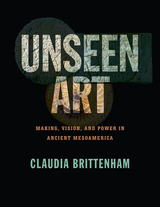
front cover of Unseen Art
Unseen Art
Making, Vision, and Power in Ancient Mesoamerica
Claudia Brittenham
University of Texas Press, 2023

In Unseen Art, Claudia Brittenham unravels one of the most puzzling phenomena in Mesoamerican art history: why many of the objects that we view in museums today were once so difficult to see. She examines the importance that ancient Mesoamerican people assigned to the process of making and enlivening the things we now call art, as well as Mesoamerican understandings of sight as an especially godlike and elite power, in order to trace a gradual evolution in the uses of secrecy and concealment, from a communal practice that fostered social memory to a tool of imperial power.

Addressing some of the most charismatic of all Mesoamerican sculptures, such as Olmec buried offerings, Maya lintels, and carvings on the undersides of Aztec sculptures, Brittenham shows that the creation of unseen art has important implications both for understanding status in ancient Mesoamerica and for analyzing art in the present. Spanning nearly three thousand years of the Indigenous art of Mexico, Guatemala, Honduras, and Belize, Unseen Art connects the dots between vision, power, and inequality, providing a critical perspective on our own way of looking.


[more]


Send via email Share on Facebook Share on Twitter