
 A SCHOLARLY BOOK REPOSITORY
Results by Title
3 books about Architecture, Greek
3 books about Architecture, Greek
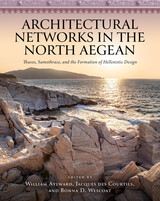
Architectural Networks in the North Aegean
Thasos, Samothrace, and the Formation of Hellenistic Design
Edited by William Aylward, Jacques des Courtils, and Bonna D. Wescoat
University of Wisconsin Press, 2025
During the Hellenistic period, the North Aegean Sea was a dynamic and diverse area, linked by robust trading networks and sometimes precarious political allegiances. The islands of Thasos, Samothrace, and Lesbos in particular played crucial roles in their position between Anatolia, Macedonia, Thrace, and Greece. Migration, trade, and politics—not to mention the specifics of sites and climate—shaped the development of architecture. The region pioneered many innovations that subsequently spread across the Mediterranean.
Employing the idea of networks to effectively describe the interconnectedness of design, materials, technology, religion, and politics, the contributors to this volume establish the need to understand this important region holistically and on its own terms. Taking a close look at major buildings and monuments—while considering technique, design, and decoration as elements of a vigorous web—this volume offers important insights about the area’s significance in the history of Hellenistic architecture, including lasting innovations in architectural illusion, Ionic entablature, and groundbreaking uses of marble and plaster. From the North Aegean, such principles and tactics were transmitted to the rest of the Hellenistic world, influencing Roman architecture and, from there, Western architectural history.
Employing the idea of networks to effectively describe the interconnectedness of design, materials, technology, religion, and politics, the contributors to this volume establish the need to understand this important region holistically and on its own terms. Taking a close look at major buildings and monuments—while considering technique, design, and decoration as elements of a vigorous web—this volume offers important insights about the area’s significance in the history of Hellenistic architecture, including lasting innovations in architectural illusion, Ionic entablature, and groundbreaking uses of marble and plaster. From the North Aegean, such principles and tactics were transmitted to the rest of the Hellenistic world, influencing Roman architecture and, from there, Western architectural history.
[more]
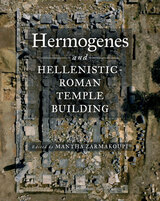
Hermogenes and Hellenistic-Roman Temple Building
Edited by Mantha Zarmakoupi
University of Wisconsin Press, 2026
Recent major excavations at a variety of sites associated with Hermogenes have refreshed, invigorated, and refined our understanding of this important Hellenistic architect. Here, in the first volume dedicated to Hermogenes in more than two decades, new evidence and multivocal analysis allow for fresh contextualization, offering new insights into ancient Greek and Roman architecture and the sociopolitical factors that informed it.
Hermogenes remains one of the most influential and famous designers of the Hellenistic world, although he is known primarily via the first-century BCE Roman architect Vitruvius, who credited his Greek predecessor with major accomplishments. Despite his comparative fame, the paucity of sources has nevertheless obscured Hermogenes’ legacy. This volume updates the evidence, reevaluates this highly significant figure, and reintroduces crucial innovations in the ancient Greek world—innovations that continue to be influential today.
Hermogenes remains one of the most influential and famous designers of the Hellenistic world, although he is known primarily via the first-century BCE Roman architect Vitruvius, who credited his Greek predecessor with major accomplishments. Despite his comparative fame, the paucity of sources has nevertheless obscured Hermogenes’ legacy. This volume updates the evidence, reevaluates this highly significant figure, and reintroduces crucial innovations in the ancient Greek world—innovations that continue to be influential today.
[more]
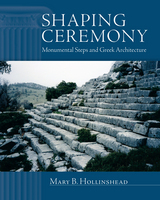
Shaping Ceremony
Monumental Steps and Greek Architecture
Mary B. Hollinshead
University of Wisconsin Press, 2014
Offering a fresh approach to ancient Greek architecture, Shaping Ceremony focuses on the overlooked subject of monumental steps. Written in a clear and readable style, the book presents three complementary ways of studying steps: examining how the human body works on steps; theoretical perspectives on the relationship between architecture and human behavior; and the socio-political effects of steps' presence. Although broad steps are usually associated with emperors and political dominance, Mary B. Hollinshead argues that earlier, in Greek sanctuaries, they expressed and reinforced communal authority. From this alternate perspective, she expands the traditional intellectual framework for studying Greek architecture.
The heart of the study is a close reading of thirty-eight sites with monumental steps from the sixth through second centuries B.C. Organized by century, the book tracks the development of built pathways and grandstands for crowds of worshippers as evidence of the Greeks' increasing awareness of the power of architecture to shape behavior and concentrate social energy. With photographs and illustrations of plans, Shaping Ceremony offers a clear account of how Greeks' adaptation of terrain for human use promoted social cohesion and integrated architectural compositions.
The heart of the study is a close reading of thirty-eight sites with monumental steps from the sixth through second centuries B.C. Organized by century, the book tracks the development of built pathways and grandstands for crowds of worshippers as evidence of the Greeks' increasing awareness of the power of architecture to shape behavior and concentrate social energy. With photographs and illustrations of plans, Shaping Ceremony offers a clear account of how Greeks' adaptation of terrain for human use promoted social cohesion and integrated architectural compositions.
[more]
READERS
Browse our collection.
PUBLISHERS
See BiblioVault's publisher services.
STUDENT SERVICES
Files for college accessibility offices.
RECENTLY PUBLISHED




UChicago Accessibility Resources
home | accessibility | search | about | contact us
BiblioVault ® 2001 - 2025
The University of Chicago Press