
 A SCHOLARLY BOOK REPOSITORY
A collection of new essays that brings archaeological insights and discoveries at the Tibes Ceremonial Center up to date
The Archaeology of Tibes is a collection of essays offering a fresh analysis of this important ceremonial center. It brings new insights about social structure, illuminating the smaller-scale daily lives of ancient peoples rather than focusing on large-scale chiefdoms.
Tibes is the earliest known (ca. 400 to 1300 CE) ceremonial center in Puerto Rico. It has been the focus of one of the largest and longest-running archaeological programs in the Caribbean. Early researchers interpreted evidence in the area of a shift from dispersed villages to a ceremonial center as suggesting the development of social stratification and accumulation of power. Seen as the seat of an early chiefdom, Tibes served as a model applied broadly across the Greater Antilles.
New discoveries prompted archaeologists to question their original assumptions about ancient Puerto Rico, and later research failed to produce evidence of social stratification at Tibes. The Archaeology of Tibes therefore incorporates updated and wider perspectives on social formation. It considers agency, decisions, and events and the possibility of more than one form of social organization. It also presents a more accurate “humanized” past: the sociological meanings of that space and its significance for the people who created, used, and occupied it and who influenced rituals, social memory, and community.
Summarizing findings from excavations at Tibes after 2010, the collection also reviews the geoarchaeology of the site. Additional essays cover ceramic pastes, lithic production, faunal remains, coral, burials, and rock art. This work will engender discussion and future research by archaeologists across the Caribbean and beyond.
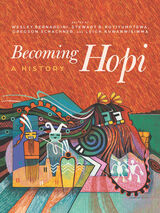
The Hopi and their ancestors have lived on the Hopi Mesas for more than two thousand years, a testimony to sustainable agricultural practices that supported one of the largest populations in the Pueblo world. Becoming Hopi is a truly collaborative volume that integrates Indigenous voices with more than fifteen years of archaeological and ethnographic fieldwork. Accessible and colorful, this volume presents groundbreaking information about Ancestral Pueblo villages in the greater Hopi Mesas region, making it a fascinating resource for anyone who wants to learn about the rich and diverse history of the Hopi people and their enduring connection to the American Southwest.
Contributors: Lyle Balenquah, Wesley Bernardini, Katelyn J. Bishop, R. Kyle Bocinsky, T. J. Ferguson, Saul L. Hedquist, Maren P. Hopkins, Stewart B. Koyiyumptewa, Leigh Kuwanwisiwma, Mowana Lomaomvaya, Lee Wayne Lomayestewa, Joel Nicholas, Matthew Peeples, Gregson Schachner, R. J. Sinensky, Julie Solometo, Kellam Throgmorton, Trent Tu’tsi

El Fin del Mundo presents and synthesizes the archaeological, geological, paleontological, and paleoenvironmental records of an important Clovis site.
Contributors
Joaquín Arroyo-Cabrales
Jordan Bright
James K. Feathers
Edmund P. Gaines
Thanairi Gamez
Gregory W. L. Hodgins
Vance T. Holliday
Susan M. Mentzer
Carmen Isela Ortega-Rosas
Manuel R. Palacios-Fest
Guadalupe Sánchez
Ismael Sánchez-Morales
Kayla B. Worthey
Kristen Wroth
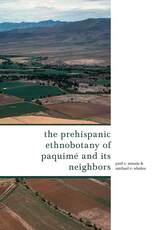
This volume is the first large-scale investigation of the prehispanic ethnobotany of this important ancient site and its neighbors. The authors examine ethnobotanical relationships during Medio Period, AD 1200–1450, when Paquimé was at its most influential. Based on two decades of archaeological research, this book examines uses of plants for food, farming strategies, wood use, and anthropogenic ecology. The authors show that the relationships between plants and people are complex, interdependent, and reciprocal. This volume documents ethnobotanical relationships and shows their importance to the development of the Paquimé polity.
How ancient farmers made a living in an arid to semi-arid region and the effects their livelihood had on the local biota, their relations with plants, and their connection with other peoples is worthy of serious study. The story of the Casas Grandes tradition holds valuable lessons for humanity.
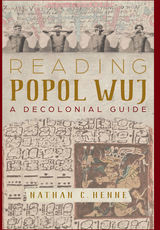
Popol Wujis considered one of the oldest books in the Americas. Various elements of Popol Wuj have appeared in different written forms over the last two millennia and several parts of Popol Wuj likely coalesced in hieroglyphic book form a few centuries before contact with Europeans. Popol Wuj offers a unique interpretation of the Maya world and ways of being from a Maya perspective. However, that perspective is often occluded since the extant Popol Wuj is likely a copy of a copy of a precontact Indigenous text that has been translated many times since the fifteenth century.
Reading Popol Wujoffers readers a path to look beyond Western constructions of literature to engage with this text through the philosophical foundation of Maya thought and culture. This guide deconstructs various translations to ask readers to break out of the colonial mold in approaching this seminal Maya text.
Popol Wuj, or Popol Vuh, in its modern form, can be divided thematically into three parts: cosmogony (the formation of the world), tales of the beings who inhabited the Earth before the coming of people, and chronicles of different ethnic Maya groups in the Guatemala area. Examining thirteen translations of the K’iche’ text, Henne offers a decolonial framework to read between what translations offer via specific practice exercises for reading, studying, and teaching. Each chapter provides a close reading and analysis of a different critical scene based on a comparison of several translations (English and Spanish) of a key K’iche’ word or phrase in order to uncover important philosophical elements of Maya worldviews that resist precise expression in Indo-European languages.
Charts and passages are frontloaded in each chapter so the reader engages in the comparative process before reading any leading arguments. This approach challenges traditional Western reading practices and enables scholars and students to read Popol Wuj—and other Indigenous texts—from within the worldview that created them.
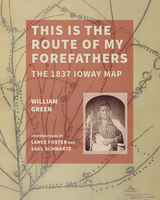
Illustrating nearly 200 years of Ioway history, the 1837 Ioway map provides insights into the tribe’s political and diplomatic strategies, their relationships with neighboring nations, and how they resisted and negotiated in the face of dispossession. This Is the Route of My Forefathers uses an interdisciplinary approach to reveal how group accounts may fade over time, while accounts of origin—legendary histories—remain rich and vibrant.
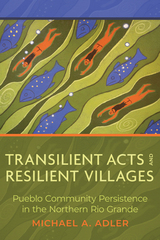
Focusing on the Tiwa-speaking communities of Taos, Picuris, and Pot Creek Pueblos, Adler shows how social and ritual organization, architectural change, and sacred geographies were mobilized in response to disruption. He challenges conventional resilience theory, which emphasizes systemic stability, instead centering Indigenous agency, mobility, and sacred practice as key to understanding cultural endurance.
Grounded in decades of collaborative research with Pueblo communities, Transilient Acts and Resilient Villages is a vital contribution to southwestern archaeology. It offers a compelling model for how archaeology can respectfully engage with descendant communities and provides essential insights for scholars, students, and community members seeking to understand the complexities of cultural persistence in the face of change.
READERS
Browse our collection.
PUBLISHERS
See BiblioVault's publisher services.
STUDENT SERVICES
Files for college accessibility offices.
RECENTLY PUBLISHED



UChicago Accessibility Resources
home | accessibility | search | about | contact us
BiblioVault ® 2001 - 2026
The University of Chicago Press