
 A SCHOLARLY BOOK REPOSITORY
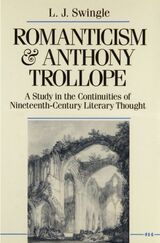
Trollope’s mother, wife, and a friend he loved platonically most of his life provided him three very different views of the Victorian woman. And, according to Jane Nardin, they were responsible for the dramatic shift in his treatment of women in his novels.
This is the first book in Sandra Gilbert’s Ad Feminam series to examine a male author. Nardin initially analyzes the novels Trollope wrote from 1855 to 1861, in which male concerns are central to the plot and women are angelic heroines, submissive and self-sacrificing. Even the titles of his novels written during this period are totally male oriented. The Three Clerks, Doctor Thorne, and The Bertrams all refer to men. Shortly after meeting Kate Field, Trollope wrote Orley Farm, which refers to the estate an angry woman steals from her husband and which marks a change in the attitudes toward women evident in his novels.
His next four books, The Small House at Allington, Rachel Ray, Can You Forgive Her?, and Miss Mackenzie, prove that women’s concerns had become central in his writing. Nardin examines specific novels written from 1861 to 1865 in which Trollope, with increasing vigor, subverts the conventional notions of gender that his earlier novels had endorsed.
Nardin argues that his novels written after 1865 and often recognized as feminist are not really departures but merely refinements of attitudes Trollope exhibited in earlier works.
READERS
Browse our collection.
PUBLISHERS
See BiblioVault's publisher services.
STUDENT SERVICES
Files for college accessibility offices.
RECENTLY PUBLISHED




UChicago Accessibility Resources
home | accessibility | search | about | contact us
BiblioVault ® 2001 - 2026
The University of Chicago Press