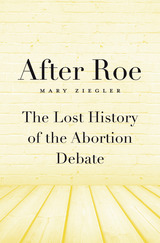
front cover of After Roe
After Roe
The Lost History of the Abortion Debate
Mary Ziegler
Harvard University Press, 2015

Forty years after the U.S. Supreme Court handed down its decision legalizing abortion, Roe v. Wade continues to make headlines. After Roe: The Lost History of the Abortion Debate cuts through the myths and misunderstandings to present a clear-eyed account of cultural and political responses to the landmark 1973 ruling in the decade that followed. The grassroots activists who shaped the discussion after Roe, Mary Ziegler shows, were far more fluid and diverse than the partisans dominating the debate today.

In the early years after the decision, advocates on either side of the abortion battle sought common ground on issues from pregnancy discrimination to fetal research. Drawing on archives and more than 100 interviews with key participants, Ziegler’s revelations complicate the view that abortion rights proponents were insensitive to larger questions of racial and class injustice, and expose as caricature the idea that abortion opponents were inherently antifeminist. But over time, “pro-abortion” and “anti-abortion” positions hardened into “pro-choice” and “pro-life” categories in response to political pressures and compromises. This increasingly contentious back-and-forth produced the interpretation now taken for granted—that Roe was primarily a ruling on a woman’s right to choose.

Peering beneath the surface of social-movement struggles in the 1970s, After Roe reveals how actors on the left and the right have today made Roe a symbol for a spectrum of fervently held political beliefs.

[more]

front cover of Pro-Life, Pro-Choice
Pro-Life, Pro-Choice
Shared Values in the Abortion Debate
Bertha Alvarez Manninen
Vanderbilt University Press, 2014
In this provocative and accessible book, the author defends a pro-choice perspective but also takes seriously pro-life concerns about the moral value of the human fetus, questioning whether a fetus is nothing more than "mere tissue." She examines the legal status of the fetus in the recent Personhood Amendments in state legislatures and in Supreme Court decisions and asks whether Roe v. Wade should have focused on the viability of the fetus or on the bodily integrity of the woman.

Manninen approaches the abortion controversy through a variety of perspectives and ethical frameworks. She addresses the social circumstances that influence many women's decision to abort and considers whether we believe that there are good and bad reasons to abort. Manninen also looks at the call for post-abortion fetal grieving rituals for women who desire them and the attempt to make room in the pro-choice position for the views of prospective fathers.

The author spells out how the two sides demonize each other and proposes ways to find degrees of convergence between the seemingly intractable positions.


[more]


Send via email Share on Facebook Share on Twitter