
 A SCHOLARLY BOOK REPOSITORY
145 start with A start with A
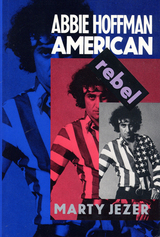
"... Abbie, more than any other radical, showed potheads how to demonstrate and radicals how to dance." -- Chicago Tribune
"... deeply sympathetic and scrupulously detached-a triumph of judicious empathy." -- MARTIN DUBERMAN, Distinguished Professor of History, Lehman/The Graduate School, C.U.N.Y.
"... details Hoffman's humor, manic energy, depressive spells, political skills, and above all, his Incurable and still contagious optimism." -- Entertainment Weekly
"Here's the Abbie I knew and loved! Marty Jezer has captured him in all his complexity, dedication, humor, and heart." -- ANITA HOFFMAN
The abolitionists of the mid-nineteenth century have long been painted in extremes--vilified as reckless zealots who provoked the catastrophic bloodletting of the Civil War, or praised as daring and courageous reformers who hastened the end of slavery. But Andrew Delbanco sees abolitionists in a different light, as the embodiment of a driving force in American history: the recurrent impulse of an adamant minority to rid the world of outrageous evil.
Delbanco imparts to the reader a sense of what it meant to be a thoughtful citizen in nineteenth-century America, appalled by slavery yet aware of the fragility of the republic and the high cost of radical action. In this light, we can better understand why the fiery vision of the "abolitionist imagination" alarmed such contemporary witnesses as Herman Melville and Nathaniel Hawthorne even as they sympathized with the cause. The story of the abolitionists thus becomes both a stirring tale of moral fervor and a cautionary tale of ideological certitude. And it raises the question of when the demand for purifying action is cogent and honorable, and when it is fanatic and irresponsible.
Delbanco's work is placed in conversation with responses from literary scholars and historians. These provocative essays bring the past into urgent dialogue with the present, dissecting the power and legacies of a determined movement to bring America's reality into conformity with American ideals.

These are the questions that drive Wendy Simonds' Abortion at Work. Simonds documents the ways in which workers at a feminist clinic construct compelling feminist visions, and also watch their ideals fall short in practice. Simonds interprets these women's narratives to get at how abortion works on feminism, and to show what feminism can gain by rethinking abortion utilizing these activists' terms. In thoroughly engaging prose, Simonds frames her analysis with a moving account of her own personal understanding of the issues.

Brexit thrust long fraught debates about “Englishness” and the idea of England into the spotlight. About England explores imaginings of English identity since the 1960s in politics, geography, art, architecture, film, and music. David Matless reveals how the national is entangled with the local, the regional, the European, the international, the imperial, the post-imperial, and the global. He also addresses physical landscapes, from the village and country house to urban, suburban, and industrial spaces, and he reflects on the nature of English modernity. In short, About England uncovers the genealogy of recent cultural and political debates in England, showing how many of today’s social anxieties developed throughout the last half-century.
Athan Theoharis, long a respected authority on surveillance and secrecy, established his reputation for meticulous scholarship with his work on the loyalty security program developed under Truman and McCarthy. In Abuse of Power, Theoharis continues his investigation of U.S. government surveillance and historicizes the 9/11 response.
Criticizing the U.S. government's secret activities and policies during periods of "unprecedented crisis," he recounts how presidents and FBI officials exploited concerns about foreign-based internal security threats.
Drawing on information sequestered until recently in FBI records, Theoharis shows how these secret activities in the World War II and Cold War eras expanded FBI surveillance powers and, in the process, eroded civil liberties without substantially advancing legitimate security interests.
Passionately argued, this timely book speaks to the costs and consequences of still-secret post-9/11 surveillance programs and counterintelligence failures. Ultimately, Abuse of Power makes the case that the abusive surveillance policies of the Cold War years were repeated in the government's responses to the September 11 attacks.
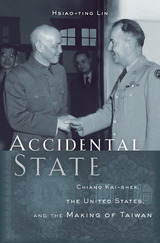
The existence of two Chinese states—one controlling mainland China, the other controlling the island of Taiwan—is often understood as a seemingly inevitable outcome of the Chinese civil war. Defeated by Mao Zedong, Chiang Kai-shek’s Nationalists fled to Taiwan to establish a rival state, thereby creating the “Two Chinas” dilemma that vexes international diplomacy to this day. Accidental State challenges this conventional narrative to offer a new perspective on the founding of modern Taiwan.
Hsiao-ting Lin marshals extensive research in recently declassified archives to show that the creation of a Taiwanese state in the early 1950s owed more to serendipity than careful geostrategic planning. It was the cumulative outcome of ad hoc half-measures and imperfect compromises, particularly when it came to the Nationalists’ often contentious relationship with the United States.
Taiwan’s political status was fraught from the start. The island had been formally ceded to Japan after the First Sino-Japanese War, and during World War II the Allies promised Chiang that Taiwan would revert to Chinese rule after Japan’s defeat. But as the Chinese civil war turned against the Nationalists, U.S. policymakers reassessed the wisdom of backing Chiang. The idea of placing Taiwan under United Nations trusteeship gained traction. Cold War realities, and the fear of Taiwan falling into Communist hands, led Washington to recalibrate U.S. policy. Yet American support of a Taiwan-based Republic of China remained ambivalent, and Taiwan had to eke out a place for itself in international affairs as a de facto, if not fully sovereign, state.

A vivid analysis of the history and revival of clinical psychedelic science
Psychedelic drugs are making a comeback. In the mid-twentieth century, scientists actively studied the potential of drugs like LSD and psilocybin for treating mental health problems. After a decades-long hiatus, researchers are once again testing how effective these drugs are in relieving symptoms for a wide variety of psychiatric conditions, from depression and obsessive–compulsive disorder to posttraumatic stress disorder and substance addiction. In Acid Revival, Danielle Giffort examines how this new generation of researchers and their allies are working to rehabilitate psychedelic drugs and to usher in a new era of psychedelic medicine.
As this team of researchers and mental health professionals revive the field of psychedelic science, they are haunted by the past and by one person in particular: psychedelic evangelist Timothy Leary. Drawing on extensive archival research and interviews with people working on scientific psychedelia, Giffort shows how today’s researchers tell stories about Leary as an “impure” scientist and perform his antithesis to address a series of lingering dilemmas that threaten to rupture their budding legitimacy. Acid Revival presents new information about the so-called psychedelic renaissance and highlights the cultural work involved with the reassembly of dormant areas of medical science.
This colorful and accessible history of the rise, fall, and reemergence of psychedelic medicine is infused with intriguing narratives and personalities—a story for popular science aficionados as well as for scholars of the history of science and medicine.

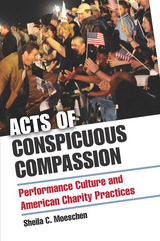
Sheila C. Moeschen sheds new light on the legacy and involvement of disabled people within charity—specifically, the articulation of performance culture as a vital theoretical framework for discussing issues of embodiment and identity, a framework that dislodges previously held notions of the disabled existing as passive “objects” of pity. This work gives rise to a more complicated and nuanced discussion of the participation of the disabled community in the charity industry, of the opportunities afforded by performance culture for disabled people to act as critical agents of charity, and of the new ethical and political issues that arise from employing performance methodology in a culture with increased appetites for voyeurism, display, and complex spectacle.
The civil rights problem of the mid-twentieth century was one of the greatest challenges to the American social fabric since the Civil War. Riots in scores of cities, and serious intergroup tensions and conflicts in thousands more, underlined the seriousness of the problem.
Administrative Implementation of Civil Rights examines the role, operation, and contribution of the device most often relied on by local and state governments for dealing with intergroup problems—the human- relations commission. First used in the early 1940s to deal with discrimination against blacks, this commission was later often charged with implementing the civil rights of other minority groups and of women, the elderly, the handicapped, and the poor. It is Joseph Parker Witherspoon’s thesis that the human-relations commission was not used effectively, that an agency of this type has great strengths that most local and state governments did not utilize, and that its weaknesses are susceptible of remedy and must be eliminated. He explains these weaknesses and develops proposals for correcting them.
Witherspoon examines the roles of the local, state, and federal governments in solving this country’s complicated and serious civil rights problem and demonstrates that a program that carefully coordinates action by the federal government with action by local and state governments could be made to work effectively. As a part of this demonstration he proposes the enactment of a new form of comprehensive civil rights legislation at local, state, and national levels, and presents a series of four model statutes—the Alpha Model Acts—for effectuating his proposals. The approach emphasized in these statutes greatly strengthens the role of the human-relations commission as a law-enforcement agency and, in particular, focuses the operation of federal and state action upon life in the individual community.
The book concludes with a group of appendices listing all state and many local commissions and agencies handling human-relations problems at that time, and summarizing the type of authority, the jurisdiction, the operating budget, and the legislative basis for each. This list will be of interest to those studying the history of civil rights and public policy in the United States.
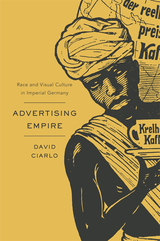
At the end of the nineteenth century, Germany turned toward colonialism, establishing protectorates in Africa, and toward a mass consumer society, mapping the meaning of commodities through advertising. These developments, distinct in the world of political economy, were intertwined in the world of visual culture.
David Ciarlo offers an innovative visual history of each of these transformations. Tracing commercial imagery across different products and media, Ciarlo shows how and why the “African native” had emerged by 1900 to become a familiar figure in the German landscape, selling everything from soap to shirts to coffee. The racialization of black figures, first associated with the American minstrel shows that toured Germany, found ever greater purchase in German advertising up to and after 1905, when Germany waged war against the Herero in Southwest Africa. The new reach of advertising not only expanded the domestic audience for German colonialism, but transformed colonialism’s political and cultural meaning as well, by infusing it with a simplified racial cast.
The visual realm shaped the worldview of the colonial rulers, illuminated the importance of commodities, and in the process, drew a path to German modernity. The powerful vision of racial difference at the core of this modernity would have profound consequences for the future.

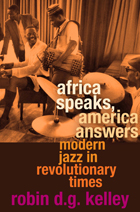
In Bedford-Stuyvesant, Brooklyn, pianist Randy Weston and bassist Ahmed Abdul-Malik celebrated with song the revolutions spreading across Africa. In Ghana and South Africa, drummer Guy Warren and vocalist Sathima Bea Benjamin fused local musical forms with the dizzying innovations of modern jazz. These four were among hundreds of musicians in the 1950s and ’60s who forged connections between jazz and Africa that definitively reshaped both their music and the world.
Each artist identified in particular ways with Africa’s struggle for liberation and made music dedicated to, or inspired by, demands for independence and self-determination. That music was the wild, boundary-breaking exultation of modern jazz. The result was an abundance of conversation, collaboration, and tension between African and African American musicians during the era of decolonization. This collective biography demonstrates how modern Africa reshaped jazz, how modern jazz helped form a new African identity, and how musical convergences and crossings altered politics and culture on both continents.
In a crucial moment when freedom electrified the African diaspora, these black artists sought one another out to create new modes of expression. Documenting individuals and places, from Lagos to Chicago, from New York to Cape Town, Robin Kelley gives us a meditation on modernity: we see innovation not as an imposition from the West but rather as indigenous, multilingual, and messy, the result of innumerable exchanges across a breadth of cultures.
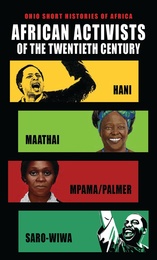
An omnibus collection of concise and up-to-date biographies of four influential figures from modern African history.
Chris Hani, by Hugh Macmillan
Chris Hani was one of the most highly respected leaders of the African National Congress, the South African Communist Party, and uMkhonto we Sizwe. His assassination in 1993 threatened to upset the country’s transition to democracy and prompted an intervention by Nelson Mandela that ultimately accelerated apartheid’s demise.
Wangari Maathai, by Tabitha Kanogo
This concise biography tells the story of Wangari Maathai, the Kenyan activist and Nobel Peace Prize winner who devoted her life to campaigning for environmental conservation, sustainable development, democracy, human rights, gender equality, and the eradication of poverty.
Josie Mpama/Palmer: Get Up and Get Moving, by Robert R. Edgar
Highly critical of the patriarchal attitudes that hindered Black women’s political activism, South Africa’s Josie Mpama/Palmer was an outspoken advocate for women’s social and political equality, a member of the Communist Party of South Africa, and an antiapartheid activist.
Ken Saro-Wiwa, by Roy Doron and Toyin Falola
A penetrating, accessible portrait of the Nigerian activist whose execution galvanized the world. Ken Saro-Wiwa became a martyr and symbolized modern Africans’ struggle against military dictatorship, corporate power, and environmental exploitation.
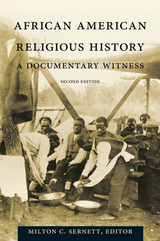
Originally published in 1985, this expanded second edition includes new sources on women, African missions, and the Great Migration. Milton C. Sernett provides a general introduction as well as historical context and comment for each document.
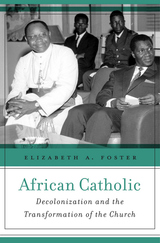
Winner of the John Gilmary Shea Prize
A groundbreaking history of how Africans in the French Empire embraced both African independence and their Catholic faith during the upheaval of decolonization, leading to a fundamental reorientation of the Catholic Church.
African Catholic examines how French imperialists and the Africans they ruled imagined the religious future of French sub-Saharan Africa in the years just before and after decolonization. The story encompasses the political transition to independence, Catholic contributions to black intellectual currents, and efforts to alter the church hierarchy to create an authentically “African” church.
Elizabeth Foster recreates a Franco-African world forged by conquest, colonization, missions, and conversions—one that still exists today. We meet missionaries in Africa and their superiors in France, African Catholic students abroad destined to become leaders in their home countries, African Catholic intellectuals and young clergymen, along with French and African lay activists. All of these men and women were preoccupied with the future of France’s colonies, the place of Catholicism in a postcolonial Africa, and the struggle over their personal loyalties to the Vatican, France, and the new African states.
Having served as the nuncio to France and the Vatican’s liaison to UNESCO in the 1950s, Pope John XXIII understood as few others did the central questions that arose in the postwar Franco-African Catholic world. Was the church truly universal? Was Catholicism a conservative pillar of order or a force to liberate subjugated and exploited peoples? Could the church change with the times? He was thinking of Africa on the eve of Vatican II, declaring in a radio address shortly before the council opened, “Vis-à-vis the underdeveloped countries, the church presents itself as it is and as it wants to be: the church of all.”

By bringing instances of Afro-Asian traffic in the realms of politics, economics, and culture to the foreground, this collection maps an alternative global circuit. The issue examines the non-Eurocentric form of cosmopolitanism that emerged from creative encounters of racialized people in Jazz Age Paris, the Harlem Renaissance, and colonial Shanghai. It reconceptualizes the Indian Ocean as a crucial site for Afro-Asian cross-pollination and investigates the cinematic culture of kung fu as a global discourse of Afro-Asian anti-imperialism.
Contributors. Brent Edwards, Andrew F. Jones, Yukiko Koshiro, Bill Mullen, Vijay Prashad, William Schaefer, Nikhil Pal Singh, Françoise Vergès, Daniel Widener
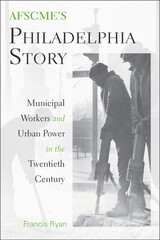
AFSCME's Philadelphia Story provides the most comprehensive account of the early years of the American Federation of State, County and Municipal Employees, which is one of the nation’s largest and most politically powerful unions in the AFL-CIO. Author Francis Ryan details the emergence of the Quaker City's interracial union, charting its beginnings in the political patronage system of one of the nation's most notorious political machines to the first decade of the twenty-first century. Ryan provides new insight into the working class origins of African American political power in the late twentieth century as well as a thorough overview of the role the municipal state played in the urban economy of one of the nation's largest cities.
Ryan describes the work processes and how they changed, and uses workers' testimonies to ground the detailed accounts of issues and negotiations. Beginning in the 1920s and ending in the 2000s, Ryan's study offers a long-term analysis of the growth of a single union in a major American city.
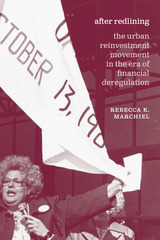
American banks, to their eternal discredit, long played a key role in disenfranchising nonwhite urbanites and, through redlining, blighting the very city neighborhoods that needed the most investment. Banks long showed little compunction in aiding and abetting blockbusting, discrimination, and outright theft from nonwhites. They denied funds to entire neighborhoods or actively exploited them, to the benefit of suburban whites—an economic white flight to sharpen the pain caused by the demographic one.
And yet, the dynamic between banks and urban communities was not static, and positive urban development, supported by banks, became possible. In After Redlining, Rebecca K. Marchiel illuminates how, exactly, urban activists were able to change some banks’ behavior to support investment in communities that they had once abandoned. The leading activists arose in an area hit hard by banks’ discriminatory actions and politics: Chicago’s West Side. A multiracial coalition of low- and moderate-income city residents, this Saul Alinsky–inspired group championed urban reinvestment. And amazingly, it worked: their efforts inspired national action, culminating in the federal Home Mortgage Disclosure Act and the Community Reinvestment Act.
While the battle for urban equity goes on, After Redlining provides a blueprint of hope.
Focusing on Chicago's West Side, After Redlining illuminates how urban activists were able to change banks’ behavior to support investment in communities that they had once abandoned.
American banks, to their eternal discredit, long played a key role in disenfranchising nonwhite urbanites and, through redlining, blighting the very city neighborhoods that needed the most investment. Banks long showed little compunction in aiding and abetting blockbusting, discrimination, and outright theft from nonwhites. They denied funds to entire neighborhoods or actively exploited them, to the benefit of suburban whites—an economic white flight to sharpen the pain caused by the demographic one.
And yet, the dynamic between banks and urban communities was not static, and positive urban development, supported by banks, became possible. In After Redlining, Rebecca K. Marchiel illuminates how, exactly, urban activists were able to change some banks’ behavior to support investment in communities that they had once abandoned. The leading activists arose in an area hit hard by banks’ discriminatory actions and politics: Chicago’s West Side. A multiracial coalition of low- and moderate-income city residents, this Saul Alinsky–inspired group championed urban reinvestment. And amazingly, it worked: their efforts inspired national action, culminating in the federal Home Mortgage Disclosure Act and the Community Reinvestment Act.
While the battle for urban equity goes on, After Redlining provides a blueprint of hope.

Over the last twenty years, a concerted effort has been made to uncover the history of the Holodomor, the Great Famine of 1932–1933 in Ukraine. Now, with the archives opened and the essential story told, it becomes possible to explore in detail what happened after the Holodomor and to examine its impact on Ukraine and its people.
In 2008 the Ukrainian Research Institute at Harvard University hosted an international conference entitled “The Great Famine in Ukraine: The Holodomor and Its Consequences, 1933 to the Present.” The papers, most of which are contained in this volume, concern a wide range of topics, such as the immediate aftermath of the Holodomor and its subsequent effect on Ukraine’s people and communities; World War II, with its wartime and postwar famines; and the impact of the Holodomor on subsequent generations of Ukrainians and present-day Ukrainian culture. Through the efforts of the historians, archivists, and demographers represented here, a fuller history of the Holodomor continues to emerge.
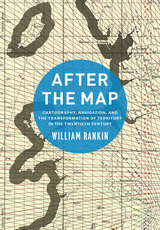
In After the Map, William Rankin argues that although this shift did not render traditional maps obsolete, it did radically change our experience of geographic knowledge, from the God’s-eye view of the map to the embedded subjectivity of GPS. Likewise, older concerns with geographic truth and objectivity have been upstaged by a new emphasis on simplicity, reliability, and convenience. After the Map shows how this change in geographic perspective is ultimately a transformation of the nature of territory, both social and political.
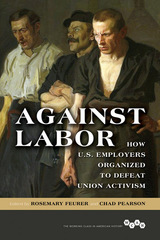
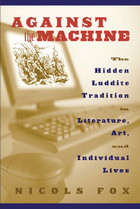
In this timely and incisive work, Nicols Fox examines contemporary resistance to technology and places it in a surprising historical context. She brilliantly illuminates the rich but oftentimes unrecognized literary and philosophical tradition that has existed for nearly two centuries, since the first Luddites—the ""machine breaking"" followers of the mythical Ned Ludd—lifted their sledgehammers in protest against the Industrial Revolution. Tracing that current of thought through some of the great minds of the 19th and 20th centuries—William Blake, Mary Shelley, Charles Dickens, John Ruskin, William Morris, Henry David Thoreau, Ralph Waldo Emerson, Robert Graves, Aldo Leopold, Rachel Carson, and many others—Fox demonstrates that modern protests against consumptive lifestyles and misgivings about the relentless march of mechanization are part of a fascinating hidden history. She shows as well that the Luddite tradition can yield important insights into how we might reshape both technology and modern life so that human, community, and environmental values take precedence over the demands of the machine.
In Against the Machine, Nicols Fox writes with compelling immediacy—bringing a new dimension and depth to the debate over what technology means, both now and for our future.
Michael Rosenfeld offers a new theory of family dynamics to account for the interesting and startling changes in marriage and family composition in the United States in recent years. His argument revolves around the independent life stage that emerged around 1960. This stage is experienced by young adults after they leave their parents' homes but before they settle down to start their own families. During this time, young men and women go away to college, travel abroad, begin careers, and enjoy social independence. This independent life stage has reduced parental control over the dating practices and mate selection of their children and has resulted in a sharp rise in interracial and same-sex unions--unions that were more easily averted by previous generations of parents.
Complementing analysis of newly available census data from the entire twentieth century with in-depth interviews that explore the histories of families and couples, Rosenfeld proposes a conceptual model to explain many social changes that may seem unrelated but that flow from the same underlying logic. He shows, for example, that the more a relationship is transgressive of conventional morality, the more likely it is for the individuals to live away from their family and area of origin.
A New York Times Book Review Editors’ Choice
Responsibility—which once meant the moral duty to help and support others—has come to be equated with an obligation to be self-sufficient. This has guided recent reforms of the welfare state, making key entitlements conditional on good behavior. Drawing on political theory and moral philosophy, Yascha Mounk shows why this re-imagining of personal responsibility is pernicious—and suggests how it might be overcome.
“This important book prompts us to reconsider the role of luck and choice in debates about welfare, and to rethink our mutual responsibilities as citizens.”
—Michael J. Sandel, author of Justice
“A smart and engaging book… Do we so value holding people accountable that we are willing to jeopardize our own welfare for a proper comeuppance?”
—New York Times Book Review
“An important new book… [Mounk] mounts a compelling case that political rhetoric…has shifted over the last half century toward a markedly punitive vision of social welfare.”
—Los Angeles Review of Books
“A terrific book. The insight at its heart—that the conception of responsibility now at work in much public rhetoric and policy is both punitive and ill-conceived—is very important and should be widely heeded.”
—Jedediah Purdy, author of After Nature: A Politics for the Anthropocene
From the Pilgrims who settled at Plymouth Rock to Christian Coalition canvassers working for George W. Bush, Americans have long sought to integrate faith with politics. Few have been as successful as Hollywood evangelist Aimee Semple McPherson.
During the years between the two world wars, McPherson was the most flamboyant and controversial minister in the United States. She built an enormously successful and innovative megachurch, established a mass media empire, and produced spellbinding theatrical sermons that rivaled Tinseltown's spectacular shows. As McPherson's power grew, she moved beyond religion into the realm of politics, launching a national crusade to fight the teaching of evolution in the schools, defend Prohibition, and resurrect what she believed was the United States' Christian heritage. Convinced that the antichrist was working to destroy the nation's Protestant foundations, she and her allies saw themselves as a besieged minority called by God to join the "old time religion" to American patriotism.
Matthew Sutton's definitive study of Aimee Semple McPherson reveals the woman, most often remembered as the hypocritical vamp in Sinclair Lewis's Elmer Gantry, as a trail-blazing pioneer. Her life marked the beginning of Pentecostalism's advance from the margins of Protestantism to the mainstream of American culture. Indeed, from her location in Hollywood, McPherson's integration of politics with faith set precedents for the religious right, while her celebrity status, use of spectacle, and mass media savvy came to define modern evangelicalism.
Aldo Moro’s kidnapping and violent death in 1978 shocked Italy as no other event has during the entire history of the Republic. It had much the same effect in Italy as the assassination of President John F. Kennedy had in the United States, with both cases giving rise to endless conspiracy theories. The dominant Christian Democratic leader for twenty years, Moro had embodied the country’s peculiar religious politics, its values as well as its practices. He was perceived as the most exemplary representative of the Catholic political tradition in Italy. The Red Brigades who killed him thought that in striking Moro they would cause the collapse of the capitalist establishment and clear the way for a Marxist-Leninist revolution.
In his thorough account of the long and anguished quest for justice in the Moro murder case, Richard Drake provides a detailed portrait of the tragedy and its aftermath as complex symbols of a turbulent age in Italian history. Since Moro’s murder, documents from two parliamentary inquiries and four sets of trials explain the historical and political process and illuminate two enduring themes in Italian history. First, the records contain a wealth of examples bearing on the nation’s longstanding culture of ideological extremism and violence. Second, Moro’s story reveals much about the inner workings of democracy Italian style, including the roles of the United States and the Mafia. These insights are especially valuable today in understanding why the Italian establishment is in a state of collapse.
The Moro case also explores the worldwide problem of terrorism. In great detail, the case reveals the mentality, the tactics, and the strategy of the Red Brigades and related groups. Moro’s fate has a universal poignancy, with aspects of a classical Greek tragedy. Drake provides a full historical account of how the Italian people have come to terms with this tragedy.

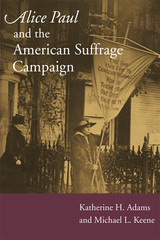
Past biographies, histories, and government documents have ignored Alice Paul's contribution to the women's suffrage movement, but this groundbreaking study scrupulously fills the gap in the historical record. Masterfully framed by an analysis of Paul's nonviolent and visual rhetorical strategies, Alice Paul and the American Suffrage Campaign narrates the remarkable story of the first person to picket the White House, the first to attempt a national political boycott, the first to burn the president in effigy, and the first to lead a successful campaign of nonviolence.
Katherine H. Adams and Michael L. Keene also chronicle other dramatic techniques that Paul deftly used to gain publicity for the suffrage movement. Stunningly woven into the narrative are accounts of many instances in which women were in physical danger. Rather than avoid discussion of Paul's imprisonment, hunger strikes, and forced feeding, the authors divulge the strategies she employed in her campaign. Paul's controversial approach, the authors assert, was essential in changing American attitudes toward suffrage.
The book begins with the Krueger-Scott Mansion’s deep history, followed by the sequence of events surrounding the proposed Cultural Center. Last owned by African-American millionaire and beauty-culture entrepreneur Louise Scott, the Victorian Krueger-Scott Mansion was built by beer baron Gottfried Krueger in 1888. Through the history of the Mansion, and the ultimately failed Cultural Center project, one learns about the Newark that African Americans migrated to, what they found when they got there, how living in the city changed them, and how they, individually and collectively, changed Newark.
After the Cultural Center project was officially halted in 2000, the cassette tapes of the oral history interviews were stored away at the Newark Public Library. Ten years later they were unearthed, and ultimately digitized. As of yet, no one has applied these sources directly to their research. Deeply committed to these rich, insightful stories, Singer calls for a more thoughtful consideration of all cities, reminding us that Newark is much more than its 1967 rebellion.
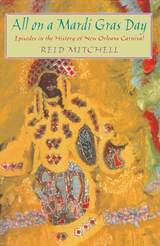
With this colorful study, Reid Mitchell takes us to Mardi Gras--to a yearly ritual that sweeps the richly multicultural city of New Orleans into a frenzy of parades, pageantry, dance, drunkenness, music, sexual display, and social and political bombast. In All on a Mardi Gras Day Mitchell tells us some of the most intriguing stories of Carnival since 1804. Woven into his narrative are observations of the meaning and messages of Mardi Gras--themes of unity, exclusion, and elitism course through these tales as they do through the Crescent City.
Moving through the decades, Mitchell describes the city's diverse cultures coming together to compete in Carnival performances. We observe powerful social clubs, or krewes, designing their elaborate parade displays and extravagant parties; Creoles and Americans in conflict over whose dances belong in the ballroom; enslaved Africans and African Americans preserving a sense of their heritage in processions and dances; white supremacists battling Reconstruction; working-class blacks creating the flamboyant Krewe of Zulu; the birth and reign of jazz; the gay community holding lavish balls; and of course tourists purchasing an authentic experience according to the dictates of our commercial culture. Interracial friction, nativism, Jim Crow separatism, the hippie movement--Mitchell illuminates the expression of these and other American themes in events ranging from the 1901 formation of the anti-prohibitionist Carrie Nation Club to the controversial 1991 ordinance desegregating Carnival parade krewes.
Through the conflicts, Mitchell asserts, "I see in Mardi Gras much what I hear in a really good jazz band: a model for the just society, the joyous community, the heavenly city...A model for community where individual expression is the basis for social harmony and where continuity is the basis for creativity." All on a Mardi Gras Day journeys into a world where hope persists for a rare balance between diversity and unity.
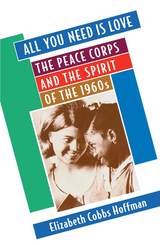
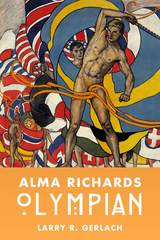
The book traces Richards from his boyhood in rural Parowan, Utah, to Cornell and through his service as an officer in World War I and his teaching career in Los Angeles. His story is that of a remarkable athlete, but also that of a man struggling for personal fulfillment while endeavoring to retain his Mormon heritage amid his changing religious circumstances and participation. More than a century has passed since Alma Richards won an Olympic gold medal, yet this story about man and sport—the drive to excel, victory as validation of hard work, the quest for public recognition and, ultimately, the achievement of self-identity and self-satisfaction—still resonates today.
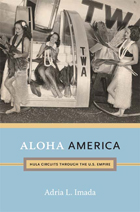
At vaudeville theaters, international expositions, commercial nightclubs, and military bases, Hawaiian women acted as ambassadors of aloha, enabling Americans to imagine Hawai'i as feminine and benign, and the relation between colonizer and colonized as mutually desired. By the 1930s, Hawaiian culture, particularly its music and hula, had enormous promotional value. In the 1940s, thousands of U.S. soldiers and military personnel in Hawai'i were entertained by hula performances, many of which were filmed by military photographers. Yet, as Adria L. Imada shows, Hawaiians also used hula as a means of cultural survival and countercolonial political praxis. In Aloha America, Imada focuses on the years between the 1890s and the 1960s, examining little-known performances and films before turning to the present-day reappropriation of hula by the Hawaiian self-determination movement.
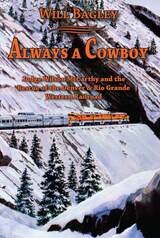
Cowboy, judge, federal official, then business executive, Wilson McCarthy mirrored change and growth in the twentieth-century West. Leading the Denver & Rio Grande back from the brink saved a vital link in the national transportation system. The D&RGW ran over and through the scenic Rockies, developing mineral resources, fighting corporate wars, and helping build communities. The Depression brought it to its knees. Accepting federal assignment to save the line, McCarthy turned it into a paragon of mid-century railroading, represented by the streamlined, Vista-Domed California Zephyr, although success hauling freight was of more economic importance. Prior to that, McCarthy’s life had taken him from driving livestock in Canada to trying to drive the national economy as a director of the Reconstruction Finance Corporation, the first line of federal attack on the Depression. Always a Cowboy positions McCarthy’s story in a rich historical panorama..
Will Bagley is the author of Blood of the Prophets: Brigham Young and the Massacre at Mountain Meadows
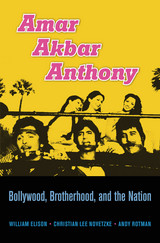
A Bollywood blockbuster when it was released in 1977, Amar Akbar Anthony has become a classic of Hindi cinema and a touchstone of Indian popular culture. Delighting audiences with its songs and madcap adventures, the film follows the heroics of three Bombay brothers separated in childhood from their parents and one another. Beyond the freewheeling comedy and camp, however, is a potent vision of social harmony, as the three protagonists, each raised in a different religion, discover they are true brothers in the end. William Elison, Christian Lee Novetzke, and Andy Rotman offer a sympathetic and layered interpretation of the film’s deeper symbolism, seeing it as a lens for understanding modern India’s experience with secular democracy.
Amar Akbar Anthony’s celebration of an India built on pluralism and religious tolerance continues to resonate with audiences today. But it also invites a critique of modernity’s mixed blessings. As the authors show, the film’s sunny exterior only partially conceals darker elements: the shadow of Partition, the crisis of Emergency Rule, and the vexed implications of the metaphor of the family for the nation. The lessons viewers draw from the film depend largely on which brother they recognize as its hero. Is it Amar, the straight-edge Hindu policeman? Is it Akbar, the romantic Muslim singer? Or is it Anthony, the Christian outlaw with a heart of gold? In this book’s innovative and multi-perspectival approach, each brother makes his case for himself (although the last word belongs to their mother).
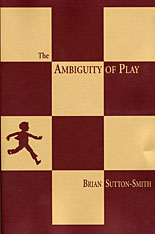
Every child knows what it means to play, but the rest of us can merely speculate. Is it a kind of adaptation, teaching us skills, inducting us into certain communities? Is it power, pursued in games of prowess? Fate, deployed in games of chance? Daydreaming, enacted in art? Or is it just frivolity? Brian Sutton-Smith, a leading proponent of play theory, considers each possibility as it has been proposed, elaborated, and debated in disciplines from biology, psychology, and education to metaphysics, mathematics, and sociology.
Sutton-Smith focuses on play theories rooted in seven distinct “rhetorics”—the ancient discourses of Fate, Power, Communal Identity, and Frivolity and the modern discourses of Progress, the Imaginary, and the Self. In a sweeping analysis that moves from the question of play in child development to the implications of play for the Western work ethic, he explores the values, historical sources, and interests that have dictated the terms and forms of play put forth in each discourse’s “objective” theory.
This work reveals more distinctions and disjunctions than affinities, with one striking exception: however different their descriptions and interpretations of play, each rhetoric reveals a quirkiness, redundancy, and flexibility. In light of this, Sutton-Smith suggests that play might provide a model of the variability that allows for “natural” selection. As a form of mental feedback, play might nullify the rigidity that sets in after successful adaption, thus reinforcing animal and human variability. Further, he shows how these discourses, despite their differences, might offer the components for a new social science of play.
In Ambition, Competition, and Electoral Reform, Jamie L. Carson and Jason M. Roberts present an original study of U.S. congressional elections and electoral institutions for 1872-1944 from a contemporary political science perspective. Using data on late nineteenth and early twentieth century congressional elections, the authors test the applicability in a historical context of modern political science theories, assess the effects of institutional reforms, and identify the factors that shape the competitiveness of elections. They present several key findings: the strategic politicians theory is applicable in an era without candidate-centered campaigns; there was an incumbency advantage prior to the full development of candidate-centered campaigns; institutional reforms have had a significant effect on elections; and the degree of electoral competition frequently correlates with elected officials' responsiveness to citizens.
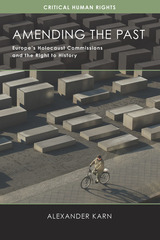
Alexander Karn analyzes more than a dozen Holocaust commissions—in Germany, Switzerland, France, Poland, Austria, Latvia, Lithuania, and elsewhere—in a comparative framework, situating each in the context of past and present politics, to evaluate their potential for promoting justice and their capacity for bringing the perspectives of rival groups more closely together. Karn also evaluates the media coverage these commissions received and probes their public reception from multiple angles.
Arguing that historical commissions have been underused as a tool for conflict management, Karn develops a program for historical mediation and moral reparation that can deepen democratic commitment and strengthen human rights in both transitional regimes and existing liberal states.

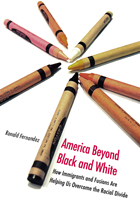
“This book is both powerful and important. Powerful for the testimony it provides from Americans of many different (and even mixed races) about their experiences. And important because there is a racial revolution underway that will upend race as we know it during the twenty-first century.”
—John Kenneth White, Catholic University of America
America Beyond Black and White is a call for a new way of imagining race in America. For the first time in U.S. history, the black-white dichotomy that has historically defined race and ethnicity is being challenged, not by a small minority, but by the fastest-growing and arguably most vocal segment of the increasingly diverse American population—Mexicans, Chinese, Japanese, Koreans, Indians, Arabs, and many more—who are breaking down and recreating the very definitions of race.
Drawing on interviews with hundreds of Americans who don’t fit conventional black/white categories, the author invites us to empathize with these “doubles” and to understand why they may represent our best chance to throw off the strictures of the black/white dichotomy.
The revolution is already underway, as newcomers and mixed-race “fusions” refuse to engage in the prevailing Anglo- Protestant culture. Americans face two choices: understand why these individuals think as they do, or face a future that continues to define us by what divides us rather than by what unites us.
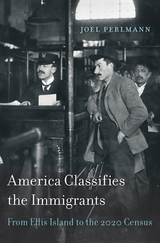
When more than twenty million immigrants arrived in the United States between 1880 and 1920, the government attempted to classify them according to prevailing ideas about race and nationality. But this proved hard to do. Ideas about racial or national difference were slippery, contested, and yet consequential—were “Hebrews” a “race,” a “religion,” or a “people”? As Joel Perlmann shows, a self-appointed pair of officials created the government’s 1897 List of Races and Peoples, which shaped exclusionary immigration laws, the wording of the U.S. Census, and federal studies that informed social policy. Its categories served to maintain old divisions and establish new ones.
Across the five decades ending in the 1920s, American immigration policy built increasingly upon the belief that some groups of immigrants were desirable, others not. Perlmann traces how the debates over this policy institutionalized race distinctions—between whites and nonwhites, but also among whites—in immigration laws that lasted four decades.
Despite a gradual shift among social scientists from “race” to “ethnic group” after the 1920s, the diffusion of this key concept among government officials and the public remained limited until the end of the 1960s. Taking up dramatic changes to racial and ethnic classification since then, America Classifies the Immigrants concentrates on three crucial reforms to the American Census: the introduction of Hispanic origin and ancestry (1980), the recognition of mixed racial origins (2000), and a rethinking of the connections between race and ethnic group (proposed for 2020).
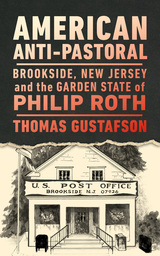
American Anti-Pastoral reads the events in Roth’s novel in relation to the history of Brookside and its region. While Roth’s protagonist Seymour “Swede” Levov initially views Old Rimrock as an idyllic paradise within the Garden State, its real-world counterpart has a more complex past in its origins as a small industrial village, as well as a site for the politics of exclusionary zoning and a 1960s anti-war protest at its celebrated 4th of July parade. Literary historian and Brookside native Thomas Gustafson casts Roth’s canonical novel in a fresh light as he studies both Old Rimrock in comparison to Brookside and the novel in relationship to NJ literature, making a case for it as the Great New Jersey novel. For Roth fans and history buffs alike, American Anti-Pastoral peels back the myths about the bucolic Garden State countryside to reveal deep fissures along the fault-lines of race and religion in American democracy.
Lynching is often viewed as a narrow form of violence: either the spontaneous act of an angry mob against accused individuals, or a demonstration of white supremacy against an entire population considered subhuman. However, in this new treatise, historian Guy Lancaster exposes the multiple forms of violence hidden beneath the singular label of lynching.
Lancaster, who has written extensively on racial violence, details several lynchings of Blacks by white posses in post-Reconstruction Arkansas. Drawing from the fields of history, philosophy, cognitive science, sociology, and literary theory, and quoting chilling contemporary accounts, he argues that the act of lynching encompasses five distinct but overlapping types of violence. This new framework reveals lynching to be even more of an atrocity than previously understood: that mobs did not disregard the humanity of their victims but rather reveled in it; that they were not simply enacting personal vengeance but manifesting an elite project of subjugation. Lancaster thus clarifies and connects the motives and goals of seemingly isolated lynch mobs, embedding the practice in the ongoing enforcement of white supremacy. By interrogating the substance of lynching, American Atrocity shines new light on both past anti-Black violence and the historical underpinnings of our present moment.
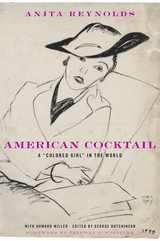
This is the rollicking, never-before-published memoir of a fascinating woman with an uncanny knack for being in the right place in the most interesting times. Of racially mixed heritage, Anita Reynolds was proudly African American but often passed for Indian, Mexican, or Creole. Actress, dancer, model, literary critic, psychologist, but above all free-spirited provocateur, she was, as her Parisian friends nicknamed her, an “American cocktail.”
One of the first black stars of the silent era, she appeared in Hollywood movies with Rudolph Valentino, attended Charlie Chaplin’s anarchist meetings, and studied dance with Ruth St. Denis. She moved to New York in the 1920s and made a splash with both Harlem Renaissance elites and Greenwich Village bohemians. An émigré in Paris, she fell in with the Left Bank avant-garde, befriending Antonin Artaud, Man Ray, and Pablo Picasso. Next, she took up residence as a journalist in Barcelona during the Spanish Civil War and witnessed firsthand the growing menace of fascism. In 1940, as the Nazi panzers closed in on Paris, Reynolds spent the final days before the French capitulation as a Red Cross nurse, afterward making a mad dash for Lisbon to escape on the last ship departing Europe.
In prose that perfectly captures the globetrotting nonchalance of its author, American Cocktail presents a stimulating, unforgettable self-portrait of a truly extraordinary woman.
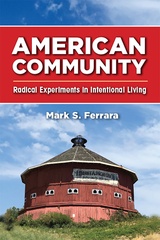
American Community takes us inside forty of the most interesting intentional communities in the nation’s history, from the colonial era to the present day. You will learn about such little-known experiments in cooperative living as the Icarian communities, which took the utopian ideas expounded in a 1840 French novel and put them into practice, ultimately spreading to five states over fifty years. Plus, it covers more recent communities such as Arizona’s Arcosanti, designed by architect Paolo Soleri as a model for ecologically sustainable living.
In this provocative and engaging book, Mark Ferrara guides readers through an array of intentional communities that boldly challenged capitalist economic arrangements in order to attain ideals of harmony, equality, and social justice. By shining a light on these forgotten histories, it shows that far from being foreign concepts, communitarianism and socialism have always been vital parts of the American experience.
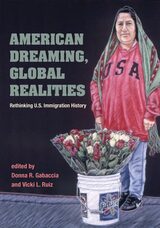
An introduction to the best from the new directions in U.S. immigration history
Representing a selection of the finest new research on immigration, American Dreaming, Global Realities explores the ways in which immigrant lives and those of their children are shaped by transnational bonds, globalization, family ties, and personal choice, and the ways in which they engender a sense of belonging and a sense of themselves as “Americans.”
American Dreaming, Global Realities considers a plurality of very specific historical, economic, regional, familial, and cultural contexts. This history reveals resistance and accommodation, both persistent older traditions and Americanization, plus the creation of new cultural forms blending old and new. The twenty-two interdisciplinary essays included in this collection explore the intricate overlapping of race, class, and gender on ethnic identity and on American citizenship.
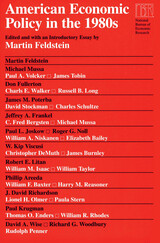
In his introduction, Martin Feldstein provides compelling analysis of policies with which he was closely involved as chairman of the Council of Economic Advisers during the Reagan administration: monetary and exchange rate policy, tax policy, and budget issues. Other leading economists and policymakers examine a variety of domestic and international issues, including monetary and exchange rate policy, regulation and antitrust, as well as trade, tax, and budget policies.
The contributors to this volume are Alberto Alesina, Phillip Areeda, Elizabeth Bailey, William F. Baxter, C. Fred Bergsten, James Burnley, Geoffrey Carliner, Christopher DeMuth, Douglas W. Elmendorf, Thomas O. Enders, Martin Feldstein, Jeffrey A. Frankel, Don Fullerton, William M. Isaac, Paul L Joskow, Paul Krugman, Robert E. Litan, Russell B. Long, Michael Mussa, William A. Niskanen, Roger G. Noll, Lionel H. Olmer, Rudolph Penner, William Poole, James M. Poterba, Harry M. Reasoner, William R. Rhodes, J. David Richardson, Charles Schultze, Paula Stern, David Stockman, William Taylor, James Tobin, W. Kip Viscusi, Paul A. Volcker, Charles E. Walker, David A. Wise, and Richard G. Woodbury.
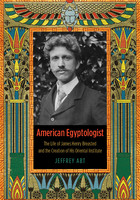
James Henry Breasted (1865–1935) had a career that epitomizes our popular image of the archaeologist. Daring, handsome, and charismatic, he traveled on expeditions to remote and politically unstable corners of the Middle East, helped identify the tomb of King Tut, and was on the cover of Time magazine. But Breasted was more than an Indiana Jones—he was an accomplished scholar, academic entrepreneur, and talented author who brought ancient history to life not just for students but for such notables as Teddy Roosevelt and Sigmund Freud.
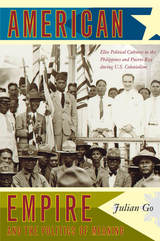
American Empire and the Politics of Meaning is an examination of how these efforts to provide the elite of Puerto Rico and the Philippines a practical education in self-government played out on the ground in the early years of American colonial rule, from 1898 until 1912. It is the first systematic comparative analysis of these early exercises in American imperial power. The sociologist Julian Go unravels how American authorities used “culture” as both a tool and a target of rule, and how the Puerto Rican and Philippine elite received, creatively engaged, and sometimes silently subverted the Americans’ ostensibly benign intentions. Rather than finding that the attempt to transplant American-style democracy led to incommensurable “culture clashes,” Go assesses complex processes of cultural accommodation and transformation. By combining rich historical detail with broader theories of meaning, culture, and colonialism, he provides an innovative study of the hidden intersections of political power and cultural meaning-making in America’s earliest overseas empire.
In a challenging, provocative book, Andrew Bacevich reconsiders the assumptions and purposes governing the exercise of American global power. Examining the presidencies of George H. W. Bush and Bill Clinton--as well as George W. Bush's first year in office--he demolishes the view that the United States has failed to devise a replacement for containment as a basis for foreign policy. He finds instead that successive post-Cold War administrations have adhered to a well-defined "strategy of openness." Motivated by the imperative of economic expansionism, that strategy aims to foster an open and integrated international order, thereby perpetuating the undisputed primacy of the world's sole remaining superpower. Moreover, openness is not a new strategy, but has been an abiding preoccupation of policymakers as far back as Woodrow Wilson.
Although based on expectations that eliminating barriers to the movement of trade, capital, and ideas nurtures not only affluence but also democracy, the aggressive pursuit of openness has met considerable resistance. To overcome that resistance, U.S. policymakers have with increasing frequency resorted to force, and military power has emerged as never before as the preferred instrument of American statecraft, resulting in the progressive militarization of U.S. foreign policy.
Neither indictment nor celebration, American Empire sees the drive for openness for what it is--a breathtakingly ambitious project aimed at erecting a global imperium. Large questions remain about that project's feasibility and about the human, financial, and moral costs that it will entail. By penetrating the illusions obscuring the reality of U.S. policy, this book marks an essential first step toward finding the answers.
Historians investigate the relationships between film, culture, and energy.
American Energy Cinema explores how Hollywood movies have portrayed energy from the early film era to the present. Looking at classics like Giant, Silkwood, There Will Be Blood, and Matewan, and at quirkier fare like A Is for Atom and Convoy, it argues that films have both reflected existing beliefs and conjured new visions for Americans about the role of energy in their lives and their history.
The essays in this collection show how film provides a unique and informative lens to understand perceptions of energy production, consumption, and infrastructure networks. By placing films that prominently feature energy within historical context and analyzing them as historical objects, the contributing authors demonstrate how energy systems of all kinds are both integral to the daily life of Americans and inextricable from larger societal changes and global politics.
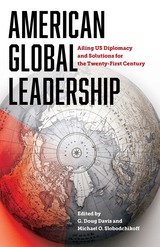
Among other themes, the discussions in this volume explore the relevance of diplomacy in resolving global crises, the use of military policy and force as diplomatic tools, skills diplomats should possess, and current obstacles facing US foreign policy. Through the lens of their professional service as US diplomats, the authors examine American mistakes and successes of the past seventy years to assess how the role of diplomacy within US foreign policy has changed over time and how it must continue to evolve to meet future challenges. One conclusion proves recurrent: the US can no longer afford to rely only on might and force but must rededicate itself to diplomatic strategies to achieve its long-term goals.
American Global Leadership is not just a valuable resource for scholars of diplomatic history and political science; it is also an important work for current diplomats and those aspiring to careers in the US Foreign Service.
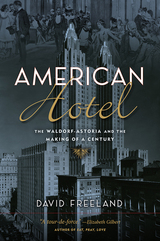
American Hotel takes us behind the glittering image to reveal the full extent of the Waldorf’s contribution toward shaping twentieth-century life and culture. Historian David Freeland examines the Waldorf from the opening of its first location in 1893 through its rise to a place of influence on the local, national, and international stage. Along the way, he explores how the hotel’s mission to provide hospitality to a diverse range of guests was put to the test by events such as Prohibition, the anticommunist Red Scare, and civil rights struggles.
Alongside famous guests like Frank Sinatra, Martin Luther King, Richard Nixon, and Eleanor Roosevelt, readers will meet the lesser-known men and women who made the Waldorf a leader in the hotel industry and a key setting for international events. American Hotel chronicles how institutions such as the Waldorf-Astoria played an essential role in New York’s growth as a world capital.
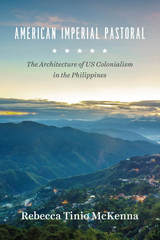
In American Imperial Pastoral, Rebecca Tinio McKenna examines the design, construction, and use of Baguio, making visible the physical shape, labor, and sustaining practices of the US’s new empire—especially the dispossessions that underwrote market expansion. In the process, she demonstrates how colonialists conducted market-making through state-building and vice-versa. Where much has been made of the racial dynamics of US colonialism in the region, McKenna emphasizes capitalist practices and design ideals—giving us a fresh and nuanced understanding of the American occupation of the Philippines.

American Interests and Policies in the Middle East, 1900-1939 was first published in
1963. Minnesota Archive Editions uses digital technology to make long-unavailable books once again accessible, and are published unaltered from the original University of Minnesota Press editions.Scholars concerned with the diplomatic history of the United States have largely neglected the subject of American relations with the Middle East during the four decades before World War I. With this study, Professor DeNovo fills the gap by describing and assessing the United States' cultural, economic, and diplomatic relations with Turkey, Persia, and the Arab East in that period. He traces, chronologically and topically, the activities of such American interest groups as Protestant missionaries, educators, philanthropists, archaeologists, businessmen, and technical advisers, as well as the official actions of their government.
The account falls roughly into three chronological periods. The first section traces the interest groups through the pre-World War I years of political and cultural stirring in the Ottoman Empire and Persia. Special attention is given to the Chester Project for railroad development in Turkey. The second part deals with the upheavals accompanying World War I and the tasks of peacemaking from the Mudros armistice through the Lausanne settlement of 1923. The latter chapters detail the rise of the Turkish national movement, the deepening Persian and Arab nationalism, and the accommodation of American cultural and economic groups to these conditions. The author points out that before World War II began, Americans had acquired a significant interest in Middle Eastern oil and had become emotionally involved in the Arab-Zionist tension. In 1939 the United States was on the verge of a new phase in its Middle Eastern relations when that region would become more intimately linked to America's national security.
The Western Federation of Miners
James C. Foster, D. H. Dinwoodie
The Industrial Workers of the World
Earl Bruce White, James Byrkit
The Rise of Unionized Farm Workers
H. L. Mitchell, Edward D. Beechert, Art Carstens
Mexican Labor, North and South of the Border
John M. Hart, Rodney Anderson, David Maciel
Labor and Politics
Paul Mandel, George N. Green, Charles O. Rice
In 1895 there was not a single case of dementia praecox reported in the United States. By 1912 there were tens of thousands of people with this diagnosis locked up in asylums, hospitals, and jails. By 1927 it was fading away . How could such a terrible disease be discovered, affect so many lives, and then turn out to be something else?
In vivid detail, Richard Noll describes how the discovery of this mysterious disorder gave hope to the overworked asylum doctors that they could at last explain—though they could not cure—the miserable patients surrounding them. The story of dementia praecox, and its eventual replacement by the new concept of schizophrenia, also reveals how asylum physicians fought for their own respectability. If what they were observing was a disease, then this biological reality was amenable to scientific research. In the early twentieth century, dementia praecox was psychiatry’s key into an increasingly science-focused medical profession.
But for the moment, nothing could be done to help the sufferers. When the concept of schizophrenia offered a fresh understanding of this disorder, and hope for a cure, psychiatry abandoned the old disease for the new. In this dramatic story of a vanished diagnosis, Noll shows the co-dependency between a disease and the scientific status of the profession that treats it. The ghost of dementia praecox haunts today’s debates about the latest generation of psychiatric disorders.
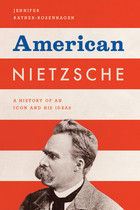
If you were looking for a philosopher likely to appeal to Americans, Friedrich Nietzsche would be far from your first choice. After all, in his blazing career, Nietzsche took aim at nearly all the foundations of modern American life: Christian morality, the Enlightenment faith in reason, and the idea of human equality. Despite that, for more than a century Nietzsche has been a hugely popular—and surprisingly influential—figure in American thought and culture.
In American Nietzsche, Jennifer Ratner-Rosenhagen delves deeply into Nietzsche's philosophy, and America’s reception of it, to tell the story of his curious appeal. Beginning her account with Ralph Waldo Emerson, whom the seventeen-year-old Nietzsche read fervently, she shows how Nietzsche’s ideas first burst on American shores at the turn of the twentieth century, and how they continued alternately to invigorate and to shock Americans for the century to come. She also delineates the broader intellectual and cultural contexts within which a wide array of commentators—academic and armchair philosophers, theologians and atheists, romantic poets and hard-nosed empiricists, and political ideologues and apostates from the Left and the Right—drew insight and inspiration from Nietzsche’s claims for the death of God, his challenge to universal truth, and his insistence on the interpretive nature of all human thought and beliefs. At the same time, she explores how his image as an iconoclastic immoralist was put to work in American popular culture, making Nietzsche an unlikely posthumous celebrity capable of inspiring both teenagers and scholars alike.
A penetrating examination of a powerful but little-explored undercurrent of twentieth-century American thought and culture, American Nietzsche dramatically recasts our understanding of American intellectual life—and puts Nietzsche squarely at its heart.
“The ghosts of the Civil War never leave us, as David Blight knows perhaps better than anyone, and in this superb book he masterfully unites two distant but inextricably bound events.”―Ken Burns
Standing on the steps of the Lincoln Memorial on August 28, 1963, a century after the signing of the Emancipation Proclamation, Martin Luther King, Jr., declared, “One hundred years later, the Negro still is not free.” He delivered this speech just three years after the Virginia Civil War Commission published a guide proclaiming that “the Centennial is no time for finding fault or placing blame or fighting the issues all over again.”
David Blight takes his readers back to the centennial celebration to determine how Americans then made sense of the suffering, loss, and liberation that had wracked the United States a century earlier. Amid cold war politics and civil rights protest, four of America’s most incisive writers explored the gulf between remembrance and reality. Robert Penn Warren, the southern-reared poet-novelist who recanted his support of segregation; Bruce Catton, the journalist and U.S. Navy officer who became a popular Civil War historian; Edmund Wilson, the century’s preeminent literary critic; and James Baldwin, the searing African-American essayist and activist—each exposed America’s triumphalist memory of the war. And each, in his own way, demanded a reckoning with the tragic consequences it spawned.
Blight illuminates not only mid-twentieth-century America’s sense of itself but also the dynamic, ever-changing nature of Civil War memory. On the eve of the 150th anniversary of the war, we have an invaluable perspective on how this conflict continues to shape the country’s political debates, national identity, and sense of purpose.
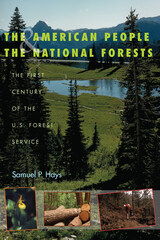
The year 2005 marked the centennial of the founding of the United States Forest Service (USFS). Samuel P. Hays uses this occasion to present a cogent history of the role of American society in shaping the policies and actions of this agency.
From its establishment in 1905 under the auspices of the Department of Agriculture, timber and grazing management dominated the agency's agenda. Due to high consumer demand for wood products and meat from livestock, the USFS built a formidable system of forest managers, training procedures, and tree science programs to specifically address these needs. This strong internal organization bolstered the agency during the tumultuous years in the final one-third of the century—when citizens and scientists were openly critical of USFS policies—yet it restricted the agency's vision and adaptability on environmental issues. A dearth of ecological capabilities tormented the USFS in 1960 when the Multiple-Use and Sustained-Yield Act set new statutes for the preservation of wildlife, recreation, watershed, and aesthetic resources. This was followed by the National Forest Management Act of 1976, which established standards for the oversight of forest ecosystems. The USFS was ill equipped to handle the myriad administrative and technological complexities that these mandates required.
In The American People and the National Forests, Hays chronicles three distinct periods in USFS history, provides a summarizing “legacy” for each, and outlines the public and private interests, administrators, and laws that guided the agency's course and set its priorities. He demonstrates how these legacies affected successive eras, how they continue to influence USFS policy in the twenty-first century, and why USFS policies should matter to all of us.
American Policy Toward Communist Eastern Europe was first published in 1965. Minnesota Archive Editions uses digital technology to make long-unavailable books once again accessible, and are published unaltered from the original University of Minnesota Press editions.
Perhaps no aspect of American foreign relations has been in greater need of clarification and understanding than our policy toward the Communist nations of Eastern Europe, both as to what has happened in the past and what is possible for the future. In this book a former State Department Official, now on the staff of the Council on Foreign Relations, provides objective information which will help students, professors, members of adult study groups, and others concerned with American foreign policy to understand and discuss this important subject.
Mr. Campbell reminds us that the cold war began in Eastern Europe in the aftermath of the second World War. Since that time, the question of what to do about Eastern Europe has been in the forefront of American foreign policy. For some years, he contends, we have been uncertain of our objectives and ambivalent in our policies. Meanwhile, changes since the death of Stalin have created new situations both for the Soviet Union and for the West.In analyzing what has happened, the author emphasizes the forces which have shaken the unity of the Soviet bloc to create new perspectives and possibilities. He discusses the effects of the Soviet- Chinese split, the relationship of the German question to that of Eastern Europe, and the phenomenon of national Communism as it has appeared in different forms in Yugoslavia, Poland, Rumania, and elsewhere.After presenting the historical background, the author discusses American aims and current policies and outlines the choices he sees ahead. He does not plead for any one of the alternative lines of action, presenting them, rather, as a basis for reasoned consideration and debate.
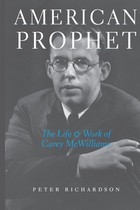
Peter Richardson's absorbing and elegantly paced book reveals a figure thoroughly engaged with the issues of his time. Deftly interweaving correspondence, diary notes, published writings, and McWilliams's own and others' observations on a colorful and influential cast of characters from Hollywood, New York, Washington, DC, and the American West, Richardson maps the evolution of McWilliams's personal and professional life. Among those making an appearance are H. L. Mencken (McWilliams's mentor and role model), Louis Adamic, John Fante, Robert Towne, Richard Nixon, Studs Terkel, J. Edgar Hoover, Arthur Schlesinger, Jr., and Joseph McCarthy.
American Prophet illustrates the arc of McWilliams's life and career from his early literary journalism through his legal and political activism, his stint in state government, and his two decades as editor of the Nation. This book makes the case for McWilliams's place in the Olympian realm of our most influential and prescient political writers.
Peter Richardson is the editorial director at PoliPointPress in Sausalito, California. He is the author or editor of numerous works on language, literature, and California public policy. He holds a Ph.D. in English from the University of California Berkeley.
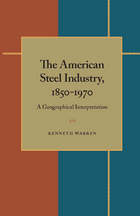
In major discussions of the east coast, Pittsburgh, the Ohio Valley, the Great Lakes, the South and the West, Warren analyzes the location and relocation of steel plants over 120 years. He explains the influence on location of a variety of factors: The accessibility of resources, the cost of transportation, the existence of specialized markets, and the availability of entrepreneurial skills, capital, and labor. He also evaluates the role of management in the development of the industry, through an analysis of individual companies, including Bethlehem, Carnegie, United States Steel, Kaiser, Inland, Jones and Laughlin, and Youngstown Sheet and Tube.
Warren examines the influence exerted on the industry by complex technological changes and weighs their significance against market forces and the supply of natural resources. In the production process alone, the industry changed from pig iron to steel; from charcoal to anthracite; to bituminous coking coal; and from the widespread use of low-grade ore from the eastern United States, to the high quality but localized deposits of the Upper Great Lakes, to imported ores.
Unlike other industrialized nations, the United States has undergone major geographical shifts in steel consumption since the 1850s. As the American population moved south and west into new territory, steel followed. Warren concludes that these radical alterations in the distribution and demand were the decisive force in the location of steel production.
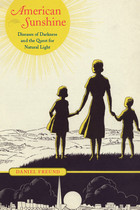
In the second half of the nineteenth century, American cities began to go dark. Hulking new buildings overspread blocks, pollution obscured the skies, and glass and smog screened out the health-giving rays of the sun. Doctors fed anxities about these new conditions with claims about a rising tide of the "diseases of darkness," especially rickets and tuberculosis.
In American Sunshine, Daniel Freund tracks the obsession with sunlight from those bleak days into the twentieth century. Before long, social reformers, medical professionals, scientists, and a growing nudist movement proffered remedies for America’s new dark age. Architects, city planners, and politicians made access to sunlight central to public housing and public health. and entrepreneurs, dairymen, and tourism boosters transformed the pursuit of sunlight and its effects into a commodity. Within this historical context, Freund sheds light on important questions about the commodification of health and nature and makes an original contribution to the histories of cities, consumerism, the environment, and medicine.
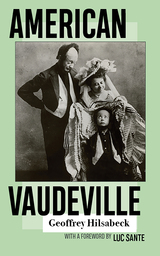
At the heart of American Vaudeville is one strange, unsettling fact: for nearly fifty years, from the late nineteenth century to the 1930s, vaudeville was everywhere—then, suddenly, it was nowhere. This book tells the story of what was once the most popular form of entertainment in the country using lists, creation myths, thumbnail biographies, dreams, and obituaries. A lyric history—part social history, part song—American Vaudeville sits at the nexus between poetry, experimental nonfiction, and, because it includes historic images, art books.
Geoffrey Hilsabeck’s book grows out of extensive archival research. Rather than arranging that research—the remains of vaudeville—into a realistic picture or tidy narrative, Hilsabeck dreams vaudeville back into existence, drawing on photographs, letters, joke books, reviews, newspaper stories, anecdotes, and other material gathered from numerous archives, as well as from memoirs by vaudeville performers like Buster Keaton, Eva Tanguay, and Eddie Cantor. Some of this research is presented as-is, a letter from a now forgotten vaudeville performer to her booking agent, for example; some is worked up into brief scenes and biographies; and some is put to even more imaginative uses, finding new life in dialogues and prose poems.
American Vaudeville pulls the past into the present and finds in the beauty and carnivalesque grotesqueness of vaudeville a fitting image of American life today.
After more than four decades, the Viet Nam War continues to haunt our national memory, culture, politics, and military actions. In this probing interdisciplinary study, Susan Lyn Eastman examines a range of cultural productions—from memorials and poetry to cinematic and fictional narratives—that have tried to grapple with the psychic afterlife of traumatic violence resulting from the ill-fated conflict in Southeast Asia.
Underpinning the book is the notion of “prosthetic memory,” which involves memories acquired by those with no direct experience of the war, such as readers and filmgoers. Prosthetic memories, Eastman argues, refuse to relegate the war to the forgotten past and challenge the authenticity of experience, thus ensuring its continued relevance to debates over America’s self-conception, specifically her coinage of the “New Vietnam Syndrome,” and the country’s role in world affairs when it comes to contemporary military interventions.
With the notable exception of the Veterans’ Memorial in Washington, Eastman’s focus is on works produced from the Persian Gulf War (1990–91) through the post-9/11 “War on Terror.” She looks not only at American representations of the war—from movies like Randall Wallace’s We Were Soldiers to poems by W. D. Ehrhart, Yusef Komunyakaa, and others—but also at novels by Vietnamese authors Bao Ninh and Huong Thu Duong. The experiences of women figure prominently in the book: Eastman devotes a chapter to the Vietnam Women’s Memorial and another to Sandie Frazier’s novel I Married Vietnam and Oliver Stone’s film Heaven and Earth, based on memoirs by Le Ly Hayslip. And by examining Jessica Hagedorn’s Dream Jungle, a novel inspired by the filming of Apocalypse Now, she considers how the war’s repercussions were felt in other countries, in this case the Philippines. Her investigation of Vietnamese American authors Lan Cao, Andrew Lam, and GB Tran adds a transnational dimension to the study.

After more than four decades, the Viet Nam War continues to haunt our national memory, culture, politics, and military actions. In this probing interdisciplinary study, Susan Lyn Eastman examines a range of cultural productions—from memorials and poetry to cinematic and fictional narratives—that have tried to grapple with the psychic afterlife of traumatic violence resulting from the ill-fated conflict in Southeast Asia.
Underpinning the book is the notion of “prosthetic memory,” which involves memories acquired by those with no direct experience of the war, such as readers and filmgoers. Prosthetic memories, Eastman argues, refuse to relegate the war to the forgotten past and challenge the authenticity of experience, thus ensuring its continued relevance to debates over America’s self-conception, specifically her coinage of the “New Vietnam Syndrome,” and the country’s role in world affairs when it comes to contemporary military interventions.
With the notable exception of the Veterans’ Memorial in Washington, Eastman’s focus is on works produced from the Persian Gulf War (1990–91) through the post-9/11 “War on Terror.” She looks not only at American representations of the war—from movies like Randall Wallace’s We Were Soldiers to poems by W. D. Ehrhart, Yusef Komunyakaa, and others—but also at novels by Vietnamese authors Bao Ninh and Huong Thu Duong. The experiences of women figure prominently in the book: Eastman devotes a chapter to the Vietnam Women’s Memorial and another to Sandie Frazier’s novel I Married Vietnam and Oliver Stone’s film Heaven and Earth, based on memoirs by Le Ly Hayslip. And by examining Jessica Hagedorn’s Dream Jungle, a novel inspired by the filming of Apocalypse Now, she considers how the war’s repercussions were felt in other countries, in this case the Philippines. Her investigation of Vietnamese American authors Lan Cao, Andrew Lam, and GB Tran adds a transnational dimension to the study.
Every May, a sea of 250,000 people decked out in red and white head to Chicago’s Loop to celebrate the Polish Constitution Day Parade. In the city, you can tune in to not one but four different Polish-language radio stations or jam out to the Polkaholics. You can have lunch at pierogi food trucks or pick up pączkis at the grocery store. And if you’re lucky, you get to take off work for Casimir Pulaski Day. For more than a century, Chicago has been home to one of the largest Polish populations outside of Poland, and the group has had an enormous influence on the city’s culture and politics. Yet, until now, there has not been a comprehensive history of the Chicago Polonia.
With American Warsaw, award-winning historian and Polish American Dominic A. Pacyga chronicles more than a century of immigration, and later emigration back to Poland, showing how the community has continually redefined what it means to be Polish in Chicago. He takes us from the Civil War era until today, focusing on how three major waves of immigrants, refugees, and fortune seekers shaped and then redefined the Polonia. Pacyga also traces the movement of Polish immigrants from the peasantry to the middle class and from urban working-class districts dominated by major industries to suburbia. He documents Polish Chicago’s alignments and divisions: with other Chicago ethnic groups; with the Catholic Church; with unions, politicians, and city hall; and even among its own members. And he explores the ever-shifting sense of Polskość, or “Polishness.”
Today Chicago is slowly being eclipsed by other Polish immigrant centers, but it remains a vibrant—and sometimes contentious—heart of the Polish American experience. American Warsaw is a sweeping story that expertly depicts a people who are deeply connected to their historical home and, at the same time, fiercely proud of their adopted city. As Pacyga writes, “While we were Americans, we also considered ourselves to be Poles. In that strange Chicago ethnic way, there was no real difference between the two.”
Wartime hysteria over "foreign" ways fueled a movement for Americanization that swept the United States during and after World War I. Eileen H. Tamura examines the forms that hysteria took in Hawai'i, where the Nisei (children of Japanese immigrants) were targets of widespread discrimination.
Tamura analyzes Hawaii's organized effort to force the Nisei to adopt "American" ways, discussing it within the larger phenomenon of Nisei acculturation. While racism was prevalent in "paradise," the Nisei and their parents also performed as active agents in their own lives, with the older generation attempting to maintain Japanese cultural ways and the younger wishing to become "true Americans." Caucasian "Americanizers," often associated with powerful agricultural interests, wanted labor to remain cheap and manageable; they lobbied for racist laws and territorial policies, portending the treatment of ethnic Japanese on the U.S. mainland during World War II.
Tamura offers a wealth of original source material, using personal accounts as well as statistical data to create an essential resource for students of American ethnic history and U.S. race and class relations.
American social critics in the 1970s, convinced that their nation was in decline, turned to psychoanalysis for answers and seized on narcissism as the sickness of the age. Books indicting Americans as greedy, shallow, and self-indulgent appeared, none more influential than Christopher Lasch’s famous 1978 jeremiad The Culture of Narcissism. This line of critique reached a crescendo the following year in Jimmy Carter’s “malaise speech” and has endured to this day.
But as Elizabeth Lunbeck reveals, the American critics missed altogether the breakthrough in psychoanalytic thinking that was championing narcissism’s positive aspects. Psychoanalysts had clashed over narcissism from the moment Freud introduced it in 1914, and they had long been split on its defining aspects: How much self-love, self-esteem, and self-indulgence was normal and desirable? While Freud’s orthodox followers sided with asceticism, analytic dissenters argued for gratification. Fifty years later, the Viennese émigré Heinz Kohut led a psychoanalytic revolution centered on a “normal narcissism” that he claimed was the wellspring of human ambition, creativity, and empathy. But critics saw only pathology in narcissism. The result was the loss of a vital way to understand ourselves, our needs, and our desires.
Narcissism’s rich and complex history is also the history of the shifting fortunes and powerful influence of psychoanalysis in American thought and culture. Telling this story, The Americanization of Narcissism ultimately opens a new view on the central questions faced by the self struggling amid the tumultuous crosscurrents of modernity.
—James Carroll, author of House of War and An American Requiem, winner of the National Book Award
“Anne Mackin has taken a fresh and provocative look at that most fascinating of relationships: the one between the American people and the American land.”
—Michael Pollan, Knight Professor of Journalism and Director of the Knight Program in Science and Environmental Journalism at University of California Berkeley, contributing writer to the New York Times Magazine, and author of The Omnivore's Dilemma and The Botany of Desire
“Anne Mackin has given us a valuable and less-used lens to view the development of our neighborhoods, towns and cities: the land itself. Our relationship to the earth beneath our feet—how we dig it, buy it, sell it, zone it, pave it, spoil it or pamper it—helps explain what is produced on top of the land in our nation, from farms to homes to skyscrapers. All in all, Mackin takes us on a novel and erudite journey, from one coast to the other, and from Colonial times to the present. This valuable book marks a significant and lasting contribution to the way we see and understand our landscape and ourselves.”
—Alex Marshall, author of How Cities Work: Suburbs, Sprawl, and the Roads Not Taken
“To really understand the origins of the range war now raging between smart growth and property rights advocates over the future of the American land, you need to read this exceptional book.”
—Robert D. Yaro, President Regional Plan Association and Professor in Practice, University of Pennsylvania
Thomas Malthus once said, “The happiness of the Americans depended much less upon their peculiar degree of civilization than . . . upon their having a great plenty of fertile uncultivated land.”
Malthus knew. Lord MacCaulay knew. Albert Gallatin knew. America and its people would change as a growing population whittled away the supply of land.
Nothing has shaped the American character like the abundance of land that met the colonist, the pioneer, and the early suburbanite. With today’s political and economic institutions shaped by the largesse of yesteryear, how will Americans fare in the new landscape of water wars, expensive housing, rising fuel prices, environmental and property rights battles, and powerful industrial lobbies?
Why is land the key to American democracy? How can we protect our democracy as more people and industries compete more intensively for our remaining resources? Americans and Their Land begins an important, overdue discussion of these questions. Anne Mackin takes the reader story by story from frontier history to the present and shows how land shaped the American political landscape. She shows how our evolving traditions of apportioning resources have allowed diminished supplies to create our present, increasingly unequal society, and she asks how 300 million Americans living in the new American landscape of growing competition can better share those resources.
In Americans First, K. Scott Wong uses archival research and oral histories to provide the first detailed account of Chinese Americans in the American military. Wong traces the history of the 14th Air Service Group, a segregated outfit of Chinese Americans sent to China in support of the American Army Air Corps and the Chinese Air Force. His ethnic history of inclusion shows how this new generation of Chinese Americans was more socially accepted, moving from the margins of society into the American mainstream during a time of pervasive racism.
When railroads connected the United States and Mexico in 1884 and overland travel between the two countries became easier and cheaper, Americans developed an intense curiosity about Mexico, its people, and its opportunities for business and pleasure. Indeed, so many Americans visited Mexico during the Porfiriato (the long dictatorship of Porfirio Díaz, 1876–1911) that observers on both sides of the border called the hordes of tourists and business speculators a “foreign invasion,” an apt phrase for a historical moment when the United States was expanding its territory and influence.
Americans in the Treasure House examines travel to Mexico during the Porfiriato, concentrating on the role of travelers in shaping ideas of Mexico as a logical place for Americans to extend their economic and cultural influence in the hemisphere. Analyzing a wealth of evidence ranging from travelogues and literary representations to picture postcards and snapshots, Jason Ruiz demonstrates that American travelers constructed Mexico as a nation at the cusp of modernity, but one requiring foreign intervention to reach its full potential. He shows how they rationalized this supposed need for intervention in a variety of ways, including by representing Mexico as a nation that deviated too dramatically from American ideals of progress, whiteness, and sexual self-control to become a modern “sister republic” on its own. Most importantly, Ruiz relates the rapid rise in travel and travel discourse to complex questions about national identity, state power, and economic relations across the U.S.–Mexico border.
In 1973, not long after the last American combat troops returned from Vietnam, President Nixon fulfilled his campaign promise and ended the draft. No longer would young men find their futures determined by the selective service system; nor would the U.S. military have a guaranteed source of recruits.
America’s Army is the story of the all-volunteer force, from the draft protests and policy proposals of the 1960s through the Iraq War. It is also a history of America in the post-Vietnam era. In the Army, America directly confronted the legacies of civil rights and black power, the women’s movement, and gay rights. The volunteer force raised questions about the meaning of citizenship and the rights and obligations it carries; about whether liberty or equality is the more central American value; what role the military should play in American society not only in time of war, but in time of peace. And as the Army tried to create a volunteer force that could respond effectively to complex international situations, it had to compete with other “employers” in a national labor market and sell military service alongside soap and soft drinks.
Based on exhaustive archival research, as well as interviews with Army officers and recruiters, advertising executives, and policy makers, America’s Army confronts the political, moral, and social issues a volunteer force raises for a democratic society as well as for the defense of our nation.
The Cold War dominated world affairs during the half century following World War II. It ended in victory for the United States, yet it was a costly triumph, claiming trillions of dollars in defense spending and the lives of nearly 100,000 U.S. soldiers. Apocalyptic anti-communism sharply limited the range of acceptable political debate, while American actions overseas led to the death of millions of innocent civilians and destabilized dozens of nations that posed no threat to the United States.
In a brilliant new interpretation, Campbell Craig and Fredrik Logevall reexamine the successes and failures of America’s Cold War. The United States dealt effectively with the threats of Soviet predominance in Europe and of nuclear war in the early years of the conflict. But in engineering this policy, American leaders successfully paved the way for domestic actors and institutions with a vested interest in the struggle’s continuation. Long after the U.S.S.R. had been effectively contained, Washington continued to wage a virulent Cold War that entailed a massive arms buildup, wars in Korea and Vietnam, the support of repressive regimes and counterinsurgencies, and a pronounced militarization of American political culture.
American foreign policy after 1945 was never simply a response to communist power or a crusade contrived solely by domestic interests. It was always an amalgamation of both. This provocative book lays bare the emergence of a political tradition in Washington that feeds on external dangers, real or imagined, a mindset that inflames U.S. foreign policy to this day.
“A creative, carefully researched, and incisive analysis of U.S. strategy during the long struggle against the Soviet Union.”
—Stephen M. Walt, Foreign Policy
“Craig and Logevall remind us that American foreign policy is decided as much by domestic pressures as external threats. America’s Cold War is history at its provocative best.”
—Mark Atwood Lawrence, author of The Vietnam War
The Cold War dominated world affairs during the half century following World War II. America prevailed, but only after fifty years of grim international struggle, costly wars in Korea and Vietnam, trillions of dollars in military spending, and decades of nuclear showdowns. Was all of that necessary?
In this new edition of their landmark history, Campbell Craig and Fredrik Logevall engage with recent scholarship on the late Cold War, including the Reagan and Bush administrations and the collapse of the Soviet regime, and expand their discussion of the nuclear revolution and origins of the Vietnam War. Yet they maintain their original argument: that America’s response to a very real Soviet threat gave rise to a military and political system in Washington that is addicted to insecurity and the endless pursuit of enemies to destroy. America’s Cold War speaks vividly to debates about forever wars and threat inflation at the center of American politics today.
In T. E. Lawrence’s classic memoir Seven Pillars of Wisdom, Lawrence of Arabia claimed that he inspired a “dream palace” of Arab nationalism. What he really inspired, however, was an American idea of the area now called the Middle East that has shaped U.S. interventions over the course of a century, with sometimes tragic consequences. America’s Dream Palace brings into sharp focus the ways U.S. foreign policy has shaped the emergence of expertise concerning this crucial, often turbulent, and misunderstood part of the world.
America’s growing stature as a global power created a need for expert knowledge about different regions. When it came to the Middle East, the U.S. government was initially content to rely on Christian missionaries and Orientalist scholars. After World War II, however, as Washington’s national security establishment required professional expertise in Middle Eastern affairs, it began to cultivate a mutually beneficial relationship with academic institutions. Newly created programs at Harvard, Princeton, and other universities became integral to Washington’s policymaking in the region. The National Defense Education Act of 1958, which aligned America’s educational goals with Cold War security concerns, proved a boon for Middle Eastern studies.
But charges of anti-Americanism within the academy soon strained this cozy relationship. Federal funding for area studies declined, while independent think tanks with ties to the government flourished. By the time the Bush administration declared its Global War on Terror, Osamah Khalil writes, think tanks that actively pursued agendas aligned with neoconservative goals were the drivers of America’s foreign policy.
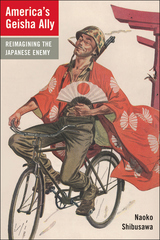
During World War II, Japan was vilified by America as our hated enemy in the East. Though we distinguished "good Germans" from the Nazis, we condemned all Japanese indiscriminately as fanatics and savages. As the Cold War heated up, however, the U.S. government decided to make Japan its bulwark against communism in Asia.
But how was the American public made to accept an alliance with Japan so soon after the "Japs" had been demonized as subhuman, bucktoothed apes with Coke-bottle glasses? In this revelatory work, Naoko Shibusawa charts the remarkable reversal from hated enemy to valuable ally that occurred in the two decades after the war. While General MacArthur's Occupation Forces pursued our nation's strategic goals in Japan, liberal American politicians, journalists, and filmmakers pursued an equally essential, though long-unrecognized, goal: the dissemination of a new and palatable image of the Japanese among the American public.
With extensive research, from Occupation memoirs to military records, from court documents to Hollywood films, and from charity initiatives to newspaper and magazine articles, Shibusawa demonstrates how the evil enemy was rendered as a feminized, submissive nation, as an immature youth that needed America's benevolent hand to guide it toward democracy. Interestingly, Shibusawa reveals how this obsession with race, gender, and maturity reflected America's own anxieties about race relations and equity between the sexes in the postwar world. America's Geisha Ally is an exploration of how belligerents reconcile themselves in the wake of war, but also offers insight into how a new superpower adjusts to its role as the world's preeminent force.
Named one of “the year’s best gardening books” by The Spectator (UK, Nov. 2014)
The 1890s saw a revolution in advertising. Cheap paper, faster printing, rural mail delivery, railroad shipping, and chromolithography combined to pave the way for the first modern, mass-produced catalogs. The most prominent of these, reaching American households by the thousands, were seed and nursery catalogs with beautiful pictures of middle-class homes surrounded by sprawling lawns, exotic plants, and the latest garden accessories—in other words, the quintessential English-style garden.
America’s Romance with the English Garden is the story of tastemakers and homemakers, of savvy businessmen and a growing American middle class eager to buy their products. It’s also the story of the beginnings of the modern garden industry, which seduced the masses with its images and fixed the English garden in the mind of the American consumer. Seed and nursery catalogs delivered aspirational images to front doorsteps from California to Maine, and the English garden became the look of America.
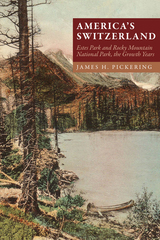
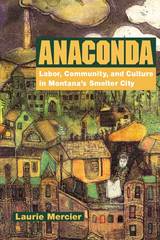
Laurie Mercier's look at "community unionism" examines the distinctive culture of cooperation and activism fostered by residents in Anaconda, Montana, home to the world's largest copper smelter and the namesake of the Anaconda Copper Mining Company.
Mercier depicts the vibrant life of the smelter city at full steam, incorporating the candid commentary of the locals ("the company furnished three pair of leather gloves . . . and all the arsenic [dust] you could eat"). During five decades of devoted unionism, locals embraced an "alternative Americanism" that championed improved living standards for working people as the best defense against communism. Mercier also explores how gender limits on women's political, economic, and social roles shaped the nature and outcome of labor struggles, and traces how union rivalries, environmental concerns, and the 1980 closing of the Anaconda smelter transformed the town.
A fascinating portrait of how community molds working class consciousness, Anaconda offers important insights about the changing nature of working class culture and collective action.

Anarchism is as much an attitude as it is a set of formulated doctrines and in this book Sean Sheehan provides an engaging introduction to what anarchism means, describing its history through anecdote and dramatic events, and offering explanations of the issues behind this "movement". He avoids a narrowly political or polemical viewpoint, using examples from all over the world and images from anarchist-inspired ideas and forms.
Anarchist thinking and influences emerge in many different aspects of contemporary culture and history, and the author looks at instances in areas of political thought, history of ideas, philosophy, theories of education and ecology, as well as film and literary criticism. Systems of thought such as Buddhism and Taoism, art movements such as Dada and Surrealism, literary treatments of anarchist ideas in the work of Blake, Wilde, Whitman, Kafka and Eugene O’Neill, anarchism in relation to sex and psychology in the work of Reich and Fromm, as well as aspects of Nietzsche’s philosophy as expressions of anarchist individualism – all these and other topics are also tackled.
This combination of history, anecdote and cultural analysis is an informative and lively study that is guaranteed to provoke debate.

1995 paperback, Saga Publishers / Folio Private
To lend weight to his charge that the public school teacher has been betrayed and gravity to his indictment of the educational establishment for that betrayal, Jurgen Herbst goes back to the beginnings of teacher education in America in the 1830s and traces its evolution up to the 1920s, by which time the essential damage had been done.
Initially, attempts were made to upgrade public school teaching to a genuine profession, but that ideal was gradually abandoned. In its stead, with the advent of newly emerging graduate schools of education in the early decades of the twentieth century, came the so-called professionalization of public education. At the expense of the training of elementary school teachers (mostly women), teacher educators shifted their attention to the turning out of educational "specialists" (mostly men)—administrators, faculty members at normal schools and teachers colleges, adult education teachers, and educational researchers.
Ultimately a history of the neglect of the American public school teacher, And Sadly Teach ends with a plea and a message that ring loud and clear. The plea: that the current reform proposals for American teacher education—the Carnegie and the Holmes reports—be heeded. The message: that the key to successful school reform lies in educating teacher’s true professionals and in acknowledging them as such in their classrooms.
READERS
Browse our collection.
PUBLISHERS
See BiblioVault's publisher services.
STUDENT SERVICES
Files for college accessibility offices.
RECENTLY PUBLISHED



UChicago Accessibility Resources
home | accessibility | search | about | contact us
BiblioVault ® 2001 - 2024
The University of Chicago Press