
 A SCHOLARLY BOOK REPOSITORY
From popular culture to politics to classic novels, quintessentially American texts take their inspiration from the idea of infinity. In the extraordinary literary century inaugurated by Ralph Waldo Emerson, the lyric too seemed to encounter possibilities as limitless as the U.S. imagination. This raises the question: What happens when boundlessness is more than just a figure of speech? Exploring new horizons is one thing, but actually looking at the horizon itself is something altogether different. In this carefully crafted analysis, James von der Heydt shines a new light on the lyric craft of Emily Dickinson, Robert Frost, Elizabeth Bishop, and James Merrill and considers how their seascape-vision redefines poetry's purpose.
Emerson famously freed U.S. literature from its past and opened it up to vastness; in the following century, a succession of brilliant, rigorous poets took the philosophical challenges of such freedom all too seriously. Facing the unmarked horizon, Emersonian poets capture—and are captured by—a stark, astringent version of human beauty. Their uncompromising visions of limitlessness reclaim infinity's proper legacy—and give American poetry its edge. Von der Heydt's book recovers the mystery of their world.
Considering the poems in the context of the fascicles, Cameron argues that an essential refusal of choice pervades all aspects of Dickinson's poetry. Because Dickinson never chose whether she wanted her poems read as single lyrics or in sequence (nor is it clear where any fascicle text ends, or even how, in context, a poem is bounded), "not choosing" is a textual issue; it is also a formal issue because Dickinson refused to chose among poetic variants; it is a thematic issue; and, finally, it is a philosophical one, since what is produced by "not choosing" is a radical indifference to difference. Extending the readings of Dickinson offered in her earlier book Lyric Time, Cameron continues to enlarge our understanding of the work of this singular American poet.
The similarities between the letters and the poems makes the typical concordance search for the poet's thematically significant words and biographical references particularly relevant. Tracing Dickinson's thoughts through her correspondence complements the ideas within her poetry and thus provides a more comprehensive insight into the poet's personal and artistic development. The concordance will facilitate an understanding of words or concepts that may be obscure in the poetry by itself. Research into Dickinson's problematic style, characterized by gaps, disjunctions, and ellipses, will be greatly enhanced.
By listing Dickinson's words together with their contexts and frequencies, the concordance provides the scholar with the ability to answer confidently questions of a statistical or stylistic nature. Finally, one of the most important functions of this concordance is to provide scholar, student, and general reader alike with endless opportunities to make exciting and unexpected discoveries by way of browsing.

"Mary Loeffelholz has written a book that actually performs what it promises. . . . It illuminates our understanding of Emily Dickinson with readings both elegant and useful, and as importantly suggests modified direction for feminist-psychoanalytic theory."
-- Diana Hume George, author of Oedipus Anne: The Poetry of Anne Sexton
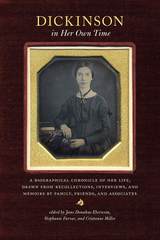
In addition, promotional items, reviews, and correspondence relating to early publications are included, as well as some later documents that reveal the changing assessments of Dickinson’s poetry in response to evolving critical standards. These documents provide evidence that counters many popular conceptions of her life and reception, such as the belief that the writer best known for poems focused on loss, death, and immortality was herself a morose soul. In fact, those who knew her found her humorous, playful, and interested in other people.
Dickinson maintained literary and personal correspondence with major representatives of the national literary scene, developing a reputation as a remarkable writer even as she maintained extreme levels of privacy. Evidence compiled here also demonstrates that she herself made considerable provision for the survival of her poems and laid the groundwork for their eventual publication. Dickinson in Her Own Time reveals the poet as her contemporaries knew her, before her legend took hold.
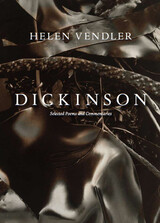
Seamus Heaney, Denis Donoghue, William Pritchard, Marilyn Butler, Harold Bloom, and many others have praised Helen Vendler as one of the most attentive readers of poetry. Here, Vendler turns her illuminating skills as a critic to 150 selected poems of Emily Dickinson. As she did in The Art of Shakespeare’s Sonnets, she serves as an incomparable guide, considering both stylistic and imaginative features of the poems.
In selecting these poems for commentary Vendler chooses to exhibit many aspects of Dickinson’s work as a poet, “from her first-person poems to the poems of grand abstraction, from her ecstatic verses to her unparalleled depictions of emotional numbness, from her comic anecdotes to her painful poems of aftermath.” Included here are many expected favorites as well as more complex and less often anthologized poems. Taken together, Vendler’s selection reveals Emily Dickinson’s development as a poet, her astonishing range, and her revelation of what Wordsworth called “the history and science of feeling.”
In accompanying commentaries Vendler offers a deeper acquaintance with Dickinson the writer, “the inventive conceiver and linguistic shaper of her perennial themes.” All of Dickinson’s preoccupations—death, religion, love, the natural world, the nature of thought—are explored here in detail, but Vendler always takes care to emphasize the poet’s startling imagination and the ingenuity of her linguistic invention. Whether exploring less familiar poems or favorites we thought we knew, Vendler reveals Dickinson as “a master” of a revolutionary verse-language of immediacy and power. Dickinson: Selected Poems and Commentaries will be an indispensable reference work for students of Dickinson and readers of lyric poetry.

The collection opens with a central portion of Sharon Cameron’s 1992 book that was the first to abandon the until-then popular search for a single unifying narrative to explain the fascicles, inaugurating a new era of fascicle scholarship. Eight prominent Dickinson scholars contribute essays to this volume and respond vigorously and variously to Cameron's argument, proposing, for instance, that the fascicles represent Dickinson's engagement with the world around her, particularly with the Civil War, and that they demonstrate her continued experimentation with poetic form.
Dickinson’s Fascicles is edited by Paul Crumbley and Eleanor Elson Heginbotham. Other contributors include Paula Bernat Bennett, Martha Nell Smith, Domhnall Mitchell, Ellen Louise Hart, Melanie Hubbard, and Alexandra Socarides who assess what constitutes a vast final frontier in the Dickinson literary landscape. Susan Howe provides a coda.
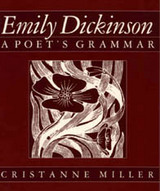
In this inventive work on Emily Dickinson’s poetry, Cristanne Miller traces the roots of Dickinson’s unusual, compressed, ungrammatical, and richly ambiguous style, finding them in sources as different as the New Testament and the daily patterns of women’s speech. Dickinson writes as she does both because she is steeped in the great patriarchal texts of her culture, from the Bible and hymns to Herbert’s poetry and Emerson’s prose, and because she is conscious of writing as a woman in an age and culture that assume great and serious poets are male.
Miller observes that Dickinson’s language deviates from normal construction along definable and consistent lines; consequently it lends itself to the categorical analysis of an interpretive “grammar” such as the one she has constructed in this book. In order to facilitate the reading of Dickinson’s poems and to reveal the values and assumptions behind the poet’s manipulations of language, Miller examines in this grammar how specific elements of the poet’s style tend to function in various contexts. Because many, especially modernist, poets use some of the same techniques, the grammar throws light on the poetic syntax of other writers as well.
In the course of her analysis, Miller draws not only on traditional historical and linguistic sources but also on current sociolinguistic studies of gender and speech and on feminist descriptions of women’s writing. Dickinson’s language, she concludes, could almost have been designed as a model for twentieth-century theories of what a women’s language might be. As a critical examination of the relationship between linguistic style and literary identity in America’s greatest woman poet, Emily Dickinson: A Poet’s Grammar provides a significant addition to feminist literary studies.

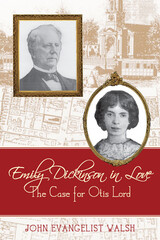
From the award-winning author of Poe the Detective: The Curious Circumstances Behind "The Mystery of Marie Roget" comes a compelling argument for the identity of Emily Dickinson’s true love
Proud of my broken heart
Since thou didst break it,
Proud of the pain I
Did not feel till thee . . .
Those words were written by Emily Dickinson to a married man. Who was he?
For a century or more the identity of Emily Dickinson’s mysterious “Master” has been eagerly sought, especially since three letters from her to him were found and published in 1955. In Emily Dickinson in Love, John Evangelist Walsh provides the first book-length treatment of this fascinating subject, offering a solution based wholly on documented facts and the poet’s own writings.
Crafting the affair as a love story of rare appeal, and writing with exquisite attention to detail, in Part I Walsh reveals and meticulously proves the Master to be Otis Lord, a friend of the poet’s father and a man of some reputation in law and politics. Part II portrays the full dimensions of their thirty-year romance, most of it clandestine, including a series of secret meetings in Boston.
After uncovering and confirming the Master’s identity, Walsh fits that information into known events of Emily’s life to make sense of facts long known but little understood—Emily’s decision to dress always in white, for instance, or her extreme withdrawal from a normal existence when she had previously been an active, outgoing friend to many men and women.
In a lengthy section of Notes and Sources, Walsh presents his proofs in abundant detail, demonstrating that the evidence favors one man so irresistibly that there is left no room for doubt. Each reader will decide if he has truly succeeded in making the case for Otis Lord.
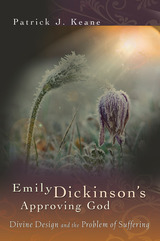

Emily Dickinson should stand as a major gothic author among her nineteenth-century American contemporaries, but two factors have previously prevented her inclusion in such company. Perhaps the most obvious is the problem of the genre: Dickinson writes gothic poetry, whereas gothic fiction defines the genre. In addition, her poetic personae have served over the decades to prompt critics to “protect” her; traditional critics concentrated on the sweet, romantic elements of her oeuvre. More recent readers, notably Sandra Gilbert and Susan Gubar, Jane Egerwein, and Cynthia Griffin Wolff, have begun studying Dickinson's gothic traits; Emily Dickinson's Gothic explores Dickinsonian gothicism with the systematic rigor it demands and deserves.
Emily Dickinson's Gothic also addresses sociohistorical concerns, from hallowed gothic conventions dating from Horace Walpole's eighteenth century to such modernist neogothic topics as rape, the void, and disjunctive language that appear in the latter nineteenth and early twentieth centuries. Wardrop recognizes the full extent to which the gothic pervades Dickinson's canon and the means by which the gothic determines her aesthetic. Such full consideration of women's gothicism allows the placement of Dickinson within a literary context, both in terms of American writers and in terms of women writers.
In a letter from 1845, the 14-year-old Emily Dickinson asked her friend Abiah Root if she had started collecting flowers and plants for a herbarium: "it would be such a treasure to you; 'most all the girls are making one." Emily's own album of more than 400 pressed flowers and plants, carefully preserved, has long been a treasure of Harvard's Houghton Library. This beautifully produced, slipcased volume now makes it available to all readers interested in the life and writings of Emily Dickinson.
The care that Emily put into her herbarium, as Richard Sewall points out, goes far beyond what one might expect of a botany student her age: "Take Emily's herbarium far enough, and you have her." The close observation of nature was a lifelong passion, and Emily used her garden flowers as emblems in her poetry and her correspondence. Each page of the album is reproduced in full color at full size, accompanied by a transcription of Dickinson's handwritten labels. Introduced by a substantial literary and biographical essay, and including a complete botanical catalog and index, this volume will delight scholars, gardeners, and all readers of Emily Dickinson's poetry.
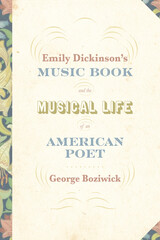
After years of studying piano as a young woman in her family home in Amherst, Massachusetts, Emily Dickinson curated her music book, a common practice at the time. Now part of the Dickinson Collection in the Houghton Library of Harvard University, this bound volume of 107 pieces of published sheet music includes the poet’s favorite instrumental piano music and vocal music, ranging from theme and variation sets to vernacular music, which was also enjoyed by the family’s servants.
Offering a fresh historical perspective on a poetic voice that has become canonical in American literature, this original study brings this artifact to life, documenting Dickinson’s early years of musical study through the time her music was bound in the early 1850s, which tellingly coincided with the writing of her first poems. Using Dickinson’s letters and poems alongside newspapers and other archival sources, George Boziwick explores the various composers, music sellers, and publishers behind this music and Dickinson’s attendance at performances, presenting new insights into the multiple layers of meaning that music held for her.
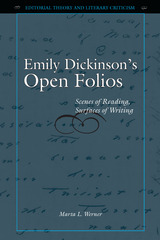
Werner argues that a redefinition of the editorial enterprise is needed to approach the revelations of these writings-- the details that have been all but erased by editorial interventions and print conventions in the twentieth century. Paradoxically, "un-editing" them allows an exploration of the relationship between medium and messages. Werner's commentary forsakes the claims to comprehensiveness generally associated with scholarly narrative in favor of a series of speculative and fragmentary "close-ups"--a portrait in pieces. Finally, she proposes the acts of both reading and writing as visual poems.
A crucial reference for Dickinson scholars, this book is also of primary importance to textual scholars, editorial theorists, and students of gender and cultural studies interested in the production, dissemination, and interpretation of works by women writers.
This publication has been supported by a grant from the National Endowment for the Humanities.
Marta L. Werner received her Ph.D. from the State University of New York-Buffalo. She is an independent scholar and a member of the Emily Dickinson Editing Collective.
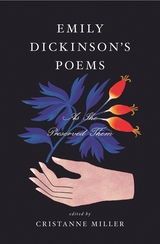
Widely considered the definitive edition of Emily Dickinson’s poems, this landmark collection presents her poems here for the first time “as she preserved them,” and in the order in which she wished them to appear. It is the only edition of Dickinson’s complete poems to distinguish clearly those she took pains to copy carefully onto folded sheets in fair hand—presumably to preserve them for posterity—from the ones she kept in rougher form. It is also unique among complete editions in presenting the alternate words and phrases Dickinson chose to use on the copies of the poems she kept, so that we can peer over her shoulder and see her composing and reworking her own poems.
The world’s foremost scholar of Emily Dickinson, Cristanne Miller, guides us through these stunning poems with her deft and unobtrusive notes, helping us understand the poet’s quotations and allusions, and explaining how she composed, copied, and circulated her poems. Miller’s brilliant reordering of the poems transforms our experience of them.
A true delight, this award-winning collection brings us closer than we have ever been to the writing practice of one of America’s greatest poets. With its clear, uncluttered page and beautiful production values, it is a gift for students of Emily Dickinson and for anyone who loves her poems.
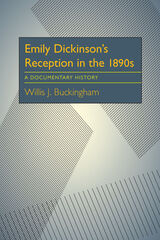
This work reprint, annotates, and indexes virtually all mention of Emily Dickinson in the first decade of her publication, tripling the known references to the poet during the nineties. Much of this material, drawn from scrapbooks of clippings, rare journals, and crumbling newspapers, was on the verge of extinction.
Modern audiences will be struck by the impact of Dickinson’s poetry on her first readers. We learn much about the taste of the period and the relationship between publishers, reviewers, and the reading public. It demonstrates that Dickinson enjoyed a wider popular reception than had been realized: readers were astonished by her creative brilliance.
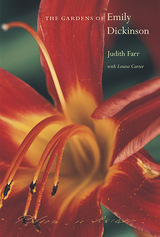
In this first substantial study of Emily Dickinson's devotion to flowers and gardening, Judith Farr seeks to join both poet and gardener in one creative personality. She casts new light on Dickinson's temperament, her aesthetic sensibility, and her vision of the relationship between art and nature, revealing that the successful gardener's intimate understanding of horticulture helped shape the poet's choice of metaphors for every experience: love and hate, wickedness and virtue, death and immortality.
Gardening, Farr demonstrates, was Dickinson's other vocation, more public than the making of poems but analogous and closely related to it. Over a third of Dickinson's poems and nearly half of her letters allude with passionate intensity to her favorite wildflowers, to traditional blooms like the daisy or gentian, and to the exotic gardenias and jasmines of her conservatory. Each flower was assigned specific connotations by the nineteenth century floral dictionaries she knew; thus, Dickinson's association of various flowers with friends, family, and lovers, like the tropes and scenarios presented in her poems, establishes her participation in the literary and painterly culture of her day. A chapter, "Gardening with Emily Dickinson" by Louise Carter, cites family letters and memoirs to conjecture the kinds of flowers contained in the poet's indoor and outdoor gardens. Carter hypothesizes Dickinson's methods of gardening, explaining how one might grow her flowers today.
Beautifully illustrated and written with verve, The Gardens of Emily Dickinson will provide pleasure and insight to a wide audience of scholars, admirers of Dickinson's poetry, and garden lovers everywhere.
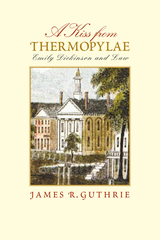
Yet Dickinson was also capable of criticizing, even satirizing, law and lawyers. Her poetic personae inhabit various legal roles including those of jurymen, judges, and attorneys, and some poems simulate courtroom contests pitting the rights of individuals against the power of the state. She was keenly interested in legal matters pertaining to women, such as breach of promise, dower, and trusts. With her tone ranging from subservient to domineering, from reverential to ridiculing, Dickinson's writings reflect an abiding concern with philosophic and political principles underpinning the law, as well as an identification with the plight of individuals who dared confront authority.
A Kiss from Thermopylae reveals a new dimension of Dickinson's writing and thinking, one indicating that she was thoroughly familiar with the legal community's idiomatic language, actively engaged with contemporary political and ethical questions, and skilled at deploying a poetic register ranging from high romanticism to low humor.
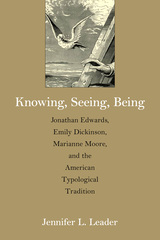
In Knowing, Seeing, Being, Jennifer L. Leader argues that Edwards, the nineteenth-century poet Emily Dickinson, and the twentieth-century poet Marianne Moore share a heretofore underrecognized set of religious and philosophical preoccupations. She contends that they represent an alternative tradition within American literature, one that differs from Transcendentalism and is grounded in Reformed Protestantism and its ways of reading and interpreting the King James Bible and the natural world. According to Leader, these three writers' most significant commonality is the Protestant tradition of typology, a rigorous mode of interpreting scripture and nature through which certain figures or phenomena are read as the fulfillment of prophecy and of God's work. Following from their similar ways of reading, they also share philosophical and spiritual questions about language, epistemology (knowing), perception (seeing), and physical and spiritual ontology (being). In connecting Edwards to these two poets, in exploring each writer's typological imagination, and through a series of insightful readings, this innovative book reevaluates three major figures in American intellectual and literary history and compels a reconsideration of these writers and their legacies.
Approximately 100 letters are published here for the first time, including almost all of the letters to Jane Humphrey and to Mrs. J. Howard Sweetser. The new material is even more extensive than it might appear, for many of the letters previously published were censored when first made public. This volume, designed to accompany Mr. Johnson’s previously published work, the widely acclaimed Poems of Emily Dickinson, assembles all of Emily Dickinson’s letters (with the exception of letters presumably destroyed). The editors present the letters chronologically, with manuscript location, previous publication data, and notes for each letter, together with a general introduction, and biographical notes on recipients of letters.
The notes for each letter identify persons and events mentioned, and the source of literary allusions and quotations is given wherever known. Since Emily Dickinson rarely dated her letters after 1850, the dates for the most part must be conjectured from careful study of handwriting changes and from internal evidence of the letters. Of the 1,150 letters and prose fragments included in this outstanding edition, the text of about 800 derives from Dickinson autographs.

Reising suggests that these "non-endings" entirely refocus the narrative structures they appear to conclude, accentuate the narrative stresses and ideological fissures that the texts seem to suppress, and reveal "shadow narratives" that trail alongside the dominant story line. He argues that unless the reader notices the ruptures in the closing moments of these works, the social and historical moments in which the narrative and the reader are embedded will be missed. This reading not only offers new interpretive possibilities, but also uncovers startling affinities between the poetry of Phillis Wheatley and the fiction of Henry James, between Charles Brockden Brown’s Wieland and Melville’s least-studied novel, and between Emily Dickinson’s poem "I Started Early—Took My Dog" and Disney’s animated classic.
Pursuing the implications of these failed moments of closure, Reising elaborates on topics ranging from the roots of domestic violence and mass murder in early American religious texts to the pornographic imperative of mid-century nature writing, and from James’s "descent" into naturalist and feminist fiction to Dumbo’s explosive projection of commercial, racial, and political agendas for postwar U. S. culture.
Here for the first time is the poetry of Emily Dickinson as she herself “published” it in the privacy of her upstairs room in the house in Amherst.
She invented her own form of bookmaking. Her first drafts, jotted on odd scraps of paper, were discarded when transcribed. Completed poems were neatly copied in ink on sheets of folded stationery which she arranged in groups, usually of sixteen to twenty-four pages, and sewed together into packets or fascicles. These manuscript books were her private mode of publication, a substitute perhaps for the public mode that, for reasons unexplained, she denied herself. In recent years there has been increasing interest in the fascicles as artistic gathering, intrarelated by theme, imagery, or emotional movement. But no edition in the past, not even the variorum, or has arranged the poems in the sequence in which they appear in the manuscript books.
Emily Dickinson’s poems, more than those of any other poet, resist translation into the medium of print. Since she never saw a manuscript through the press, we cannot tell how she would have adapted for print her unusual capitalization, punctuation, line and stanza divisions, and alternate readings. The feather-light punctuation, in particular, is misrepresented when converted to conventional stop or even to dashes.
This elegant edition presents all of Emily Dickinson’s manuscript books and unsewn fascicle sheets—1,148 poems on 1,250 pages—restored insofar as possible to their original order, as they were when her sister found them after her death. The manuscripts are reproduced with startling fidelity in 300-line screen. Every detail is preserved: the bosses on the stationery, the sewing holes and tears, and poet’s alternate reading and penciled revisions, ink spots and other stains offset onto adjacent leaves, and later markings by Susan Dickinson, Mabel Todd, and others. The experience of reading these facsimile pages is virtually the same as reading the manuscripts themselves. Supplementary information is provided in introductions, notes, and appendices.
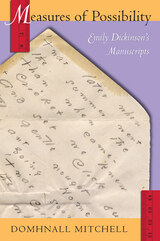
In Measures of Possibility, Domhnall Mitchell sets out to test the hypothesis of Dickinson's textual radicalism, and its consequences for readers, students, and teachers, by looking closely at features such as spacing, the physical direction of the writing, and letter-shapes in handwritten lyric and epistolary texts. Through systematic contextualization and cross-referencing, Mitchell provides the reader with a critical apparatus by which to measure the extent to which contemporary approaches to Dickinson's autograph procedures can reasonably be formulated as corresponding to the poet's own purposes.
Yet that image scarcely captures the fullness and vitality of Dickinson’s life, most notably her many connections—to family, to friends, to correspondents, to the literary tastemakers of her day, even to the unnamed, and perhaps unknowable, “Master” to whom she addressed three of her most breathtaking works of prose. Through an exploration of a relatively small group of items from Dickinson’s vast literary remains, this volume—an accompaniment to an exhibition on Dickinson mounted at The Morgan Library & Museum in New York—demonstrates the complex ways in which these often humble objects came into conversation with other people, places, and events in the poet’s life. Seeing the network of connections and influences that shaped Dickinson’s life presents us with a different understanding of this most enigmatic yet elegiac poet in American letters, and allows us more fully to appreciate both her uniqueness and her humanity.
The materials collected here make clear that the story of Dickinson’s manuscripts, her life, and her work is still unfolding. While the image of Dickinson as the reclusive poet dressed only in white remains a popular myth, details of Dickinson’s life continue to emerge. Several items included both in the exhibit and in this volume were not known to exist until the present century. The scrap of biographical intelligence recorded by Sarah Tuthill in a Mount Holyoke catalogue, or the concern about Dickinson’s salvation expressed by Abby Wood in a private letter to Abiah Root, were acquired by Amherst College in the last fifteen years. What additional pieces of evidence remain to be uncovered and identified in the attics and basements of New England?
Published to accompany The Morgan Library & Museum’s pathbreaking exhibit I’m Nobody! Who are You? The Life and Poetry of Emily Dickinson—part of a series of exhibits at the Morgan celebrating and exploring the creative lives of significant women authors—The Networked Recluse offers the reader an account of the exhibit itself, together with a series of contributions by curators, scholars of Dickinson, and poets whose own work her words have influenced.
--Harold Bloom, Genius
" . . . a truly literary study in the largest, most humane, sense. Instead of subjecting poems to the distortions of theory, it brings biography, theology, psychology, and cultural history to bear on the intricacies of language, where all the issues of the poet's life and work converge, contend, and seek resolution."
--Albert Gelpi, American Literature
" . . . insightful readings of many of Dickinson's difficult poems and . . . a significant contribution to Dickinson studies."
---Choice
"McIntosh shows the power of Dickinson's religious quest in word, in verse, and in truth. He shows that she was much more than an ever-adolescent angry rebel trying to subvert the religious oppression of benighted Amherst neighbors."
---Emily Dickinson Journal
"How tame and manageable are the emotions of our bards, how placid and literary their allusions!" complained essayist T. W. Higginson in the Atlantic Monthly in 1870. "The American poet of passion is yet to come." He was, of course, unaware of the great erotic love poems such as "Wild Nights--Wild Nights!" and "Struck was I, nor yet by Lightning" being privately written by his reclusive friend Emily Dickinson.
In a profound new analysis of Dickinson's life and work, Judith Farr explores the desire, suffering, exultation, spiritual rapture, and intense dedication to art that characterize Dickinson's poems, and deciphers their many complex and witty references to texts and paintings of the day. In The Passion of Emily Dickinson the poet emerges, not as a cryptic proto-modern or a victim of female repression, but as a cultivated mid-Victorian in whom the romanticism of Emerson and the American landscape painters found bold expression.
Dickinson wrote two distinct cycles of love poetry, argues Farr, one for her sister-in-law Sue and one for the mysterious "Master," here convincingly identified as Samuel Bowles, a friend of the family. For each of these intimates, Dickinson crafted personalized metaphoric codes drawn from her reading. Calling books her "Kinsmen of the Shelf," she refracted elements of Jane Eyre, Antony and Cleopatra, Tennyson's Maud, De Quincey's Confessions, and key biblical passages into her writing. And, to a previously unexplored degree, Dickinson also quoted the strategies and subject matter of popular Hudson River, Luminist, and Pre-Raphaelite paintings, notably Thomas Cole's Voyage of Life and Frederic Edwin Church's Heart of the Andes. Involved in the delicate process of both expressing and disguising her passion, Dickinson incorporated these sources in an original and sophisticated manner.
Farr's superb readings of the poems and letters call on neglected archival material and on magazines, books, and paintings owned by the Dickinsons. Viewed as part of a finely articulated tradition of Victorian iconography, Dickinson's interest in the fate of the soul after death, her seclusion, her fascination with landscape's mystical content, her quest for honor and immortality through art, and most of all her very human passions become less enigmatic. Farr tells the story of a poet and her time.
Dickinson and Whitman developed their environmentally suggestive poetics at roughly the same historical moment, at a time when a major shift was occurring in American culture’s view and understanding of the natural world. Just as they were achieving poetic maturity, the dominant view of wilderness was beginning to shift from obstacle or exploitable resource to an endangered treasure in need of conservation and preservation.
A Place for Humility examines Dickinson’s and Whitman’s poetry in conjunction with this important change in American environmental perception, exploring the links between their poetic projects within the context of developing nineteenth-century environmental thought. Christine Gerhardt argues that each author's poetry participates in this shift in different but related ways, and that their involvement with their culture’s growing environmental sensibilities constitutes an important connection between their disparate poetic projects. There may be few direct links between Dickinson’s “letter to the World” and Whitman’s “language experiment,” but via a web of environmentally-oriented discourses, their poetry engages in a cultural conversation about the natural world and the possibilities and limitations of writing about it—a conversation in which their thematic and formal choices meet on a surprising number of levels.
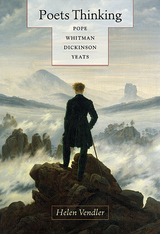
Poetry has often been considered an irrational genre, more expressive than logical, more meditative than given to coherent argument. And yet, in each of the four very different poets she considers here, Helen Vendler reveals a style of thinking in operation; although they may prefer different means, she argues, all poets of any value are thinkers.
The four poets taken up in this volume—Alexander Pope, Walt Whitman, Emily Dickinson, and William Butler Yeats—come from three centuries and three nations, and their styles of thinking are characteristically idiosyncratic. Vendler shows us Pope performing as a satiric miniaturizer, remaking in verse the form of the essay, Whitman writing as a poet of repetitive insistence for whom thinking must be followed by rethinking, Dickinson experimenting with plot to characterize life’s unfolding, and Yeats thinking in images, using montage in lieu of argument.
With customary lucidity and spirit, Vendler traces through these poets’ lines to find evidence of thought in lyric, the silent stylistic measures representing changes of mind, the condensed power of poetic thinking. Her work argues against the reduction of poetry to its (frequently well-worn) themes and demonstrates, instead, that there is always in admirable poetry a strenuous process of thinking, evident in an evolving style—however ancient the theme—that is powerful and original.
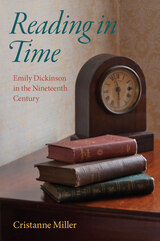
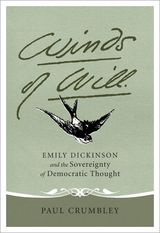
Before 1865, Dickinson at least ambivalently considered publication, circulated relatively few poems, and saved almost everything she wrote in organized booklets. After this date, she wrote far fewer poems, circulated many poems without retaining them, and took less interest in formally preserving her work. Yet, Miller argues, even when circulating relatively few poems, Dickinson was vitally engaged with the literary and political culture of her day and, in effect, wrote to her contemporaries. Unlike previous accounts placing Dickinson in her era, Reading in Time demonstrates the extent to which formal properties of her poems borrow from the short-lined verse she read in schoolbooks, periodicals, and single-authored volumes. Miller presents Dickinson's writing in relation to contemporary experiments with the lyric, the ballad, and free verse, explores her responses to American Orientalism, presents the dramatic lyric as one of her preferred modes for responding to the Civil War, and gives us new ways to understand the patterns of her composition and practice of poetry.
We cannot know why Dickinson compiled the books or what she thought of them, but we can observe what she left in them. What she left is visible only by noting the way the poem answers in a dialogue across the pages, the way lines spilling onto a second page introduce the next poem, the way openings suggest image clusters so that each book has its own network of concerns and language—not a story or philosophical preachment but an aesthetic wholeness.
This book is the first to demonstrate that Dickinson’s poetic and philosophical creativity is most startling when the reader observes the individual lyric in the poet’s own, and only, context for them. For teacher, student, scholar, and poetry lover, Heginbotham creates an important new framework for understanding one of the most complex, clever, and profound U.S. poets.
Emily Dickinson wrote a "letter to the world" and left it lying in her drawer more than a century ago. This widely admired epistle was her poems, which were never conventionally published in book form during her lifetime. Since the posthumous discovery of her work, general readers and literary scholars alike have puzzled over this paradox of wanting to communicate widely and yet apparently refusing to publish. In this pathbreaking study, Martha Nell Smith unravels the paradox by boldly recasting two of the oldest and still most frequently asked questions about Emily Dickinson: Why didn't she publish more poems while she was alive? and Who was her most important contemporary audience?
Regarding the question of publication, Smith urges a reconception of the act of publication itself. She argues that Dickinson did publish her work in letters and in forty manuscript books that circulated among a cultured network of correspondents, most important of whom was her sister-in-law, Susan Huntington Gilbert Dickinson. Rather than considering this material unpublished because unprinted, Smith views its alternative publication as a conscious strategy on the poet's part, a daring poetic experiment that also included Dickinson's unusual punctuation, line breaks, stanza divisions, calligraphic orthography, and bookmaking—all the characteristics that later editors tried to standardize or eliminate in preparing the poems for printing.
Dickinson's relationship with her most important reader, Sue Dickinson, has also been lost or distorted by multiple levels of censorship, Smith finds. Emphasizing the poet-sustaining aspects of the passionate bonds between the two women, Smith shows that their relationship was both textual and sexual. Based on study of the actual holograph poems, Smith reveals the extent of Sue Dickinson's collaboration in the production of poems, most notably "Safe in Their Alabaster Chambers." This finding will surely challenge the popular conception of the isolated, withdrawn Emily Dickinson.
Well-versed in poststructuralist, feminist, and new textual criticism, Rowing in Eden uncovers the process by which the conventional portrait of Emily Dickinson was drawn and offers readers a chance to go back to original letters and poems and look at the poet and her work through new eyes. It will be of great interest to a wide audience in literary and feminist studies.
"Theatricals of Day" explores how popular culture and entertainments are seen, heard, and felt in Dickinson's writing. In accessible prose, Sandra Runzo proposes that the presence of popular entertainment in Dickinson's life and work opens our eyes to new dimensions of the poems, illuminating the ways in which the poet was attentive to strife and conflict, to amusement, and to play.

the authoritative discourses of her time.
Through Deppman's original analysis, readers come to see how Dickinson's mind and poetry were informed by two strong but opposing philosophical vocabularies: on the one hand, the Lockean materialism and Scottish Common Sense that dominated her schoolbooks in logic and mental philosophy—Reid, Hedge, Watts, Stewart, Brown, and Upham—and on the other, the neo-Kantian modes of apprehending the supersensible that circulated throughout German idealism and Transcendentalism.
Blending close readings with philosophical and historical approaches, Deppman affirms Dickinson's place in the history of ideas and brings her to the center of postmodern conversations initiated by Jean-François Lyotard, Jean-Luc Nancy, Jacques Derrida, Richard Rorty, and Gianni Vattimo. Trying her out in various postmodern roles—the Nietzschean accomplished nihilist, the Nancian finite thinker, the Vattimian weak thinker, and the Rortian liberal ironist—Deppman adds to the traditional expressive functions of her poetry a valuable, timely, and interpretable layer of philosophical inquiry. Dickinson, it turns out, is an ideal companion for anybody trying to think in the contemporary conditions that Vattimo characterizes as the "weakened experience of truth."
This unique anthology gathers work by eighty poets inspired by Emily Dickinson. Beginning with Hart Crane's 1927 poem “To Emily Dickinson” and moving forward through the century to such luminary figures as Archibald MacLeish, John Berryman, Yvor Winters, Adrienne Rich, Richard Eberhart, Richard Wilbur, Maxine Kumin, Amy Clampitt, William Stafford, and Galway Kinnell, Visiting Emily offers both a celebration of and an homage to one of the world's great poets.
If there was ever any doubt about Dickinson's influence on modern and contemporary poets, this remarkable collection surely puts it to rest. Gathered here are poems reflecting a wide range of voices, styles, and forms—poems written in traditional and experimental forms; poems whose tones are meditative, reflective, reverent and irreverent, satirical, whimsical, improvisational, and serious. Many of the poets draw from Dickinson's biography, while others imagine events from her life. Some poets borrow lines from Dickinson's poems or letters as triggers for their inspiration. Though most of the poems connect directly to Dickinson's life or work, for others the connection is more oblique.
Essays included in this book cover the topics of mentoring influence on each poet, religion, the Civil War, phenomenology, the environment, humor, poetic structures of language, and Whitman’s and Dickinson’s twentieth- and twenty-first–century reception—including prolonged engagement with Adrienne Rich’s response to this “strange uncoupled couple” of poets who stand at the beginning of an American national poetic.
Contributors Include:
Marina Camboni
Andrew Dorkin
Vincent Dussol
Betsy Erkkilä
Ed Folsom
Christine Gerhardt
Jay Grossman
Jennifer Leader
Marianne Noble
Cécile Roudeau
Shira Wolosky
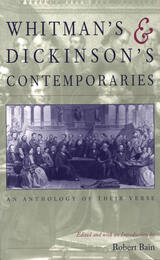
Emily Dickinson and Walt Whitman were not the poetic stars of their day; only a few friends knew that Dickinson wrote, and Whitman’s following was minuscule, if influential. But the contemporaries who eclipsed these major poets now have largely disappeared from our literary landscape.
In this distinctive anthology, Robert Bain gathers together thirteen other scholars to re-present the poetry of these former luminaries, allowing readers to rediscover them, reconstruct the poetic contexts of their age, and better understand why Whitman and Dickinson now overshadow other poets of their time.
Arranged chronologically according to the birth dates of the poets, this anthology introduces each poet’s work, providing biographical information and discussing the major forms and themes of the work. Each introduction places the poet in a literary and historical context with Whitman and Dickinson and provides a bibliography of secondary sources.
This remarkable book recovers a part of our literary heritage that has been lost.
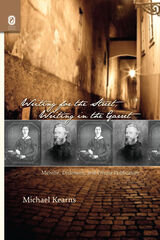
Although Herman Melville and Emily Dickinson differed dramatically in terms of their lives and writing careers, they shared not only a distaste for writing “for the street” (mass readership) but a preference for the intimate writer–reader relationship created by private publication, especially in the form of manuscripts. In Writing for the Street, Writing in the Garret: Melville, Dickinson, and Private Publication, Michael Kearns shows that this distaste and preference were influenced by American copyright law, by a growing tendency in America to treat not only publications but their authors as commodities, and by the romantic stereotype of the artist (usually suffering in a garret) living only for her or his own work.
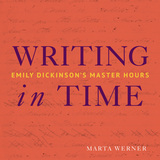
For more than half a century, the story of Emily Dickinson’s “Master” documents has been the largely biographical tale of three letters to an unidentified individual. Writing in Time seeks to tell a different story—the story of the documents themselves. Rather than presenting the “Master” documents as quarantined from Dickinson’s larger scene of textual production, Marta Werner’s innovative new edition proposes reading them next to Dickinson’s other major textual experiment in the years between ca. 1858–1861: the Fascicles. In both, Dickinson can be seen testing the limits of address and genre in order to escape bibliographical determination and the very coordinates of “mastery” itself. A major event in Dickinson scholarship, Writing in Time: Emily Dickinson’s Master Hours proposes new constellations of Dickinson’s work as well as exciting new methodologies for textual scholarship as an act of “intimate editorial investigation.”
READERS
Browse our collection.
PUBLISHERS
See BiblioVault's publisher services.
STUDENT SERVICES
Files for college accessibility offices.
RECENTLY PUBLISHED



UChicago Accessibility Resources
home | accessibility | search | about | contact us
BiblioVault ® 2001 - 2024
The University of Chicago Press