 A SCHOLARLY BOOK REPOSITORY
4 start with W start with W

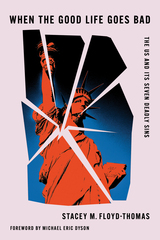
Stacey M. Floyd-Thomas examines how the Seven Deadly Sins have shaped the moral strivings and sociopolitical condition of American society and culture in the twenty-first century. Drawing on a multidimensional approach, Floyd-Thomas uses race, gender, class, and other lenses to break down the moral crises that define the American Dream. Her critique exposes the harm done by individual and collective practices of sexual objectification, capitalist materialism, wealth inequality, and technological hubris before pivoting to the rise of right-wing populism, white Christian nationalism, and the politics of cruelty. But Floyd-Thomas also proposes an ethic that emphasizes truth-telling, community engagement, and values rooted in humility, justice, and mercy—a new path for the US to overcome systemic oppression and create a more just society.
Evocative and ambitious, When the Good Life Goes Bad takes readers on a wide-ranging journey through US life and culture to explain what corrupted the American dream.

Just what is a human being? Who counts? The answers to these questions are crucial when one is faced with the ethical issue of taking human life. In this affirmation of the intrinsic personal dignity and inviolability of every human individual, John Kavanaugh, S. J., denies that it can ever be moral to intentionally kill another.
Today in every corner of the world men and women are willing to kill others in the name of "realism" and under the guise of race, class, quality of life, sex, property, nationalism, security, or religion. We justify these killings by either excluding certain humans from our definition of personhood or by invoking a greater good or more pressing value.
Kavanaugh contends that neither alternative is acceptable. He formulates an ethics that opposes the intentional killing not only of medically "marginal" humans but also of depersonalized or criminalized enemies. Offering a philosophy of the person that embraces the undeveloped, the wounded, and the dying, he proposes ways to recover a personal ethical stance in a global society that increasingly devalues the individual.
Kavanaugh discusses the work of a range of philosophers, artists, and activists from Richard Rorty and Søren Kierkegaard to Albert Camus and Woody Allen, from Mother Teresa to Jack Kevorkian. His approach is in stark contrast to that of writer Peter Singer and others who believe that not all human life has intrinsic moral worth. It will challenge philosophers, students of ethics, and anyone concerned about the depersonalization of contemporary life.
On November 10, 2017, Pope Francis became the first pontiff in the nuclear era to take a complete stand against nuclear weapons, even as a form of deterrence. At a Vatican conference of leaders in the field of disarmament, he made it clear that the possession of the bomb itself was immoral. A World Free from Nuclear Weapons presents the pope’s address and original testimony from Nobel Peace Prize laureates, religious leaders, diplomats, and civil society activists.
These luminaries, which include the pope and a Hiroshima survivor, make the moral case against possessing, manufacturing, and deploying nuclear arms. Drew Christiansen, a member of the Holy See delegation to the 2017 United Nations conference that negotiated the Treaty to Prohibit Nuclear Weapons, helps readers to understand this conference in its historical context.
A World Free from Nuclear Weapons is a critical companion for scholars of modern Catholicism, moral theology, and peace studies, as well as policymakers working on effective disarmament. It shows how the Church’s revised position presents an opportunity for global leaders to connect disarmament to larger movements for peace, pointing toward future action.
READERS
Browse our collection.
PUBLISHERS
See BiblioVault's publisher services.
STUDENT SERVICES
Files for college accessibility offices.
RECENTLY PUBLISHED



UChicago Accessibility Resources
home | accessibility | search | about | contact us
BiblioVault ® 2001 - 2025
The University of Chicago Press