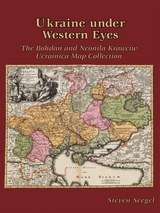
front cover of Ukraine under Western Eyes
Ukraine under Western Eyes
The Bohdan and Neonila Krawciw Ucrainica Map Collection
Steven Seegel
Harvard University Press

From the Renaissance to the Enlightenment, the geopolitical placement of Ukraine drew the attention of some of Europe’s most influential cartographers. Many of these maps, including ones of exceptional rarity, were collected by the Ukrainian scholar and journalist Bohdan Krawciw.

Krawciw traced the physical and aesthetic depiction of Ukraine across its changing borders as a means of self-recognition and as a cultural and political history of the contested nation and its peoples. Of special interest are his maps of Ukraine from the nineteenth and twentieth centuries, at the crossroads of four empires: Habsburg, Ottoman, Russian, and Soviet.

As part of his personal archive, Krawciw’s maps were bequeathed to Harvard University upon his death in 1975. This book serves as both a catalog of his collection and a description of how the maps he collected serve as an invaluable source for Ukraine’s history and a symbol of Ukrainian national identity. The book contains nearly 100 examples from the collection, many in full color, as well as indices listing maps by cartographer and by place name.

[more]

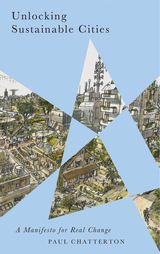
front cover of Unlocking Sustainable Cities
Unlocking Sustainable Cities
A Manifesto for Real Change
Paul Chatterton
Pluto Press, 2018
Our urban spaces today struggle to thrive in the face corporate greed, increasing privatization, and rising inequality. Unlocking Sustainable Cities offers a way forward, challenging the unsustainable and damaging practices our cities are mired in and paving the way for alternative urban futures.
            Across the world, people are implementing promising new practices—from transforming abandoned public spaces and setting up community co-operatives, to rewilding urban nature and powering up civic energy. Paul Chatterton explores how these grassroots experiments harness the creative power of the collective to transform our city systems, from transportation, energy, and economy, to community, democracy, and nature. Imagining radical alternatives—such as car-free, post-carbon, “bio cities”—this is a toolkit for realizing a better urban future.

 
[more]


Send via email Share on Facebook Share on Twitter