front cover of Teaching American Students
Teaching American Students
A Guide for International Faculty and Teaching Assistants in Colleges and Universities, Third Edition
Ellen Sarkisian
Harvard University Press, 2006

Many faculty and graduate students from other countries expect language difficulties when they teach, but are unprepared for other surprises: different cultures make different assumptions about the academic background of college students, how students learn, the appropriate roles of teachers and students, and even the fundamental purpose of a college education.

The third edition of Teaching American Students explains the expectations of undergraduates at American colleges and universities and offers practical strategies for teaching, including how to give clear presentations, how to teach interactively, and how to communicate effectively. Also included are illustrative examples as well as advice from international faculty and teaching assistants. Appendices offer concrete suggestions on topics from planning the first day of class to grading papers and problem sets.

[more]

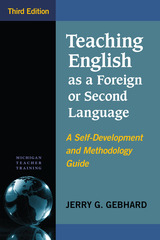
front cover of Teaching English as a Foreign or Second Language, Third Edition
Teaching English as a Foreign or Second Language, Third Edition
A Self-Development and Methodology Guide
Jerry G. Gebhard
University of Michigan Press, 2017
Like previous editions, the third edition is an ideal teacher development text for pre-service and in-service EFL/ESL teachers, as well as a guide for those who find themselves teaching English overseas but who do not have a master's in TESOL.

This edition has the same three major sections: (1) Self-Development, Exploration, and Settings; (2) Principles of EFL/ESL Teaching; and (3) Teaching Language Skills. New to this edition are:
  • a chapter on digital literacy, technology, and teaching
  • the addition of technology issues as they relate to the teaching of the various skills in Part 3
  • discussions of task-based teaching, student presentations, how corpus linguistics can inform teaching, metacognitive reading strategies, collaborative writing, assessing writing, and the teaching of grammar.
The lists of recommended resources that appear at the end of each chapter have been updated, and all research and pedagogical practices have been revised and updated. 
 
[more]

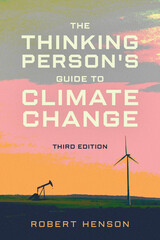
front cover of The Thinking Person's Guide to Climate Change, Third Edition
The Thinking Person's Guide to Climate Change, Third Edition
Robert Henson
University of Chicago Press

Updated throughout, the definitive guide for students, practitioners, and anyone interested in where climate science, politics, and policy stand today.

The physics and chemistry that drive human-caused climate change are surprisingly clear-cut. How we think about, talk about, and respond to the situation is dizzyingly complex. Meteorologist and journalist Robert Henson has spent years making climate science approachable and engaging. His internationally recognized book, TheThinking Person’s Guide to Climate Change, provides both specialists and newcomers with the background, insights, and confidence to engage with the paramount environmental issues of our lives (and beyond).

Drawing on a wealth of studies and assessments, this comprehensive yet lively guide brings a fresh eye to topics often buried in rhetoric. Introductory sections bring to life more than a century of painstaking research that tells us what we know and don’t know about human effects on climate. Henson discusses how and where fossil fuel use has been linked to heat waves, melting ice, wildfires, and other extremes. The guide also explores the high-stakes debates that swirl around climate change—including efforts to deny, downplay, or distract from the crisis—and how political, diplomatic, and legal systems are grappling with it. Color illustrations help explain everything from how the greenhouse effect traps heat to which everyday activities emit the most carbon. Special-feature boxes take readers to locations across the globe: small Pacific islands confronting sea level rise, Africa and its major rainfall shifts, California and year-round wildfire threats, and Florida with hurricanes intensifying ever more rapidly.

Thoroughly updated, this third edition has new coverage of the survivability of extreme heat, the use of global temperature thresholds, the challenge of carbon pricing, and other timely topics. It spotlights the Intergovernmental Panel on Climate Change’s Sixth Assessment Report as well as evolving geopolitics, including the 2024 US election and its national and global repercussions. This book acknowledges controversy, underscores points of agreement, and favors action over apathy and doomism.


[more]


Send via email Share on Facebook Share on Twitter