
front cover of Sanctuary Everywhere
Sanctuary Everywhere
The Fugitive Sacred in the Sonoran Desert
Barbara Andrea Sostaita
Duke University Press, 2024
In Sanctuary Everywhere, Barbara Andrea Sostaita reimagines practices of sanctuary along the U.S.-Mexico border in order to explore the possibilities for radical fugitivity in the face of militarized border enforcement. After the 2016 presidential election, churches, universities, cities, and even states began declaring themselves sanctuaries. Sostaita proposes that these calls for expanded sanctuary are insufficient when dealing with the everyday workings of immigration enforcement. Through fieldwork in migrant clinics, shelters, and the Sonoran Desert, Sostaita demonstrates that, as a sacred practice, sanctuary cannot be fixed in any one destination or mandate. She turns to those working to create sanctuary on the move, from a deported nurse offering medical care on the border to incarcerated migrant women denying rules on touch in detention facilities to collectives set up to honor those who died crossing the border. Understanding sanctuary to be a set of fugitive practices that escapes the everyday, Sostaita shows us how, in the wake of extreme violence and loss, migrants create sanctuaries of their own to care for the living and the dead.
[more]

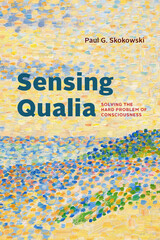
front cover of Sensing Qualia
Sensing Qualia
Solving the Hard Problem of Consciousness
Paul G. Skokowski
University of Chicago Press, 2026
A new, naturalistic theory of consciousness and sensory experience.

Philosophers of mind and neuroscientists often debate what they call the hard problem of consciousness, that is, how we might account for qualia—our subjective experiences of phenomena like color, taste, pain, smell, and more. In Sensing Qualia, Paul G. Skokowski surveys the most influential theories of mind since Descartes in order to establish a new theory he calls sensory naturalism, which recognizes the senses as natural detectors of physical properties in the world.

Drawing on neuroscience, physics, and philosophy, Skokowski provides a naturalistic framework for studying qualia in the physical world and explores the limits of qualia in androids and AI. The result is a compelling explanation of qualia for anyone curious about the nature of conscious experience in humans and AI.
[more]

front cover of Settler Militarism
Settler Militarism
World War II in Hawai'i and the Making of US Empire
Juliet Nebolon
Duke University Press, 2024
Under martial law during World War II, Hawaiʻi was located at the intersection of home front and war front. In Settler Militarism, Juliet Nebolon shows how settler colonialism and militarization simultaneously perpetuated, legitimated, and concealed one another in wartime Hawaiʻi for the purposes of empire building in Asia and the Pacific Islands. She demonstrates how settler militarism operated through a regime of racial liberal biopolitics that purported to protect all people in Hawaiʻi, even as it intensified the racial and colonial differentiation of Kanaka Maoli, Asian settlers, and white settlers. Nebolon identifies settler militarism’s inherent contradiction: It depends on life, labor, and land to reproduce itself, yet it avariciously consumes, via violent and extractive projects, those same lives and natural resources that it needs to subsist. From vaccination and blood bank programs to the administration of internment and prisoner-of-war camps, Nebolon reveals how settler militarism and racial liberal biopolitics operated together in the service of capitalism. Collectively, the social reproduction of these regimes created the conditions for the late-twentieth-century expansion of US military empire.
[more]

front cover of Southern Migrants, Northern Exiles
Southern Migrants, Northern Exiles
Chad Berry
University of Illinois Press, 2000
One of the largest internal migrations in U.S. history, the great white migration left its mark on virtually every family in every southern upland and flatland town. In this extraordinary record of ordinary lives, dozens of white southern migrants describe their experiences in the northern "wilderness" and their irradicable attachments to family and community in the South.

Southern out-migration drew millions of southern workers to the steel mills, automobile factories, and even agricultural fields and orchards of Ohio, Indiana, Michigan, and Illinois. Through vivid oral histories, Chad Berry explores the conflict between migrants' economic success and their "spiritual exile" in the North. He documents the tension between factory owners who welcomed cheap, naive southern laborers and local "native" workers who greeted migrants with suspicion and hostility. He examines the phenomenon of "shuttle migration," in which migrants came north to work during the winter and returned home to plant spring crops on their southern farms. He also explores the impact of southern traditions--especially the southern evangelical church and "hillbilly" music--brought north by migrants.

Berry argues that in spite of being scorned by midwesterners for violence, fecundity, intoxication, laziness, and squalor, the vast majority of southern whites who moved to the Midwest found the economic prosperity they were seeking. By allowing southern migrants to assess their own experiences and tell their own stories, Southern Migrants, Northern Exiles refutes persistent stereotypes about migrants' clannishness, life-style, work ethic, and success in the North.


[more]

front cover of Speculative Relations
Speculative Relations
Indigenous Worlding and Repair
Joseph M. Pierce
Duke University Press, 2025
Indigenous relations are often described in anthropological terms, or as expressions of timeless, unchanging kinship ties. In Speculative Relations, Joseph M. Pierce challenges this view, considering the potential of these relations as a means of repairing the damages of history. Pierce approaches Indigenous art and culture not as objects of study, but through relations committed to reciprocity and care for human and more-than-human beings. Drawing on Cherokee thinking, Indigenous queer theory, literary and cultural studies, and art criticism, he illuminates pathways for understanding and resisting the ongoing damages of colonialism while pointing to future worlds and imaginaries that breathe life into Indigenous thought and practice. Analyzing a range of materials—from photography, literature, and sculpture to film and ethnography—Pierce reveals how speculation, as a form of situated knowledge production, can repair and reimagine the worlds that colonialism sought to destroy. In doing so, Pierce highlights how gestures, poetics, and embodiment can uphold tradition and harness the imaginative power of speculation to create pathways for living in good relations.
[more]

front cover of Stay Black and Die
Stay Black and Die
On Melancholy and Genius
I. Augustus Durham
Duke University Press, 2023
In Stay Black and Die, I. Augustus Durham examines melancholy and genius in black culture, letters, and media from the nineteenth century to the contemporary moment. Drawing on psychoanalysis, affect theory, and black studies, Durham explores the black mother as both a lost object and a found subject often obscured when constituting a cultural legacy of genius across history. He analyzes the works of Frederick Douglass, Ralph Ellison, Marvin Gaye, Octavia E. Butler, and Kendrick Lamar to show how black cultural practices and aesthetics abstract and reveal the lost mother through performance. Whether attributing Douglass’s intellect to his matrilineage, reading Gaye’s falsetto singing voice as a move to interpolate black female vocality, or examining the women in Ellison’s life who encouraged his aesthetic interests, Durham demonstrates that melancholy becomes the catalyst for genius and genius in turn is a signifier of the maternal. Using psychoanalysis to develop a theory of racial melancholy while “playing” with affect theory to investigate racial aesthetics, Durham theorizes the role of the feminine, especially the black maternal, in the production of black masculinist genius.
[more]


Send via email Share on Facebook Share on Twitter