
 A SCHOLARLY BOOK REPOSITORY
110 books about Individual Philosophers and 4
start with R
110 books about Individual Philosophers and 4
110 books about Individual Philosophers
4 start with R start with R
4 start with R start with R
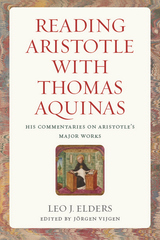
Reading Aristotle with Thomas Aquinas
His Commentaries on Aristotle's Major Works
Leo J. Elders
Catholic University of America Press, 2022
Reading Aristotle with Thomas Aquinas: His Commentaries on Aristotle’s Major Works offers an original and decisive work for the understanding of the thought of Thomas Aquinas. For decades his commentaries on the major works of Aristotle have been the subject of lively discussions. Are his commentaries faithful and reliable expositions of the Stagirite's thought or do they contain Thomas’s own philosophy and are they read through the lens of Thomas’s own Christian faith and in doing so possibly distorting Aristotle?
In order to be able to provide clarity and offer a nuanced response to this question a careful study of all the relevant texts is needed. This is precisely what the author sets out do to in this work.
Each chapter is devoted to one of the twelve commentaries Thomas wrote on major works of Aristotle including both his massive and influential commentaries on the Metaphysics, Physics and Nicomachean Ethics as well as lesser known commentaries. Elders places Thomas’s commentary in its historical context, reviews the Greek, Arabic and Latin translation and reception of Aristotle’s text as well as contemporary interpretations thereof and presents the reader with a thorough presentation and analysis of the content of the commentary, drawing attention to all the places where Thomas intervenes and makes special observations. In this way the reader can study Aristotle’s treatises with Thomas as guide.
The conclusion reached is that Thomas’s commentaries are a masterful and faithful presentation of Aristotle’s thought and of that of Thomas himself. Thomas’s Christian faith does not falsify Aristotle’s text, but gives occasionally an outlook at what lies behind philosophical thought.
[more]
Reading Hegel
Irony, Recollection, Critique
Robert Lucas Scott
University of Chicago Press, 2025
Retrieves Hegelian speculative experience for literary theory.
The relationship between Hegel and literary theory has for a long time been both contested and paradoxical. On the one hand, “theory” is often skeptical of all that Hegel ostensibly stood for: idealism, systematicity, and identity at the expense of difference. Yet, in spite of itself, literary theory is taken to owe a profound debt to Hegel’s philosophy. Robert Lucas Scott’s book complicates this account and argues that literary theory has made the mistake of abstracting Hegel’s thought from its more dynamic presentation in Hegel’s writings, reducing “Hegel” to a series of propositions or positions. Literary theory, Scott argues, misses what is perhaps the greatest innovation of Hegel’s philosophy: a presentation of experience that begins precisely by setting aside all preconceptions or prior assumptions. It is on this point that Hegel’s philosophy itself approaches literature: its content cannot be simply abstracted from the singular experience of reading it. Only through a mode of reading alive to speculative experience can literary theory become truly Hegelian. Scott’s exposition of Hegel offers a model of reading with relevance beyond philosophy: one that is critical without pretensions of mastery and detachment and that honors the singularity of the reading experience without succumbing to the subjectivism of the “postcritical.”
The book also includes engagements with the work of Luther, Kant, Marx, Gillian Rose, Fredric Jameson, Robert Brandom, Catherine Malabou, and more in its recovery of Hegel’s thought for a critical understanding of our time.
The relationship between Hegel and literary theory has for a long time been both contested and paradoxical. On the one hand, “theory” is often skeptical of all that Hegel ostensibly stood for: idealism, systematicity, and identity at the expense of difference. Yet, in spite of itself, literary theory is taken to owe a profound debt to Hegel’s philosophy. Robert Lucas Scott’s book complicates this account and argues that literary theory has made the mistake of abstracting Hegel’s thought from its more dynamic presentation in Hegel’s writings, reducing “Hegel” to a series of propositions or positions. Literary theory, Scott argues, misses what is perhaps the greatest innovation of Hegel’s philosophy: a presentation of experience that begins precisely by setting aside all preconceptions or prior assumptions. It is on this point that Hegel’s philosophy itself approaches literature: its content cannot be simply abstracted from the singular experience of reading it. Only through a mode of reading alive to speculative experience can literary theory become truly Hegelian. Scott’s exposition of Hegel offers a model of reading with relevance beyond philosophy: one that is critical without pretensions of mastery and detachment and that honors the singularity of the reading experience without succumbing to the subjectivism of the “postcritical.”
The book also includes engagements with the work of Luther, Kant, Marx, Gillian Rose, Fredric Jameson, Robert Brandom, Catherine Malabou, and more in its recovery of Hegel’s thought for a critical understanding of our time.
[more]
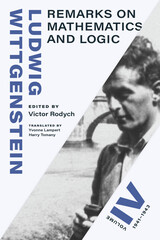
Remarks on Mathematics and Logic
Volume IV, 1941–1943
Ludwig Wittgenstein
University of Chicago Press
The first of five planned volumes, this book collects Wittgenstein’s unabridged writings on mathematics and logic composed between 1941 and 1943.
In 1956, a significant but abridged portion of Ludwig Wittgenstein’s 1937–1944 writings for a continuation of what became Philosophical Investigations was published as Remarks on the Foundations of Mathematics. Now, in the five German-English facing pages volumes of Remarks on Mathematics and Logic, these writings are presented in full as Wittgenstein wrote them: in chronological order, without editorial omissions, selections, or rearrangements.
Volume IV contains materials from 1941 to 1943, including one previously unpublished manuscript and three manuscripts from which selections were made for the previous abridgment. The topics covered in this volume include the philosophy of mathematics, mathematical foundationalism, surveyability in mathematics, language-games and proof-networks, Gödelian undecidability, pictures in mathematics, Cantorian diagonal proofs, applied mathematics without pure mathematics, and mathematics and chess, among others.
This German-English facing pages edition presents Wittgenstein’s writings in their original context—as Wittgenstein wrote them, in chronological order, and without editorial omissions, selections, or rearrangements.
In 1956, a significant but abridged portion of Ludwig Wittgenstein’s 1937–1944 writings for a continuation of what became Philosophical Investigations was published as Remarks on the Foundations of Mathematics. Now, in the five German-English facing pages volumes of Remarks on Mathematics and Logic, these writings are presented in full as Wittgenstein wrote them: in chronological order, without editorial omissions, selections, or rearrangements.
Volume IV contains materials from 1941 to 1943, including one previously unpublished manuscript and three manuscripts from which selections were made for the previous abridgment. The topics covered in this volume include the philosophy of mathematics, mathematical foundationalism, surveyability in mathematics, language-games and proof-networks, Gödelian undecidability, pictures in mathematics, Cantorian diagonal proofs, applied mathematics without pure mathematics, and mathematics and chess, among others.
This German-English facing pages edition presents Wittgenstein’s writings in their original context—as Wittgenstein wrote them, in chronological order, and without editorial omissions, selections, or rearrangements.
[more]
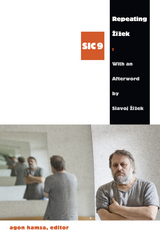
Repeating Žižek
Agon Hamza, ed.
Duke University Press, 2015
Repeating Žižek offers a serious engagement with the ideas and propositions of philosopher Slavoj Žižek. Often subjecting Žižek's work to a Žižekian analysis, this volume's contributors consider the possibility (or impossibility) of formalizing Žižek's ideas into an identifiable philosophical system. They examine his interpretations of Hegel, Plato, and Lacan, outline his debates with Badiou, and evaluate the implications of his analysis of politics and capitalism upon Marxist thought. Other essays focus on Žižek's approach to Christianity and Islam, his "sloppy" method of reading texts, his relation to current developments in neurobiology, and his theorization of animals. The book ends with an afterword by Žižek in which he analyzes Shakespeare's and Beckett's plays in relation to the subject. The contributors do not reach a consensus on defining a Žižekian school of philosophy—perhaps his idiosyncratic and often heterogeneous ideas simply resist synthesis—but even in their repetition of Žižek, they create something new and vital.
Contributors. Henrik Jøker Bjerre, Bruno Bosteels, Agon Hamza, Brian Benjamin Hansen, Adrian Johnston, Katja Kolšek, Adam Kotsko, Catherine Malabou, Benjamin Noys, Geoff Pfeifer, Frank Ruda, Oxana Timofeeva, Samo Tomšic, Gabriel Tupinambá, Fabio Vighi, Gavin Walker, Sead Zimeri, Slavoj Žižek
Contributors. Henrik Jøker Bjerre, Bruno Bosteels, Agon Hamza, Brian Benjamin Hansen, Adrian Johnston, Katja Kolšek, Adam Kotsko, Catherine Malabou, Benjamin Noys, Geoff Pfeifer, Frank Ruda, Oxana Timofeeva, Samo Tomšic, Gabriel Tupinambá, Fabio Vighi, Gavin Walker, Sead Zimeri, Slavoj Žižek
[more]
READERS
Browse our collection.
PUBLISHERS
See BiblioVault's publisher services.
STUDENT SERVICES
Files for college accessibility offices.
RECENTLY PUBLISHED





UChicago Accessibility Resources
home | accessibility | search | about | contact us
BiblioVault ® 2001 - 2026
The University of Chicago Press