
 A SCHOLARLY BOOK REPOSITORY
5 start with R start with R

To frame the analysis of contemporary travel writing, author Jane Hanley examines key moments in the history of Mexican-Spanish relations, including the origins of narratives regarding Spaniards' sense of Mexico's similarity to and difference from Spain. This history underpins the discussion of the role of Spanish travelers in their encounters with Mexican peoples and places and their reflection on their own role as communicators of cultural meaning and participants in the tourist economy with its impact—both negative and positive—on places.
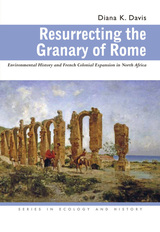
Tales of deforestation and desertification in North Africa have been told from the Roman period to the present. Such stories of environmental decline in the Maghreb are still recounted by experts and are widely accepted without question today. International organizations such as the United Nations frequently invoke these inaccurate stories to justify environmental conservation and development projects in the arid and semiarid lands in North Africa and around the Mediterranean basin. Recent research in arid lands ecology and new paleoecological evidence, however, do not support many claims of deforestation, overgrazing, and desertification in this region.
Diana K. Davis’s pioneering analysis reveals the critical influence of French scientists and administrators who established much of the purported scientific basis of these stories during the colonial period in Algeria, Morocco, and Tunisia, illustrating the key role of environmental narratives in imperial expansion. The processes set in place by the use of this narrative not only systematically disadvantaged the majority of North Africans but also led to profound changes in the landscape, some of which produced the land degradation that continues to plague the Maghreb today.
Resurrecting the Granary of Rome exposes many of the political, economic, and ideological goals of the French colonial project in these arid lands and the resulting definition of desertification that continues to inform global environmental and development projects. The first book on the environmental history of the Maghreb, this volume reframes much conventional thinking about the North African environment. Davis’s book is essential reading for those interested in global environmental history.
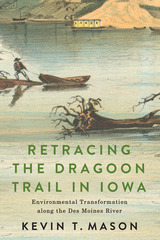
In Retracing the Dragoon Trail in Iowa, historian Kevin T. Mason presents a vivid and deeply researched account of Iowa’s evolving landscape, beginning with the 1835 expedition of the First U.S. Dragoons. Drawing from archival records, maps, government surveys, Indigenous histories, and ecological data, Mason explores how Iowa’s prairies and wetlands gave way to farms, towns, and transportation networks. He situates these environmental shifts within the broader forces of Manifest Destiny, military expansion, and settler colonialism, while amplifying the voices of the Sauk, Meskwaki, Dakota, and other Indigenous nations whose histories are often marginalized.
But Mason doesn’t just write about history—he walks it. His 371-mile journey retracing the original dragoon route across Iowa blends scholarship with storytelling, captured through video essays, photography, and writing. This modern-day trek, featured on Iowa PBS’s Iowa Life and Iowa Public Radio’s Talk of Iowa, brings the past into the present, offering a compelling look at how landscapes remember. The result is a powerful contribution to environmental history, regional studies, and Indigenous scholarship—one that reveals the layered interactions between land use, policy, and historical change.
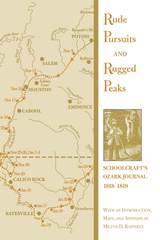
The journal kept by Schoolcraft as he traveled ninety days in the rugged terrain of southern Missouri and northern Arkansas was originally published in 1821 and has become an essential record of Ozark territorial society and natural history documenting some of the earliest American settlers in the region, the power and beauty of many lost portions of the White River, the majesty of the open prairies, and the wealth of wildlife once found in the Ozarks.
READERS
Browse our collection.
PUBLISHERS
See BiblioVault's publisher services.
STUDENT SERVICES
Files for college accessibility offices.
RECENTLY PUBLISHED




UChicago Accessibility Resources
home | accessibility | search | about | contact us
BiblioVault ® 2001 - 2026
The University of Chicago Press