
 A SCHOLARLY BOOK REPOSITORY
7 start with O start with O
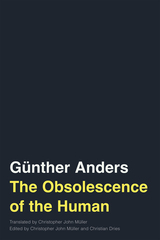
Now available in English—one of the twentieth century’s most important works on the philosophy of technology
With this first English translation of influential German philosopher Günther Anders’s 1956 masterpiece of critical theory, The Obsolescence of the Human, a new generation of readers can now engage with his prescient and haunting vision of a “world without us” dominated by technology.
Looking at technological events such as the detonation of the nuclear bomb and the arrival of televisions in our living rooms, Anders advances a warning of what humanity looks like in a world where it has surrendered all agency. He outlines the new emotional landscapes that shape our relationship to increasingly capable technology, including Promethean shame, the human sense of unease our own superior technological innovations can instill. Confronting the growing gap between what we can collectively create and what we can individually comprehend, Anders speculates on the trajectory of a developing technological world that rapidly exceeds our ability to control or even foresee its negative consequences.
The Obsolescence of the Human prefigures contemporary posthumanist discourse and is eerily predictive of current debates around automation, global warming, and artificial intelligence. Providing new ways to conceptualize the intersection of technology and emotion, it offers groundbreaking frameworks for future-oriented ethics. Radical in both its stylistic experimentation and its theoretical insights, this new translation presents a cautionary tale regarding the human capacity to usher in its own destruction.
Retail e-book files for this title are screen-reader friendly with images accompanied by short alt text and/or extended descriptions.
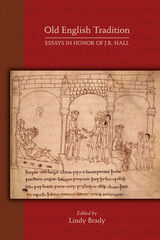
Old English Tradition contains eighteen new essays by leading scholars in the field of Old English literary studies. The collection is centered around five key areas of research—Old English poetics, Anglo-Saxon Christianity, Beowulf, codicology, and early Anglo-Saxon studies—on which the work of scholar J. R. Hall, the volume’s honorand, has been influential over the course of his career.
The volume’s contents range from fresh insights on individual Old English poems such as The Wife’s Lament and Beowulf; new studies in Old English metrics and linguistics; codicological examinations of individual manuscripts; fresh editions of understudied texts; and innovative examinations of the role of early antiquarians in shaping the field of Old English literary studies as we know it today.


Available for the first time in English: the complete and annotated transcripts of Deleuze’s 1981 seminars on painting
From 1970 until 1987, Gilles Deleuze held a weekly seminar at the Experimental University of Vincennes and, starting in 1980, at Saint-Denis. In the spring of 1981, he began a series of eight seminars on painting and its intersections with philosophy. The recorded sessions, newly transcribed and translated into English, are now available in their entirety for the first time. Extensively annotated by philosopher David Lapoujade, On Painting illuminates Deleuze’s thinking on artistic creation, significantly extending the lines of thought in his book Francis Bacon.
Through paintings and writing by Rembrandt, Delacroix, Turner, Cézanne, Van Gogh, Klee, Pollock, and Bacon, Deleuze explores the creative process, from chaos to the pictorial fact. The introduction and use of color feature prominently as Deleuze elaborates on artistic and philosophical concepts such as the diagram, modulation, code, and the digital and the analogical. Through this scrutiny, he raises a series of profound and stimulating questions for his students: How does a painter ward off grayness and attain color? What is a line without contour? Why paint at all?
Written and thought in a rhizomatic manner that is thoroughly Deleuzian—strange, powerful, and novel—On Painting traverses both the conception of art history and the possibility of color as a philosophical concept.
Retail e-book files for this title are screen-reader friendly with images accompanied by short alt text and/or extended descriptions.
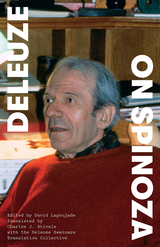
Through newly transcribed and translated lectures, Deleuze explores Spinoza’s philosophy concerning questions of good and evil and humanity’s potential for realizing a full life
Available for the first time in English, On Spinoza presents the annotated transcripts of Gilles Deleuze’s fifteen seminars on the seventeenth-century philosopher’s Ethics, delivered at the experimental University of Vincennes at the behest of Michel Foucault. Spinoza’s ambitious treatise was central to Deleuze’s thought, and his course provides an accessible framework for understanding the vitality of Spinoza’s philosophy.
In an informal classroom setting, Deleuze addresses fundamental aspects of Spinoza’s thought: How does one undo the negativity of harmful passions such as hate, resentment, and envy? How can a system of moral judgment based on good and evil be replaced by a more sophisticated ethics of the good and the bad? And since such questions commit Spinoza to a new theory of signs, Deleuze also delves into his thinking on how these signs should guide human existence and the differences between concepts of eternity, experienced in the here and now, and the immortality promised by philosophy and religion.
Building gradually from session to session, Deleuze shows how Spinoza rejects a hierarchical reality dominated by an authoritarian and impenetrable God, instead proposing a world ruled by light and reason in which all beings are equal. Annotated by David Lapoujade and including recorded exchanges with Deleuze’s students, On Spinoza offers a rare window into Deleuze’s teaching, offering readers a guide for linking Spinoza to other philosophers—including Deleuze himself.
Retail e-book files for this title are screen-reader friendly with image accompanied by short alt text and/or extended description.
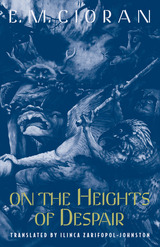
On the Heights of Despair shows Cioran's first grappling with themes he would return to in his later, mature works: despair and decay, absurdity and alienation, futility and the irrationality of existence. It also presents Cioran as a connoisseur of apocalypse, a theoretician of despair, for whom writing and philosophy both share the "lyrical virtues" that alone lead to a metaphysical revelation.
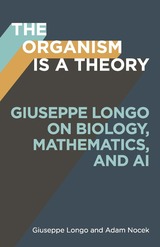
A bold reimagining of life that bridges science, philosophy, cybernetics, and the complexities of biological existence
The Organism Is a Theory is an intriguing synthesis of decades of interdisciplinary research by eminent mathematician and biological scientist Giuseppe Longo. A unique collaboration between Longo and philosopher of technology Adam Nocek, the volume confronts foundational issues in the history of mathematics, computer science, physics, and theoretical biology.
Challenging conventional approaches that apply computational and formalist models to the biological world, Longo reveals how the limitations of these models hinder the understanding of organismic complexity, development, and evolution. Through a critique of dominant scientific paradigms, he emphasizes the need for a new biological theory that accounts for the temporal and spatial intricacies of life. Enhanced by Nocek’s comprehensive introduction and a fascinating three-part interview with Longo, The Organism Is a Theory offers a bold rethinking of the biosciences, integrating the work of Alan Turing, Bernhard Riemann, Henri Poincaré, Kurt Gödel, and others into Longo’s vision of critical biology.
Bridging scientific and philosophical discourses, this book creatively applies insights from mathematics, physics, and computing into the study of the organism to present a new theoretical approach to understanding biological complexity that resists reductive mechanistic and informatic explanations.
Retail e-book files for this title are screen-reader friendly with image accompanied by short alt text and/or extended description.
READERS
Browse our collection.
PUBLISHERS
See BiblioVault's publisher services.
STUDENT SERVICES
Files for college accessibility offices.
RECENTLY PUBLISHED




UChicago Accessibility Resources
home | accessibility | search | about | contact us
BiblioVault ® 2001 - 2026
The University of Chicago Press