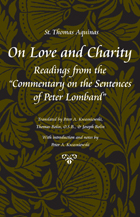
front cover of On Love and Charity
On Love and Charity
Readings from the Commentary on the Sentences of Peter Lombard (Thomas Aquinas in Translation)
Saint Thomas Aquinas
Catholic University of America Press, 2008
No description available
[more]

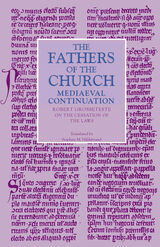
front cover of On the Cessation of the Laws
On the Cessation of the Laws
Robert Grosseteste
Catholic University of America Press, 2012
In On the Cessation of the Laws, Grosseteste draws out the theological, christological, and soteriological issues implicit in the question of the relationship between the Old and New Covenants.
[more]

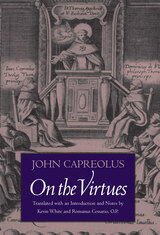
front cover of On the Virtues
On the Virtues
Jean Capreolus
Catholic University of America Press, 2001
The selection from Capreolus's work represented in this translation shows him defending Aquinas's conclusions on faith, hope, charity, the gifts of the Holy Spirit, and the virtues against such adversaries.
[more]

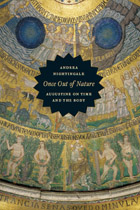
front cover of Once Out of Nature
Once Out of Nature
Augustine on Time and the Body
Andrea Nightingale
University of Chicago Press, 2011
Once Out of Nature offers an original interpretation of Augustine’s theory of time and embodiment. Andrea Nightingale draws on philosophy, sociology, literary theory, and social history to analyze Augustine’s conception of temporality, eternity, and the human and transhuman condition.
 
In Nightingale’s view, the notion of embodiment illuminates a set of problems much larger than the body itself: it captures the human experience of being an embodied soul dwelling on earth. In Augustine’s writings, humans live both in and out of nature—exiled from Eden and punished by mortality, they are “resident aliens” on earth. While the human body is subject to earthly time, the human mind is governed by what Nightingale calls psychic time. For the human psyche always stretches away from the present moment—where the physical body persists—into memories and expectations. As Nightingale explains, while the body is present in the here and now, the psyche cannot experience self-presence. Thus, for Augustine, the human being dwells in two distinct time zones, in earthly time and in psychic time. The human self, then, is a moving target. Adam, Eve, and the resurrected saints, by contrast, live outside of time and nature: these transhumans dwell in an everlasting present.
 
Nightingale connects Augustine’s views to contemporary debates about transhumans and suggests that Augustine’s thought reflects our own ambivalent relationship with our bodies and the earth. Once Out of Nature offers a compelling invitation to ponder the boundaries of the human.

[more]

logo for Georgetown University Press
The Origins of Moral Theology in the United States
Three Different Approaches
Charles E. Curran
Georgetown University Press, 1997

Charles E. Curran presents the first in-depth analysis of the origins of Catholic moral theology in the United States, focusing on three significant figures in the late nineteenth century and demonstrating that methodological pluralism and theological diversity existed in the Church even then.

Curran begins by tracing the historical development of moral theology, especially as presented in nineteenth-century manuals of moral theology, which offered a legal model of morality including a heavy emphasis on canon law. He then probes the different approaches and ideas of three important writers: Aloysius Sabetti, a Jesuit who was a typical, as well as the most influential, American manualist; Thomas J. Bouquillon, first chair of moral theology at Catholic University of America, a neoscholastic who criticized the manuals' approach as narrow and incomplete for failing to address principles, virtues, and the connection to systematic theology; and clerical educator John B. Hogan, a casuist who developed a more inductive and historically conscious methodology.

Curran describes how all three men dealt in different ways with the increasing role of authoritative teachings in moral theology from the Vatican. He also shows how they reflected their American context and the views of their own time on women and sexuality.

So little attention has been paid to the development of moral theology in this country that these authors are unknown to many scholars. Curran's book corrects this oversight and proposes that the ferment revealed in their writings offers important lessons for contemporary Catholic moral theology.

[more]

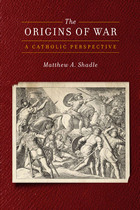
front cover of The Origins of War
The Origins of War
A Catholic Perspective
Matthew A. Shadle
Georgetown University Press, 2011

Debate rages within the Catholic Church about the ethics of war and peace, but the simple question of why wars begin is too often neglected. Catholics’ assumptions about the causes of conflict are almost always drawn uncritically from international relations theory—a field dominated by liberalism, realism, and Marxism—which is not always consistent with Catholic theology.

In The Origins of War, Matthew A. Shadle examines several sources to better understand why war happens. His retrieval of biblical literature and the teachings of figures from church tradition sets the course for the book. Shadle then explores the growing awareness of historical consciousness within the Catholic tradition—the way beliefs and actions are shaped by time, place, and culture. He examines the work of contemporary Catholic thinkers like Pope John Paul II, Jacques Maritain, John Courtney Murray, Dorothy Day, Brian Hehir, and George Weigel. In the constructive part of the book, Shadle analyzes the movement within international relations theory known as constructivism—which proposes that war is largely governed by a set of socially constructed and cultural influences. Constructivism, Shadle claims, presents a way of interpreting international politics that is highly amenable to a Catholic worldview and can provide a new direction for the Christian vocation of peacemaking.

[more]


Send via email Share on Facebook Share on Twitter