
 A SCHOLARLY BOOK REPOSITORY
7 start with M start with M
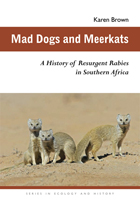
Through the ages, rabies has exemplified the danger of diseases that transfer from wild animals to humans and their domestic stock. In South Africa, rabies has been on the rise since the latter part of the twentieth century despite the availability of postexposure vaccines and regular inoculation campaigns for dogs.
In Mad Dogs and Meerkats: A History of Resurgent Rabies in Southern Africa, Karen Brown links the increase of rabies to the HIV/AIDS epidemic. Her study shows that the most afflicted regions of South Africa have seen a dangerous rise in feral dog populations as people lack the education, means, or will to care for their pets or take them to inoculation centers. Most victims are poor black children. Ineffective disease control, which in part depends on management policies in neighboring states and the diminished medical and veterinary infrastructures in Zimbabwe, has exacerbated the problem.
This highly readable book is the first study of rabies in Africa, tracing its history in South Africa and neighboring states from 1800 to the present and showing how environmental and economic changes brought about by European colonialism and global trade have had long-term effects.
Mad Dogs and Meerkats is recommended for public health policy makers and anyone interested in human-animal relations and how societies and governments have reacted to one of the world’s most feared diseases.

How was frontier expansion rationalized in the Americas during the late nineteenth century? As new states fleshed out expanded national maps, how did they represent their advances? Were there any distinct pan-American patterns? The renowned anthropologist and human rights advocate David Maybury-Lewis saw the Latin American frontiers as relatively unknown physical spaces as well as unexplored academic “territory.” He invited eight specialists to explore public narratives of the expansion of Argentina, Brazil, Chile, and the western regions of Canada and the United States during the late nineteenth century, a time when those who then identified as “Americans” claimed territories in which indigenous peoples, who were now seen as economic and political obstacles, lived. The authors examine the narrative forms that stirred or rationalized expansion, and emphasize their impact on the native residents.
The authors illustrate the variety and the similarities of these nationalist ideas and experiences, which were generally expressed in symbolic and cultural terms rather than on simple materialist or essentialist grounds. The cases also point out that civic nationalism, often seem as inclusive and more benign than ethnic nationalism, can produce similarly destructive human and cultural ends. The essays thus suggest a view of nationalism as a theoretical concept, and of frontier expansion as a historical phenomenon.
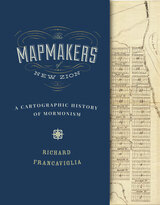
From their earliest days on the American frontier through their growth into a worldwide church, the spatially expansive Mormons made maps to help them create idealized communities, migrate to and colonize large parts of the American West, visualize the stories in their sacred texts, and spread their message internationally through a well-organized missionary system. This book identifies many Mormon mapmakers who played an important but heretofore unsung role in charting the course of Latter-day Saint history. For Mormons, maps had and continue to have both practical and spiritual significance. In addition to using maps to help build their new Zion and to explore the Intermountain West, Latter-day Saint mapmakers used them to depict locations and events described in the Book of Mormon.
Featuring over one hundred historical maps reproduced in full color—many never before published—The Mapmakers of New Zion sheds new light on Mormonism and takes readers on a fascinating journey through maps as both historical documents and touchstones of faith.
Winner of the Southwest Book Design and Production Award from the New Mexico Book Association.
Selected as one of the American Library Association's Best of the Best from University Presses.
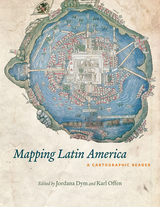
For many, a map is nothing more than a tool used to determine the location or distribution of something—a country, a city, or a natural resource. But maps reveal much more: to really read a map means to examine what it shows and what it doesn’t, and to ask who made it, why, and for whom. The contributors to this new volume ask these sorts of questions about maps of Latin America, and in doing so illuminate the ways cartography has helped to shape this region from the Rio Grande to Patagonia.
In Mapping Latin America,Jordana Dym and Karl Offen bring together scholars from a wide range of disciplines to examine and interpret more than five centuries of Latin American maps.Individual chapters take on maps of every size and scale and from a wide variety of mapmakers—from the hand-drawn maps of Native Americans, to those by famed explorers such as Alexander von Humboldt, to those produced in today’s newspapers and magazines for the general public. The maps collected here, and the interpretations that accompany them, provide an excellent source to help readers better understand how Latin American countries, regions, provinces, and municipalities came to be defined, measured, organized, occupied, settled, disputed, and understood—that is, how they came to have specific meanings to specific people at specific moments in time.
The first book to deal with the broad sweep of mapping activities across Latin America, this lavishly illustrated volume will be required reading for students and scholars of geography and Latin American history, and anyone interested in understanding the significance of maps in human cultures and societies.
In more recent decades, historians have pieced together a story that is not only more likely but more complicated and interesting. Patrick Jung synthesizes the research about Nicolet and his superior Samuel de Champlain, whose diplomatic goals in the region are crucial to understanding this much misunderstood journey across the Great Lakes. Additionally, historical details about Franco-Indian relations and the search for the Northwest Passage provide a framework for understanding Nicolet’s famed mission.

The Latin American and Caribbean regions’ historical trajectories have been shaped by complex human-nonhuman interactions. In these histories, people are important, even crucial, actors, but not the only ones. Offering a novel approach to the writing of Latin American history, this book brings eight thought-provoking chapters together with a historiographical introduction and critical afterword to center nonhuman beings and things. The oscillating glare of the sun, the allure and resourcefulness of animals, the reluctant genetic malleability of plant seeds, and the life-giving and intractable impassivity of rivers are some of the other-than-human agents driving history in the volume’s chapters.
This book problematizes Latin American(ist) historiography’s tendency to frame “nature” as a separate ontological domain that is only acted upon—conquered, manipulated, devastated—lacking the self-propelled dynamics capable of shaping the course of events. With broad regional and temporal coverage across Latin America and the Caribbean from the pre-colonial period to the present day, More-than-Human Histories of Latin America and the Caribbean responds to environmental history’s call to write biophysical environments into the human past—a reconsideration of historical agency that, in this era of climate change, is more necessary than ever.
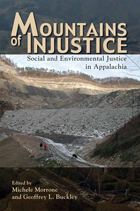
Research in environmental justice reveals that low-income and minority neighborhoods in our nation’s cities are often the preferred sites for landfills, power plants, and polluting factories. Those who live in these sacrifice zones are forced to shoulder the burden of harmful environmental effects so that others can prosper. Mountains of Injustice broadens the discussion from the city to the country by focusing on the legacy of disproportionate environmental health impacts on communities in the Appalachian region, where the costs of cheap energy and cheap goods are actually quite high.
Through compelling stories and interviews with people who are fighting for environmental justice, Mountains of Injustice contributes to the ongoing debate over how to equitably distribute the long-term environmental costs and consequences of economic development.
Contributors:
Laura Allen, Brian Black, Geoffrey L. Buckley, Donald Edward Davis, Wren Kruse, Nancy Irwin Maxwell, Chad Montrie, Michele Morrone, Kathryn Newfont, John Nolt, Jedediah S. Purdy, and Stephen J. Scanlan.
READERS
Browse our collection.
PUBLISHERS
See BiblioVault's publisher services.
STUDENT SERVICES
Files for college accessibility offices.
RECENTLY PUBLISHED






UChicago Accessibility Resources
home | accessibility | search | about | contact us
BiblioVault ® 2001 - 2026
The University of Chicago Press