
 A SCHOLARLY BOOK REPOSITORY
12 start with M start with M
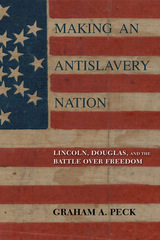
This sweeping narrative presents an original and compelling explanation for the triumph of the antislavery movement in the United States prior to the Civil War. Abraham Lincoln's election as the first antislavery president was hardly preordained. From the country's inception, Americans had struggled to define slavery's relationship to freedom. Most Northerners supported abolition in the North but condoned slavery in the South, while most Southerners denounced abolition and asserted slavery's compatibility with whites' freedom. On this massive political fault line hinged the fate of the nation.
Graham A. Peck meticulously traces the conflict over slavery in Illinois from the Northwest Ordinance in 1787 to Lincoln's defeat of his archrival Stephen A. Douglas in the 1860 election. Douglas's attempt in 1854 to persuade Northerners that slavery and freedom had equal national standing stirred a political earthquake that brought Lincoln to the White House. Yet Lincoln's framing of the antislavery movement as a conservative return to the country's founding principles masked what was in fact a radical and unprecedented antislavery nationalism. It justified slavery's destruction but triggered the Civil War.
Presenting pathbreaking interpretations of Lincoln, Douglas, and the Civil War's origins, Making an Antislavery Nation shows how battles over slavery paved the way for freedom's triumph in America.
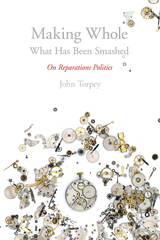
Viewing the search for “coming to terms with the past” as a form of politics, John Torpey argues that there are major differences between reparations for the living victims of past wrongdoing and reparations for the descendants of such victims. More fundamentally, he argues that claims for reparations comprise a relatively novel kind of politics that involves a quest for symbolic recognition and material compensation for those seeking them—through the idiom of the past rather than the present. This reissue is the first paperback edition and contains a new preface by the author.
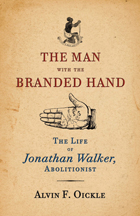
Captured While Attempting to Smuggle Slaves to Freedom in 1844, the Only Man Branded in a Courtroom by a United States Marshal
Sailing around the Florida Keys in 1844, forty-five-year-old Jonathan Walker had a price on his head. On board the small boat he had built that winter in Alabama were seven fugitives from slavery. The Cape Cod sailor and abolitionist was wanted in Pensacola, Florida, for his crime: stealing slaves. The slaves’ owners had posted $100 each as reward money for their property and $1,000 for Walker’s apprehension. Only a day’s sail from their goal of freedom in British-controlled Bahamas, Walker and the slaves were stopped and seized by bounty hunters and taken to a Key West court. Ordered back to Pensacola for trial, Walker ended up spending a year in jail. He was fined and sentenced to stand in the pillory; in addition, he was to suffer a unique punishment in American history: while a packed courtroom watched, a United States marshal was ordered to use a hot branding iron to burn the letters SS, for “slave stealer,” into Walker’s right hand.
Walker survived his ordeal, spending much of his incarceration in isolation. Once released, he remained active in the antislavery movement even while he and his devoted wife Jane raised their nine children. His attempt to help form a new colony in Mexico for runaway American slaves also led to punishing experiences for Walker and one of his sons. Living later with his family in Plymouth, Massachusetts, in the years before the Civil War, Walker made room in his crowded house to shelter runaway slaves along the Underground Railroad. He participated in abolitionist lecture tours across the North where he would be urged to reveal his branded hand—made famous by John Greenleaf Whittier’s poem “The Branded Hand”—to astonished audiences. Too old to enlist in the Civil War, Walker instead headed to Virginia in the war’s final year to help educate African Americans fleeing Confederate forces. In The Man With the Branded Hand: The Life of Jonathan Walker, Abolitionist, distinguished journalist Alvin F. Oickle relates this entire remarkable story of a life devoted to the supposition that “all men are created equal.”
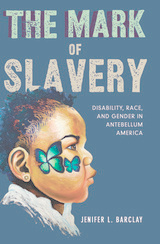
Time and again, antebellum Americans justified slavery and white supremacy by linking blackness to disability, defectiveness, and dependency. Jenifer L. Barclay examines the ubiquitous narratives that depicted black people with disabilities as pitiable, monstrous, or comical, narratives used not only to defend slavery but argue against it. As she shows, this relationship between ableism and racism impacted racial identities during the antebellum period and played an overlooked role in shaping American history afterward. Barclay also illuminates the everyday lives of the ten percent of enslaved people who lived with disabilities. Devalued by slaveholders as unsound and therefore worthless, these individuals nonetheless carved out an unusual autonomy. Their roles as caregivers, healers, and keepers of memory made them esteemed within their own communities and celebrated figures in song and folklore.
Prescient in its analysis and rich in detail, The Mark of Slavery is a powerful addition to the intertwined histories of disability, slavery, and race.
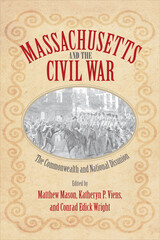
All states are not created equal, at least not when it comes to their influence on American history. That assumption underlies Massachusetts and the Civil War. The volume's ten essays coalesce around the national significance of Massachusetts through the Civil War era, the ways in which the commonwealth reflected and even modeled the Union's precarious but real wartime unification, and the Bay State's postwar return to the schisms that predated the war. Rather than attempting to summarize every aspect of the state's contribution to the wartime Union, the collection focuses on what was distinctive about its influence during the great crisis of national unity.
In the first section, “The Opposition to Slavery,” essays by John Stauffer, Dean Grodzins, Peter Wirzbicki, and Richard S. Newman demonstrate the central role Massachusetts played in the rise of both the antislavery movement and abolitionism. They show how slavery's foes united, planned, and understood their cause, and how they envisioned a postwar nation free of servitude. In the second section, “The War Years,” Matthew Mason, Carol Bundy, and Ronald J. Zboray and Mary Saracino Zboray investigate how the exigencies of war unified the commonwealth across party lines and over the distance between home and the front. In the final section, “Reconciliation,” Sarah J. Purcell, Amy Morsman, and Kanisorn Wongsrichanalai probe postwar efforts to recover from the war's profound disruptions.
How media shapes our actions and feelings about race
Amid fervent conversations about antiracism and police violence, Media and the Affective Life of Slavery delivers vital new ideas about how our feelings about race are governed and normalized by our media landscape. Allison Page examines U.S. media from the 1960s to today, analyzing how media culture instructs viewers to act and feel in accordance with new racial norms created for an era supposedly defined by an end to legal racism.
From the classic television miniseries Roots to the edutainment video game Mission 2: Flight to Freedom and the popular website slaveryfootprint.org, Media and the Affective Life of Slavery provides an in-depth look at the capitalist and cultural artifacts that teach the U.S. public about slavery. Page theorizes media not only as a system of representation but also as a technology of citizenship and subjectivity, wherein race is seen as a problem to be solved. Ultimately, she argues that visual culture works through emotion, a powerful lever for shaping and managing racialized subjectivity.
Media and the Affective Life of Slavery delivers compelling, provocative material and includes a wealth of archival research into such realms as news, entertainment, television, curricula, video games, and digital apps, providing new and innovative scholarship where none currently exists.
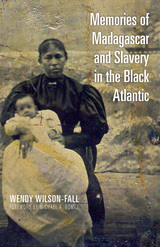
From the seventeenth century into the nineteenth, thousands of Madagascar’s people were brought to American ports as slaves. In Memories of Madagascar and Slavery in the Black Atlantic, Wendy Wilson-Fall shows that the descendants of these Malagasy slaves in the United States maintained an ethnic identity in ways that those from the areas more commonly feeding the Atlantic slave trade did not. Generations later, hundreds, if not thousands, of African Americans maintain strong identities as Malagasy descendants, yet the histories of Malagasy slaves, sailors, and their descendants have been little explored.
Wilson-Fall examines how and why the stories that underlie this identity have been handed down through families—and what this says about broader issues of ethnicity and meaning-making for those whose family origins, if documented at all, have been willfully obscured by history.
By analyzing contemporary oral histories as well as historical records and examining the conflicts between the two, Wilson-Fall carefully probes the tensions between the official and the personal, the written and the lived. She suggests that historically, the black community has been a melting pot to which generations of immigrants—enslaved and free—have been socially assigned, often in spite of their wish to retain far more complex identities. Innovative in its methodology and poetic in its articulation, this book bridges history and ethnography to take studies of diaspora, ethnicity, and identity into new territory.
Metaphor and the Slave Trade provides compelling evidence of the hidden but unmistakable traces of the transatlantic slave trade that persist in West African discourse. Through an examination of metaphors that describe the trauma, loss, and suffering associated with the commerce in human lives, this book shows how the horrors of slavery are communicated from generation to generation.
Laura T. Murphy’s insightful new readings of canonical West African fiction, autobiography, drama, and poetry explore the relationship between memory and metaphor and emphasize how repressed or otherwise marginalized memories can be transmitted through images, tropes, rumors, and fears. By analyzing the unique codes through which West Africans have represented the slave trade, this work foregrounds African literary contributions to Black Atlantic discourse and draws attention to the archive that metaphor unlocks for scholars of all disciplines and fields of study.
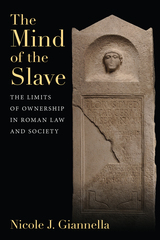
In order to place Roman jurists in conversation with both technical and literary sources, Giannella grounds this study in philology and argues that conceptions of the mind of the slave were at the heart of legal and cultural debates about the nature of slavery and ownership. It also contributes to a wider debate about selfhood and autonomy, since philosophers often used the figure of the slave as a representation of humanity as its limits.
The Moment Is Now includes the proceedings of The International Carl Bernhard Wadström Conference on Human Rights and the Abolition of Slavery, which was held in London on June 2–4, 2015. Accessing source materials in different languages that were previously scattered throughout English, French, and Swedish archives, the scholars involved have been able to successfully investigate Wadström’s work and influence in such diverse areas as economics, science, abolitionism, travel writing, African colonial history, Swedenborgianism, philanthropy, utopianism, and human rights.
As its title makes clear, this book not only offers a glimpse into a significant moment in history but also serves as a call to action and a primer to be used in the here and now—a guide from which we can learn how to deal with those horrific forms of human oppression that Wadström and others like him sought to bring to an end.
The Moment Is Now is the twenty-second installment in the Swedenborg Studies scholarly series.
All three women lived for a time in close proximity on the Eastern Shore of Maryland, an isolated region that thrived on tobacco and then lost it, procured slaves and then lost them, and produced strong-minded women and then condemned them. Though they never actually met, and their backgrounds and beliefs differed drastically, these women's lives converged through their active experiences of the conflict over slavery in Maryland and beyond, the uncertainties of economic transformation, the struggles in the legal foundation of slavery and, most of all, the growing dispute in gender relations in America.
Throughout this book, Carole C. Marks gleans historical fact and sociological insight from the persistent myths and exaggerations that color the women's legacies, and she investigates the common roots and motivations of three remarkable figures who bucked the era's expectations for women. She also considers how each woman's public identity reflected changing ideas of domesticity and the public sphere, spirituality, and legal rights and limitations. Cannon, Carroll, and Tubman, each in her own way, passionately fought for the future of Maryland and the United States, and from these unique vantage points, Moses and the Monster and Miss Anne portrays the intersecting and conflicting forces of race, economics, and gender that threatened to rend a nation apart.
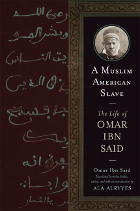
Born to a wealthy family in West Africa around 1770, Omar Ibn Said was abducted and sold into slavery in the United States, where he came to the attention of a prominent North Carolina family after filling “the walls of his room with piteous petitions to be released, all written in the Arabic language,” as one local newspaper reported. Ibn Said soon became a local celebrity, and in 1831 he was asked to write his life story, producing the only known surviving American slave narrative written in Arabic.
In A Muslim American Slave, scholar and translator Ala Alryyes offers both a definitive translation and an authoritative edition of this singularly important work, lending new insights into the early history of Islam in America and exploring the multiple, shifting interpretations of Ibn Said’s narrative by the nineteenth-century missionaries, ethnographers, and intellectuals who championed it.
This edition presents the English translation on pages facing facsimile pages of Ibn Said’s Arabic narrative, augmented by Alryyes’s comprehensive introduction, contextual essays and historical commentary by leading literary critics and scholars of Islam and the African diaspora, photographs, maps, and other writings by Omar Ibn Said. The result is an invaluable addition to our understanding of writings by enslaved Americans and a timely reminder that “Islam” and “America” are not mutually exclusive terms.
This edition presents the English translation on pages facing facsimile pages of Ibn Said’s Arabic narrative, augmented by Alryyes’s comprehensive introduction and by photographs, maps, and other writings by Omar Ibn Said. The volume also includes contextual essays and historical commentary by literary critics and scholars of Islam and the African diaspora: Michael A. Gomez, Allan D. Austin, Robert J. Allison, Sylviane A. Diouf, Ghada Osman, and Camille F. Forbes. The result is an invaluable addition to our understanding of writings by enslaved Americans and a timely reminder that “Islam” and “America” are not mutually exclusive terms.
Best Books for General Audiences, selected by the American Association of School Librarians
READERS
Browse our collection.
PUBLISHERS
See BiblioVault's publisher services.
STUDENT SERVICES
Files for college accessibility offices.
RECENTLY PUBLISHED


UChicago Accessibility Resources
home | accessibility | search | about | contact us
BiblioVault ® 2001 - 2026
The University of Chicago Press