
 A SCHOLARLY BOOK REPOSITORY
7 start with L start with L
In Lands of Likeness, Kevin Hart develops a new hermeneutics of contemplation through a meditation on Christian thought and secular philosophy. Drawing on Kant, Schopenhauer, Coleridge, and Husserl, Hart first charts the emergence of contemplation in and beyond the Romantic era. Next, Hart shows this hermeneutic at work in poetry by Gerard Manley Hopkins, Marianne Moore, Wallace Stevens, and others. Delivered in its original form as the prestigious Gifford Lectures, Lands of Likeness is a revelatory meditation on contemplation for the modern world.
Can the law promote moral values even in pluralistic societies such as the United States? Drawing upon important federal legislation such as the Americans with Disabilities Act, legal scholar and moral theologian Cathleen Kaveny argues that it can. In conversation with thinkers as diverse as Thomas Aquinas, Pope John Paul II, and Joseph Raz, she argues that the law rightly promotes the values of autonomy and solidarity. At the same time, she cautions that wise lawmakers will not enact mandates that are too far out of step with the lived moral values of the actual community.
According to Kaveny, the law is best understood as a moral teacher encouraging people to act virtuously, rather than a police officer requiring them to do so. In Law’s Virtues Kaveny expertly applies this theoretical framework to the controversial moral-legal issues of abortion, genetics, and euthanasia. In addition, she proposes a moral analysis of the act of voting, in dialogue with the election guides issued by the US bishops. Moving beyond the culture wars, this bold and provocative volume proposes a vision of the relationship of law and morality that is realistic without being relativistic and optimistic without being utopian.
Life refers not to the life force that sustains us but to the way we live our lives. This short piece focuses on the concept of regeneration, or spiritual rebirth, as a process of consciously rejecting our own destructive impulses and internalizing love and goodness. It argues that the choices we make and the reasons we make them have everything to do with our salvation. Swedenborg includes a brief overview of the inner sense of the Ten Commandments as a way to understand the nature of the choice between good and evil.
In Faith, Swedenborg rejects the notion that faith can be a choice to believe things that make no rational sense. Instead, he defines faith as an inner recognition of what is actually true. He explores the complex relationship between faith and knowledge, and emphasizes that true faith can occur only in people who love others and treat them well.
Life / Faith is part of the New Century Edition of the Works of Emanuel Swedenborg (NCE), an ongoing translation series. The NCE series incorporates the latest scholarship and translation standards for a more accurate and accessible rendering of Swedenborg’s works. Traditionally titled The Doctrine of Life and The Doctrine of Faith, these short works are often published together with two others—The Lord and Sacred Scripture—under the title The Four Doctrines. These four titles will be published together in the forthcoming NCE hardcover annotated volume The Shorter Works of 1763.
At the heart of Christian ethics is the biblical commandment to love God and to love one's neighbor as oneself. But what is the meaning of love? Scholars have wrestled with this question since the recording of the Christian gospels, and in recent decades teachers and students of Christian ethics have engaged in vigorous debates about appropriate interpretations and implications of this critical norm.
In Love and Christian Ethics, nearly two dozen leading experts analyze and assess the meaning of love from a wide range of perspectives. Chapters are organized into three areas: influential sources and exponents of Western Christian thought about the ethical significance of love, perennial theoretical questions attending that consideration, and the implications of Christian love for important social realities. Contributors bring a richness of thought and experience to deliver unprecedentedly broad and rigorous analysis of this central tenet of Christian ethics and faith. William Werpehowski provides an afterword on future trajectories for this research. Love and Christian Ethics is sure to become a benchmark resource in the field.
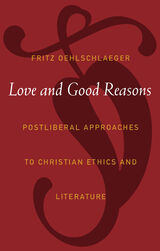
Love and Good Reasons combines postliberal narrative theology—especially Stanley Hauerwas’s Christian ethics and Alasdair MacIntyre’s idea of traditional inquiry—with recent scholarship in literature and ethics including the work of Martha Nussbaum, J. Hillis Miller, Wayne Booth, Jeffrey Stout, and Richard Rorty. Oehlschlaeger offers detailed readings of literature by five major authors—Herman Melville, Jane Austen, Anthony Trollope, Henry James, and Stephen Crane. He examines their works in light of biblical scripture and the grand narratives of Israel, Jesus, and the Church. Discussing the role of religion in contemporary higher education, Oehlschlaeger shares his own experiences of teaching literature from a religious perspective at a state university.

Although the two great commandments to love God and to love our neighbors as ourselves are central to Christianity, few theologians or spiritual writers have undertaken an extensive account of the meaning and forms of these loves. Most accounts, in fact, make love of God and love of self either impossible or immoral. Integrating these two commandments, Edward Vacek, SJ, develops an original account of love as the theological foundation for Christian ethics.
Vacek criticizes common understandings of agape, eros, and philia, examining the arguments of Aquinas, Nygren, Outka, Rahner, Scheler, and other theologians and philosophers. He defines love as an emotional, affirmative participation in the beloved's real and ideal goodness, and he extends this definition to the love between God and self. Vacek proposes that the heart of Christian moral life is loving cooperation with God in a mutually perfecting friendship.
Loyal Dissent is the candid and inspiring story of a Catholic priest and theologian who, despite being stripped of his right to teach as a Catholic theologian by the Vatican, remains committed to the Catholic Church. Over a nearly fifty-year career, Charles E. Curran has distinguished himself as the most well-known and the most controversial Catholic moral theologian in the United States. On occasion, he has disagreed with official church teachings on subjects such as contraception, homosexuality, divorce, abortion, moral norms, and the role played by the hierarchical teaching office in moral matters. Throughout, however, Curran has remained a committed Catholic, a priest working for the reform of a pilgrim church. His positions, he insists, are always in accord with the best understanding of Catholic theology and always dedicated to the good of the church.
In 1986, years of clashes with church authorities finally culminated in a decision by the Congregation for the Doctrine of the Faith, headed by then-Cardinal Josef Ratzinger, that Curran was neither suitable nor eligible to be a professor of Catholic theology. As a result of that Vatican condemnation, he was fired from his teaching position at Catholic University of America and, since then, no Catholic university has been willing to hire him. Yet Curran continues to defend the possibility of legitimate dissent from those teachings of the Catholic faith—not core or central to it—that are outside the realm of infallibility. In word and deed, he has worked in support of more academic freedom in Catholic higher education and for a structural change in the church that would increase the role of the Catholic community—from local churches and parishes to all the baptized people of God.
In this poignant and passionate memoir, Curran recounts his remarkable story from his early years as a compliant, pre-Vatican II Catholic through decades of teaching and writing and a transformation that has brought him today to be recognized as a leader of progressive Catholicism throughout the world.
READERS
Browse our collection.
PUBLISHERS
See BiblioVault's publisher services.
STUDENT SERVICES
Files for college accessibility offices.
RECENTLY PUBLISHED


UChicago Accessibility Resources
home | accessibility | search | about | contact us
BiblioVault ® 2001 - 2025
The University of Chicago Press