front cover of Icastes
Icastes
Marsilio Ficino's Interpretation of Plato's Sophist
Michael J. B. Allen
Arizona Center for Medieval and Renaissance Studies, 2016

New 2016 paperback edition of the original 1989 printing (out-of-print).

Michael Allen's latest work on the profoundly influential Florentine thinker of the fifteenth century, Marsilio Ficino, will be welcomed by philosophers, literary scholars, and historians of the Renaissance, as well as by classicists. Ficino was responsible for inaugurating, shaping, and disseminating the wide-ranging philosophico-cultural movement known as Renaissance Platonism, and his views on the Sophist, which he saw as Plato's preeminent ontological dialogue, are of signal interest. This dialogue also served Ficino as a vehicle for exploring a number of other humanist, philosophical, and magical preoccupations, including the theme of man the artist and creator.

[more]

front cover of Identity and Difference
Identity and Difference
Martin Heidegger
University of Chicago Press, 2002

Two essential works by Heidegger on the nature of identity 

Identity and Difference consists of English translations and the original German versions of two little-known lectures given in 1957 by Martin Heidegger, "The Principle of Identity" and "The Onto-theo-logical Constitution of Metaphysics." Both lectures discuss the difficult problem of the nature of identity in the history of metaphysics. 
 
This translation marks a significant improvement over earlier versions in English. In addition to her clear, accurate translation, Joan Stambaugh, who was a student of Heidegger's, offers a helpful introduction and a list of references.
[more]

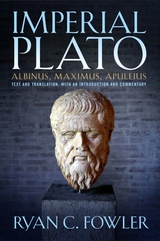
front cover of Imperial Plato
Imperial Plato
Albinus, Maximus, Apuleius: Text and Translation, with an Introduction and Commentary
Ryan C. Fowler
Parmenides Publishing, 2016
Imperial Plato presents new translations of three introductions to Plato’s thought from the second half of the second century CE: the Introduction to Plato by Albinus of Smyrna, Dissertation 11 of Maximus of Tyre, and On Plato and his Teaching by Apuleius of Madaurus. These three presentations of Plato’s ideas—one a Greek dialectic introduction with a suggested reading order for Plato's dialogues, another a Greek speech in the sophistic style of the time, and one a lengthy doxological study in Latin—are examples by three distinct authors using divergent methods of the assorted ways in which Plato and Platonism were understood and discussed during the revival of Hellenism and Greek Philosophy, and the period of the Roman Empire often referred to as the Second Sophistic. 
[more]

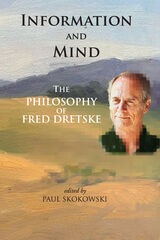
front cover of Information and Mind
Information and Mind
The Philosophy of Fred Dretske
Edited by Paul G. Skokowski
CSLI, 2020
Information and Mind explores questions of consciousness that Fred Dretske addressed in his philosophical career. Ranging from one of the earliest problems Dretske analyzed—the nature of seeing an object—to epistemological issues that he began working on mid-career, to matters he focused on in later years, including information, mental representation, and conscious experience, this volume investigates and engages with a spectrum of his prolific works. These papers, written by former colleagues and students from the University of Wisconsin and Stanford University, were inspired by talks given at the Center for the Explanation of Consciousness at Stanford in 2015 to celebrate Dretske’s life and work. In addition to scholarly essays, the authors also recount stories of personal interactions with Dretske that transformed their views or changed their professional trajectory. A bibliography of Dretske’s publications rounds out the volume. This generous volume includes contributions by Fred Adams, John A. Barker, John Perry, Paul Skokowski, and Dennis Stampe.
 
[more]

front cover of Investigations into the Literary Use of Language
Investigations into the Literary Use of Language
Course Notes from the Collège de France, 1953
Maurice Merleau-Ponty, Bryan Smyth
Northwestern University Press, 2026

A closely annotated translation of Merleau-Ponty’s lecture notes on literary language

Investigations into the Literary Use of Language presents an annotated translation of Maurice Merleau-Ponty’s lecture notes from one of the two courses that he gave during his inaugural year teaching at the Collège de France. In his notes from the concurrent course, The Sensible World and the World of Expression, Merleau-Ponty contends that our embodied perceptual engagement with the sensible world already involves the same spontaneity that underlies cultural expression. Approaching it from the other side, he revisits here the analysis of language that he had undertaken in the unfinished manuscript The Prose of the World.

Focusing on the work of Paul Valéry (1871–1945) and Stendhal (Marie-Henri Beyle, 1783–1842), Merleau-Ponty explores how the spontaneity of literary language sheds light on the relation between lived experience and language more broadly, and how cultural expression remains grounded in embodied perceptual experience in a way that is homologous yet irreducible to it. Specifically, Merleau-Ponty shows how Stendhal had already overcome Valéry’s skepticism concerning literary sincerity by effectively incorporating what the latter called the linguistic “implex”—in effect, language as institution—and thus achieving a “total style” of improvisational spontaneity in which the “conquering function” characteristic of the literary use of language gives shape to an immanent model of political engagement.
 

[more]


Send via email Share on Facebook Share on Twitter