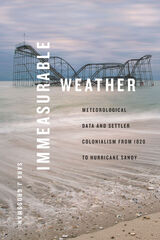

front cover of Immeasurable Weather
Immeasurable Weather
Meteorological Data and Settler Colonialism from 1820 to Hurricane Sandy
Sara J. Grossman
Duke University Press, 2023
In Immeasurable Weather Sara J. Grossman explores how environmental data collection has been central to the larger project of settler colonialism in the United States. She draws on an extensive archive of historical and meteorological data spanning two centuries to show how American scientific institutions used information about the weather to establish and reinforce the foundations of a white patriarchal settler society. Grossman outlines the relationship between climate data and state power in key moments in the history of American weather science, from the nineteenth-century public data-gathering practices of settler farmers and teachers and the automation of weather data during the Dust Bowl to the role of meteorological satellites in data science’s integration into the militarized state. Throughout, Grossman shows that weather science reproduced the natural world as something to be measured, owned, and exploited. This data gathering, she contends, gave coherence to a national weather project and to a notion of the nation itself, demonstrating that weather science’s impact cannot be reduced to a set of quantifiable phenomena.
[more]

front cover of Indigenomicon
Indigenomicon
American Indians, Video Games, and the Structures of Dispossession
Jodi A. Byrd
Duke University Press, 2025
Settler colonial studies and Indigenous studies are often assumed to be the same intellectual project. In Indigenomicon, Jodi A. Byrd examines the differences between the two fields by bringing video game studies and Indigenous studies into conversation with Black studies, queer studies, and Indigenous feminist critique. Byrd theorizes “the image of the law of the Indigenous” as structuring dispossession in games including Assassin’s Creed, Animal Crossing, BioShock Infinite, and Demon Souls. They demonstrate how games and play might reveal histories of slavery, genocide, and theft of Indigenous lands even as their structures obscure Indigenous spatial and embodied practices that prioritize relationships with land, water, plants, and spirits. With ground and relationality defined as key concepts, Byrd centers Indigenous visions of dystopias to reveal how game spaces encode settler structures of governance even as the design of games might yet provide vital modes of resistance to Indigenous erasure.
[more]

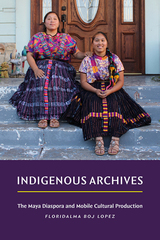
front cover of Indigenous Archives
Indigenous Archives
The Maya Diaspora and Mobile Cultural Production
Floridalma Boj Lopez
Duke University Press, 2026
Indigenous Archives analyzes the modes through which young Guatemalan Mayas in Los Angeles and Guatemala make sense of and respond to transnational structures of settler colonialism. Drawing on in-depth analysis of cultural production and interviews with Guatemalan Maya youth and young adults, Floridalma Boj Lopez examines how Mayas in diaspora craft and circulate narratives about their experiences across borders. Citing a more active practice of “archives in formation,” Boj Lopez depicts Indigenous archives as a cross-generational, collective conversation rooted in memory, survival, and cultural expression where Indigenous cultural practices and artifacts move, adapt, and assert their presence in the contemporary. Indigenous Archives invites readers to consider Indigeneity as a process, lived experience, and historical perspective, rather than as a static identity, and shows how extending analysis across borders is critical to understanding Latinidad and Indigeneity.
[more]

front cover of Inside Jobs
Inside Jobs
Prison Work in the Making of the American Labor Market
reich
Russell Sage Foundation, 2026

From the stone quarries of Sing Sing that supplied marble for early New York City landmarks, to twenty-first-century construction projects staffed by formerly incarcerated workers, Inside Jobs traces the relationship between prison work and the labor market over the past two hundred years. Sociologist Adam Reich demonstrates how prison labor has repeatedly been used to solve economic problems—disciplining workers, lowering labor costs, managing unemployment—revealing unexpected connections that challenge our assumptions about freedom, coercion, and labor itself.

Reich examines the history of work in prisons to understand how it has related to the free labor market. He finds that the organization of prison work, and debates over it, have changed dramatically over time. In the mid to late nineteenth century, prisons helped shape the emerging factory system as the apprentice-based labor market gave way to industrial production. Labor unions opposed prison labor as immoral, and in the early to mid-twentieth century, the moral character of the workforce became central to economic life within the prison and without. Therapeutic professionals worked in prisons to rehabilitate the incarcerated and determine what motivated them to work. Following prison uprisings in the late twentieth century, prison work became a tool of population control. Yet, paradoxically, work programs were remodeled to mirror the free labor market, requiring applications and hiring processes. 

Blending archival research, political economy, and sociological theory, Inside Jobs offers a powerful new framework for understanding mass incarceration and reentry today. Reich examines how the dynamics of mass incarceration have begun to shift. He explores how the "mark of a criminal record"—the stigma traditionally associated with felony convictions—has given way to a "market" for criminal records, as employers discover advantages in hiring disadvantaged, dependent, and disciplined workers recently released from prison. Looking toward the future, Reich focuses on promising efforts to transform this system.

Inside Jobs is an illuminating examination of prison work's history, its relationship to work outside prison walls, and how the criminal justice system disempowers workers both behind bars and beyond.
[more]

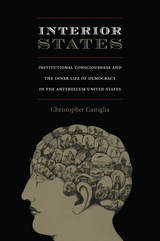
front cover of Interior States
Interior States
Institutional Consciousness and the Inner Life of Democracy in the Antebellum United States
Christopher Castiglia
Duke University Press, 2008
In Interior States Christopher Castiglia focuses on US citizens’ democratic impulse: their ability to work with others to imagine genuinely democratic publics while taking divergent views into account. Castiglia contends that citizens of the early United States were encouraged to locate this social impulse not in associations with others but in the turbulent and conflicted interiors of their own bodies. He describes how the human interior—with its battles between appetite and restraint, desire and deferral—became a displacement of the divided sociality of nineteenth-century America’s public sphere and contributed to the vanishing of that sphere in the twentieth century and the twenty-first. Drawing insightful connections between political structures, social relations, and cultural forms, he explains that as the interior came to reflect the ideological conflicts of the social world, citizens were encouraged to (mis)understand vigilant self-scrutiny and self-management as effective democratic action.

In the late eighteenth century and early nineteenth, as discourses of interiority gained prominence, so did powerful counter-narratives. Castiglia reveals the flamboyant pages of antebellum popular fiction to be an archive of unruly democratic aspirations. Through close readings of works by Maria Monk and George Lippard, Walt Whitman and Timothy Shay Arthur, Hannah Webster Foster and Hannah Crafts, and Nathaniel Hawthorne and Herman Melville, Castiglia highlights a refusal to be reformed or self-contained. In antebellum authors’ representations of nervousness, desire, appetite, fantasy, and imagination, he finds democratic strivings that refused to disappear. Taking inspiration from those writers and turning to the present, Castiglia advocates a humanism-without-humans that, denied the adjudicative power of interiority, promises to release democracy from its inner life and to return it to the public sphere where U.S. citizens may yet create unprecedented possibilities for social action.
[more]

front cover of Interrogating the Future of Puerto Rican Studies
Interrogating the Future of Puerto Rican Studies
Aurora Santiago Ortiz and Jorell A. Meléndez-Badillo, editors
Duke University Press, 2026
Interrogating The Future of Puerto Rican Studies brings together emerging and established scholars from a wide range of disciplines to examine the disciplinary and epistemic transformations that have given way to new understandings of the field of Puerto Rican studies. Documenting the intellectual contours that have shaped the field of Puerto Rican Studies in the last decade, a diverse range of contributors survey the field with new lenses that are attentive to gender, queerness, disability, and Blackness among other things. A foreword by Yarimar Bonilla situates the volume in the context of the field’s shift, specifically in the aftermath of Hurricane Maria, while other sections, including “Queering Puerto Rican Studies,” “Centering Blackness,” and “Disaster Studies and Environmental Studies,” as well as “Puerto Rican Studies in Broader Fields of Knowledges,” “Prefigurative Politics and Social Movements,” and “Legal and Political Disruptions,” create a vibrant archive of conversations taking place within the field of Puerto Rican studies with the aim of interrogating its future.

Contributors. José Atiles, Bárbara Abadía Rexach, Yarimar Bonilla, daniela crespo-miró, Marie Cruz Soto, Yomaira Figueroa-Vásquez, Marcela Guerrero, Gustavo García López, Mónica Jiménez, Lawrence LaFountain Stokes, Marisol LeBrón, Pedro Lebrón Ortiz, Beatriz Llenín Figueroa, Jorell Meléndez-Badillo, Sarah Molinari, Marisel Moreno, Daniel Nevárez Araújo, Aurora Santiago Ortiz, Karrieann Soto Vega, Daniel Vázquez Sanabria, Roberto Vélez-Vélez, Joaquín Villanueva, Jacqueline Villarrubia-Mendoza

[more]

front cover of Intoxicated
Intoxicated
Race, Disability, and Chemical Intimacy across Empire
Mel Y. Chen
Duke University Press, 2023
In Intoxicated Mel Y. Chen explores the ongoing imperial relationship between race, sexuality, and disability. They focus on nineteenth-century biopolitical archives in England and Australia to show how mutual entanglements of race and disability take form through toxicity. Examining English scientist John Langdon Down’s characterization of white intellectual disability as Asian interiority and Queensland’s racialization and targeting of Aboriginal peoples through its ostensible concern with black opium, Chen explores how the colonial administration of race and disability gives rise to “intoxicated” subjects often shadowed by slowness. Chen charts the ongoing reverberations of these chemical entanglements in art and contemporary moments of political and economic conflict or agitation. Although intoxicated subjects may be affected by ongoing pollution or discredited as agents of failure, Chen affirmatively identifies queer/crip forms of unlearning and worldmaking under imperialism. Exemplifying an undisciplined thinking that resists linear or accretive methods of inquiry, Chen unsettles conventional understandings of slowness and agitation, intellectual method, and the toxic ordinary.
[more]

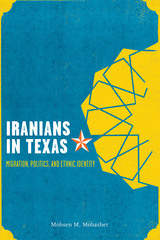
front cover of Iranians in Texas
Iranians in Texas
Migration, Politics, and Ethnic Identity
Mohsen Mostafavi MobasherForeword by Nestor Rodriguez
University of Texas Press, 2025

An exploration of the link between politics of migration, prospects of integration, and ethnic identity among Iranian immigrants and their descendants in the United States, spanning from the 1970s to the present day.

Thousands of Iranians fled their homeland when the 1978–1979 revolution ended the fifty-year reign of the Pahlavi dynasty. Some fled to Europe and Canada, while others settled in the United States, where anti-Iranian sentiment flared as the hostage crisis unfolded. For those who chose America, Texas became the fourth-largest settlement area. Iranians in Texas culls data, interviews, and participant observations in Iranian communities in Houston, Dallas, and Austin to reveal the difficult, private world of cultural pride, religious experience, marginality, culture clashes, and other aspects of the lives of these immigrants.

Examining the political nature of immigration between Iran and the United States and social, cultural, and economic life for Iranian immigrants and their American-born children, Mohsen Mostafavi Mobasher incorporates his own experience as a Texas scholar born in Iran. In this revised edition, two new chapters and a new introduction and conclusion provide updates on what has happened in the Obama, Trump, and Biden administrations, including the Iran nuclear deal and resulting controversy, the Muslim ban, and the global protests over the death of twenty-two-year-old Mahsa Amini for not wearing a hijab. Bringing to life a unique immigrant population in the context of global politics, Iranians in Texas overturns stereotypes and echoes diverse voices.
[more]

front cover of Iranians in Texas
Iranians in Texas
Migration, Politics, and Ethnic Identity
By Mohsen M. Mobasher
University of Texas Press, 2012

Thousands of Iranians fled their homeland when the 1978–1979 revolution ended the fifty-year reign of the Pahlavi Dynasty. Some fled to Europe and Canada, while others settled in the United States, where anti-Iranian sentiment flared as the hostage crisis unfolded. For those who chose America, Texas became the fourth-largest settlement area, ultimately proving to be a place of paradox for any Middle Easterner in exile. Iranians in Texas culls data, interviews, and participant observations in Iranian communities in Houston, Dallas, and Austin to reveal the difficult, private world of cultural pride, religious experience, marginality, culture clashes, and other aspects of the lives of these immigrants.

Examining the political nature of immigration and how the originating and receiving countries shape the prospects of integration, Mohsen Mobasher incorporates his own experience as a Texas scholar born in Iran. Tracing current anti-Muslim sentiment to the Iranian hostage crisis, two decades before 9/11, he observes a radically negative shift in American public opinion that forced thousands of Iranians in the United States to suddenly be subjected to stigmatization and viewed as enemies. The book also sheds light on the transformation of the Iranian family in exile and some of the major challenges that second-generation Iranians face in their interactions with their parents.

Bringing to life a unique population in the context of global politics, Iranians in Texas overturns stereotypes while echoing diverse voices.

[more]


Send via email Share on Facebook Share on Twitter