
 A SCHOLARLY BOOK REPOSITORY
7 start with I start with I
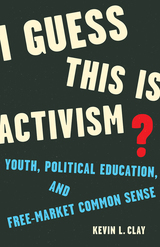
How neoliberal capitalism and pedagogical deideologization constrain the radical possibilities of youth activism
In I Guess This Is Activism? Kevin L. Clay presents an eye-opening account of his experience with Youth Participatory Action Research (YPAR) as an Upward Bound educator. Grounded in Paulo Freire’s tradition of critical pedagogy, YPAR has been championed by community-based educators and scholars in the United States as an approach for supporting critical consciousness development and social change with working-class Black and Latino youth. Clay, however, questions whether YPAR can effectively prepare youths to subvert the systems reproducing their material conditions under neoliberal capitalism. Exposing the political and pedagogical limits of YPAR’s progressive education model, he reveals how omnipresent neoliberalism undermines youths’ radical potential when political education is not prioritized in youth activism.
I Guess This Is Activism? engages Black radical thinkers, including Ella Baker and Fred Hampton, to reveal the faulty assumptions implicit in YPAR’s program. Looking deeply into how he and his students navigated questions of community problems and social change at the twilight of the Obama presidency, Clay demonstrates how, in the absence of political education on the structures of race, class, and capitalism, youth activism is always eclipsed by the common sense of the free market.
As working-class Black and Latino youth inherit a society deeply shaped by neoliberal dogma, I Guess This Is Activism? delivers a much-needed reexamination of YPAR and visions for the future of youth activist education.
Retail e-book files for this title are screen-reader friendly with images accompanied by short alt text and/or extended descriptions.
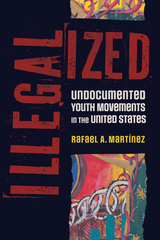
Rafael A. Martínez, an undocu-scholar, intricately weaves his lived experience into this deeply insightful exploration. Martínez’s interdisciplinary approach will engage scholars and readers alike, resonating with disciplines such as history, American studies, Chicana and Chicano studies, and borderlands studies.
Illegalized shows that undocumented youth and their activism represent a disruption to the social imaginary of the U.S. nation-state and its figurative and physical borders. It invites readers to explore how undocumented youth activists changed the way immigrant rights are discussed in the United States today.

Inclusive Dance offers a concise ethnography of disability arts and a historiographic overview of the field in the 1980s when many new disability arts groups emerged in the UK. It focuses in particular on the inclusive teaching modalities of Touchdown Dance, which was the work of dancer Steve Paxton and theater-maker and psychotherapist Anne Kilcoyne. It involved visually impaired and sighted adults in a dyadic movement form called Contact Improvisation. Katy Dymoke took over Touchdown Dance in 1994, and this book draws on archives, participant accounts, and personal experience to detail the work of Touchdown Dance and its effects on its participants since its founding. Three guests from Touchdown Dance contribute eyewitness accounts of the methods and performance projects.

How Indigenous communities are transforming the idea and practice of reparations through their laws and leadership
In recent decades, a growing number of Indigenous groups across Canada have initiated movements for colonial reparations. Too often, the settler state has responded by attempting to enfold their work into a narrative of reconciliation that consigns colonialism to “sad chapters” of history. In this book, Pauline Wakeham calls attention to the ways that Indigenous reparations movements exceed state reconciliatory frameworks and prompt a deeper reckoning with the enduring structures of settler colonialism.
To expose and redress colonial injustices, Indigenous reparations movements draw upon long local traditions of political organizing as well as transformations on the global stage since World War II. As international law formulated new instruments regarding gross human rights violations, atrocity crimes, and the reparative obligations of states, colonized peoples across the world have sought to mobilize these mechanisms in their struggles for decolonization and reparations. While international law has provided strategic tools for this work, the colonial foundations of the field continue to limit how it conceptualizes and shapes access to justice. Indigenous Reparations and Settler Colonial Reckoning traces the specific implications for Indigenous nations whose land is occupied by settler states—nations whose legal orders remain subordinated to both settler “domestic” and international legal systems.
Amid this complex multijurisdictional terrain, how are Indigenous peoples carving out space to articulate their own visions of justice? To answer this question, Wakeham learns from the Inuit-led Qikiqtani Truth Commission as well as reparations movements for residential schools and the High Arctic Relocations of 1953 and 1955. These movements offer powerful lessons about the importance of centering Indigenous leadership and laws in redress processes, thereby connecting reparations to the living enactment of Indigenous rights.
Retail e-book files for this title are screen-reader friendly with images accompanied by short alt text and/or extended descriptions.


READERS
Browse our collection.
PUBLISHERS
See BiblioVault's publisher services.
STUDENT SERVICES
Files for college accessibility offices.
RECENTLY PUBLISHED



UChicago Accessibility Resources
home | accessibility | search | about | contact us
BiblioVault ® 2001 - 2026
The University of Chicago Press