
 A SCHOLARLY BOOK REPOSITORY
5 start with F start with F
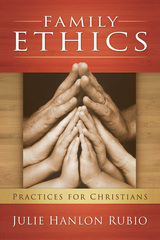
How can ordinary Christians find moral guidance for the mundane dilemmas they confront in their daily lives? To answer this question, Julie Hanlon Rubio brings together a rich Catholic theology of marriage and a strong commitment to social justice to focus on the place where the ethics of ordinary life are played out: the family.
Sex, money, eating, spirituality, and service. According to Rubio, all are areas for practical application of an ethics of the family. In each area, intentional practices can function as acts of resistance to a cultural and middle-class conformity that promotes materialism over relationships. These practices forge deep connections within the family and help families live out their calling to be in solidarity with others and participate in social change from below. It is through these everyday moral choices that most Christians can live out their faith—and contribute to progress in the world.

Bringing Orthodox Christianity into the recent dialog on virtue ethics, Joseph Woodill investigates the correspondences between the Eastern Orthodox tradition and contemporary virtue ethics, and he develops a distinctly Orthodox vision of theological ethics.
This book fills a vacuum in our understanding of the Eastern Church by revealing themes, persons, and insights that offer resources for a contemporary moral theology. Reviewing the Eastern tradition from patristic times to the present, Woodill shows its relevance to contemporary virtue ethics and identifies both differences and similarities between Orthodox and other—Catholic, Protestant, and Jewish—virtue ethics.
In this new century, born in hope but soon thereafter cloaked in terror, many see religion and politics as a volatile, if not deadly, mixture. For All Peoples and All Nations uncovers a remarkable time when that was not so; when together, those two entities gave rise to a new ideal: universal human rights.
John Nurser has given life to a history almost sadly forgotten, and introduces the reader to the brilliant and heroic people of many faiths who, out of the aftermath of World War II and in the face of cynicism, dismissive animosity, and even ridicule, forged one of the world's most important secular documents, the United Nations's Universal Declaration of Human Rights. These courageous, persistent, visionary individuals—notable among them an American Lutheran Seminary professor from Philadelphia, O. Frederick Nolde—created the Commission on Human Rights. Eventually headed by one of the world's greatest humanitarians, Eleanor Roosevelt, the Universal Declaration has become the touchstone for political legitimacy.
As David Little says in the foreword to this remarkable chronicle, "Both because of the large gap it fills in the story of the founding of the United Nations and the events surrounding the adoption of human rights, and because of the wider message it conveys about religion and peacebuilding, For All Peoples and All Nations is an immensely important contribution. We are all mightily in John Nurser's debt." If religion and politics could once find common ground in the interest of our shared humanity, there is hope that it may yet be found again.
In this stimulating rethinking of the basic foundations of ethics, Patricia McAuliffe derives a fundamental ethic from liberation theology. She asserts that the experience of resisting suffering, especially oppressive social suffering, must be brought from the fringe to the very center of ethics. Arguing for the conceptual priority of ethics over religion, McAuliffe defines an innovative ethic based on experience and practice. Ethics precedes religion and theology because experience and practice precede theory and interpretation, which are the human activities of religion and theology—knowledge is based on experience. She proposes that ethics can be independent of religion, but that while her liberationist ethic can be either Christian or universal, finally the poor and oppressed are the paradigm source of the disclosure of God and of final salvation.
In rethinking the basic foundations of ethics, she compares a liberationist ethic, including Latin American and women's liberation theology, with various classical ethics, and examines and critiques the works of Edward Schillebeeckx, Juan Luis Segundo, Dorothee Soelle, James Gustafson, and George Lindbeck. McAuliffe offers a flexible ethic that balances the absolute and the relative, the particular and the universal, personal and social, creativity and conditioning, practice and theory, and the ethical and religious. Combining superior scholarship with an original and creative approach to ethics, this book is likely to create debate in the fields of fundamental ethics, theology, and philosophy.
The Future of Ethics interprets the big questions of sustainability and social justice through the practical problems arising from humanity’s increasing power over basic systems of life. What does climate change mean for our obligations to future generations? How can the sciences work with pluralist cultures in ways that will help societies learn from ecological change?
Traditional religious ethics examines texts and traditions and highlights principles and virtuous behaviors that can apply to particular issues. Willis Jenkins develops lines of practical inquiry through "prophetic pragmatism," an approach to ethics that begins with concrete problems and adapts to changing circumstances. This brand of pragmatism takes its cues from liberationist theology, with its emphasis on how individuals and communities actually cope with overwhelming problems.
Can religious communities make a difference when dealing with these issues? By integrating environmental sciences and theological ethics into problem-based engagements with philosophy, economics, and other disciplines, Jenkins illustrates the wide understanding and moral creativity needed to live well in the new conditions of human power. He shows the significance of religious thought to the development of interdisciplinary responses to sustainability issues and how this calls for a new style of religious ethics.
READERS
Browse our collection.
PUBLISHERS
See BiblioVault's publisher services.
STUDENT SERVICES
Files for college accessibility offices.
RECENTLY PUBLISHED



UChicago Accessibility Resources
home | accessibility | search | about | contact us
BiblioVault ® 2001 - 2025
The University of Chicago Press