
 A SCHOLARLY BOOK REPOSITORY
4 start with E start with E

The essays in Encountering the Past in Nature provide various approaches to the new discipline. Experts with diverse educational backgrounds tackle important issues in environmental history, ranging from the intellectual formation of environmental concepts to case studies of forest history and animal extinction. Most essays in the collection focus on the issue of wilderness and the various uses of forest resources. Encountering the Past in Nature also offers introductory essays on the historiography and methodology of this field of historical study.
Encountering the Past in Nature is a useful addition to the introductory texts currently available in the United States.
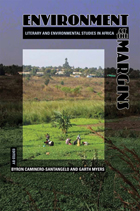
Environment at the Margins brings literary and environmental studies into a robust interdisciplinary dialogue, challenging dominant ideas about nature, conservation, and development in Africa and exploring alternative narratives offered by writers and environmental thinkers. The essays bring together scholarship in geography, anthropology, and environmental history with the study of African and colonial literatures and with literary modes of analysis. Contributors analyze writings by colonial administrators and literary authors, as well as by such prominent African activists and writers as Ngugi wa Thiong’o, Mia Couto, Nadine Gordimer, Wangari Maathai, J. M. Coetzee, Zakes Mda, and Ben Okri. These postcolonial ecocritical readings focus on dialogue not only among disciplines but also among different visions of African environments. In the process, Environment at the Margins posits the possibility of an ecocriticism that will challenge and move beyond marginalizing, limiting visions of an imaginary Africa.
Contributors:
Jane Carruthers
Mara Goldman
Amanda Hammar
Jonathan Highfield
David McDermott Hughes
Roderick P. Neumann
Rob Nixon
Anthony Vital
Laura Wright
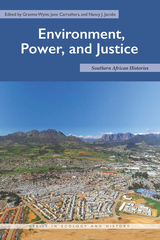
Spanning the colonial, postcolonial, and postapartheid eras, these historical and locally specific case studies analyze and engage vernacular, activist, and scholarly efforts to mitigate social-environmental inequity.
This book highlights the ways poor and vulnerable people in South Africa, Lesotho, and Zimbabwe have mobilized against the structural and political forces that deny them a healthy and sustainable environment. Spanning the colonial, postcolonial, and postapartheid eras, these studies engage vernacular, activist, and scholarly efforts to mitigate social-environmental inequity. Some chapters track the genealogies of contemporary activism, while others introduce positions, actors, and thinkers not previously identified with environmental justice. Addressing health, economic opportunity, agricultural policy, and food security, the chapters in this book explore a range of issues and ways of thinking about harm to people and their ecologies.
Because environmental justice is often understood as a contemporary phenomenon framed around North American examples, these fresh case studies will enrich both southern African history and global environmental studies. Environment, Power, and Justice expands conceptions of environmental justice and reveals discourses and dynamics that advance both scholarship and social change.
Contributors:
- Christopher Conz
- Marc Epprecht
- Mary Galvin
- Sarah Ives
- Admire Mseba
- Muchaparara Musemwa
- Matthew A. Schnurr
- Cherryl Walker

Back by popular demand and new in paperback, this spirited collection of nearly twenty papers celebrates the 450th anniversary of Hernando de Soto’s epic expedition across the Southeast and West.
Originally presented at two symposia conducted by the University Museum at the University of Arkansas, the collection offers an array of viewpoints and diverse approaches to de Soto scholarship. Archaeologists, anthropologists, historians, museum curators, and folklorists all contribute to this lively debate on the Spanish explorer and his travels.
The book focuses on research that challenges traditional interpretation of de Soto’s entrada and travel route, particularly after the expedition crossed the Mississippi River. David H. Dye hypothesizes a route across the river and the alluvial plain by linking the narrative accounts with geography and archaeological knowledge. Phyllis A. Morse asserts that the Parkin site is the location of the capital of Casqui, one of the polities visited by de Soto. Charles M. Hudson repostulates his version of the expedition route, which in 1988 severely challenged the De Soto Commission theory of 1939. Ann M. Early redraws the trail in the uplands of the Ouachita Mountains And Frank E. Schambach tests the possibility that the expedition wandered through Caddoan territory in east Texas after de Soto’s death.
Several chapters examine the Native Americans whom de Soto and his expedition encountered in their journey; other contributions provide a fresh look at the chronicles of the expedition that have survived. What emerges is a redrawn map of de Soto’s exploration—and a deeper understanding of the impact of European contact on the New World.
READERS
Browse our collection.
PUBLISHERS
See BiblioVault's publisher services.
STUDENT SERVICES
Files for college accessibility offices.
RECENTLY PUBLISHED




UChicago Accessibility Resources
home | accessibility | search | about | contact us
BiblioVault ® 2001 - 2026
The University of Chicago Press